Published 4 September 2026 · Updated 1 October 2026
Sagging skin on the lower face, neck or jawline responds to two broad approaches: cutting and re-draping tissue in a facelift, or heating the dermis with radiofrequency (RF) energy so the body rebuilds its own collagen and elastin. RF cannot lift skin the way a scalpel can, and no non-surgical device claims to replace a facelift in cases of significant tissue excess. What it can do, documented across published trials, is produce a measurable tightening effect in skin with mild to moderate laxity, with none of the incisions, anaesthesia or recovery time a surgical lift requires.
What monopolar RF actually changes in the skin
Radiofrequency devices pass an electrical current through the dermis, and the tissue’s own resistance converts that current into heat. At the right depth and temperature, existing collagen fibres contract immediately, which is the visible short-term effect, while the controlled thermal injury triggers new collagen and elastin production over the following weeks. Monopolar RF uses a single active electrode and a grounding pad, which lets the energy travel deeper into the dermis and subdermal layer than bipolar systems that pass current between two closely spaced electrodes on the surface. That depth is why monopolar RF is generally the category studied for jawline and neck laxity rather than fine surface lines.
What the research shows
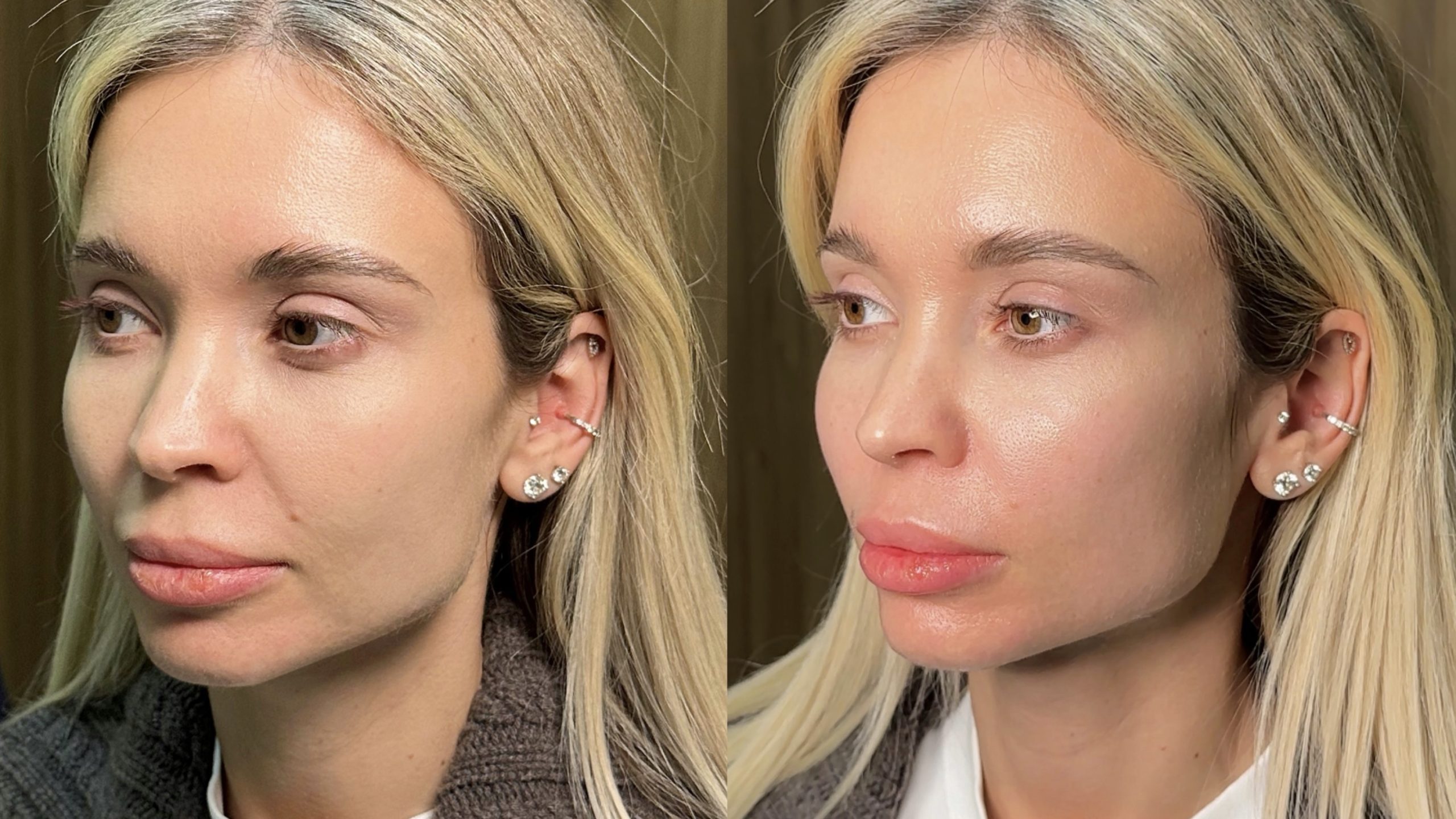
A systematic review of the MEDLINE literature on monopolar and bipolar RF devices for facial and body rejuvenation screened 207 articles and carried 23 through to final analysis, of which nine studies evaluated monopolar devices on the face and three on the body (1). The reviewers concluded that both monopolar and bipolar RF produced measurable improvement in skin laxity with an acceptable complication profile, while noting that outcomes vary by device, treatment protocol and the area treated, and that not every device on the market has been studied to the same standard.
More recent device-specific data reinforce that pattern rather than settling it for the category as a whole. A prospective randomised controlled trial of 40 participants compared a newer monopolar RF device against an established RF standard, with a single treatment per participant and follow-up photo at one, three and six months (2). On the lower face, the newer device was found not inferior to the established one for nasolabial fold correction, a result that speaks to that specific comparison and cannot be assumed to transfer to a different monopolar device by a different manufacturer.
Where RF sits next to surgery
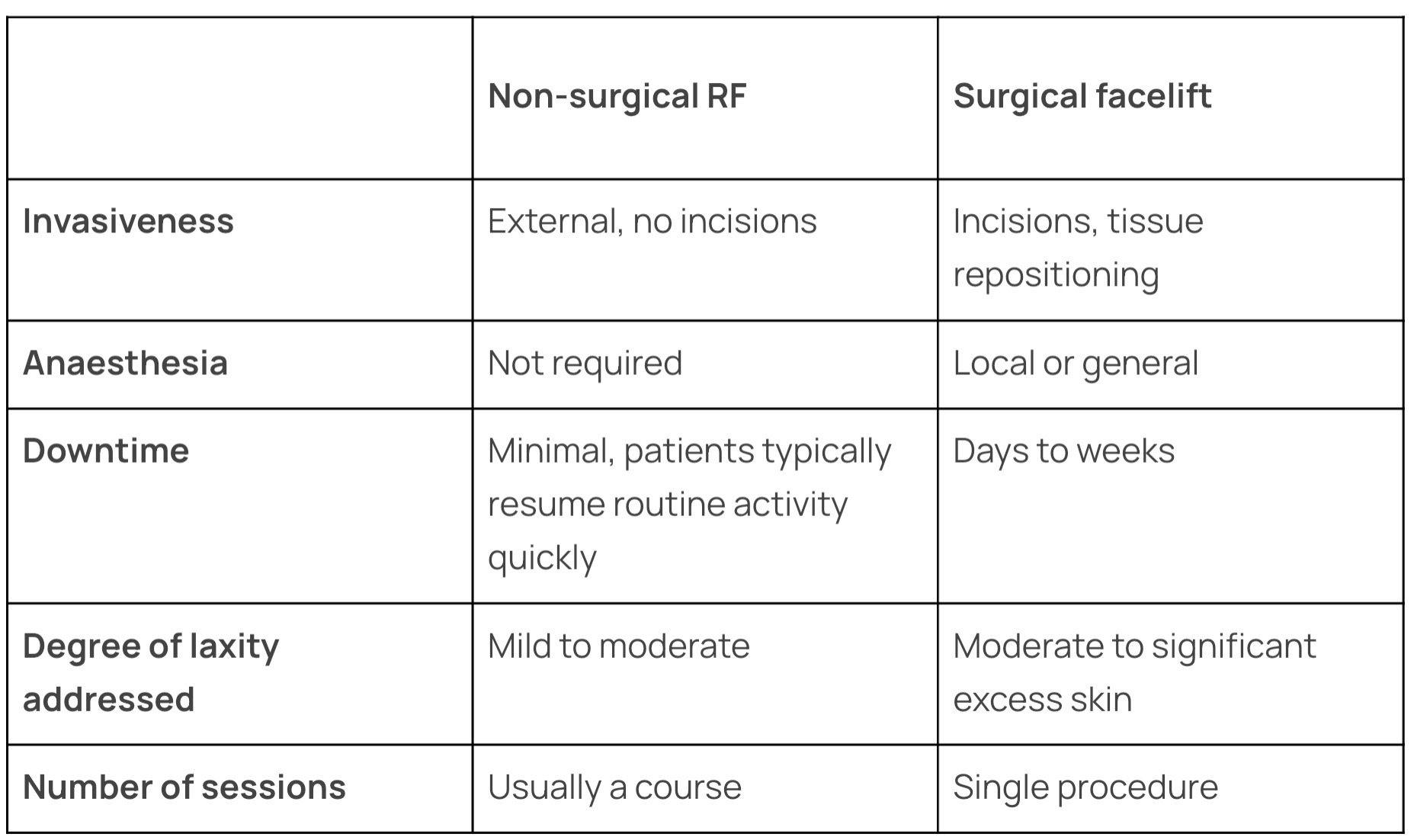
RF is not positioned as a substitute for a facelift when there is significant excess skin or deep folds; it is a separate tool for a different degree of laxity, and the systematic review above is explicit that its evidence base sits in the mild-to-moderate range rather than at the level surgery addresses [1].
Who is, and isn’t, a reasonable candidate
Patients with early jawline softening, mild neck laxity or skin that has lost some firmness without visible excess or heavy folds are the group RF studies generally describe. Patients with significant skin redundancy, deep nasolabial folds or a jawline that has genuinely dropped are more often surgical candidates, and a doctor should say so honestly rather than offering a course of sessions that will under-deliver. RF is not performed on active skin infection or inflammation at the treatment site, over recent fillers or implants without clearance from the treating doctor, during pregnancy, or in patients with pacemakers or other implanted electrical devices. This list is not exhaustive, and suitability is confirmed at an in-person assessment.
When a diagnosis has to come first
Skin laxity that has appeared suddenly, is accompanied by unexplained weight change, or affects one side of the face more than the other is not a cosmetic question. Sudden asymmetric sagging can signal a neurological issue and needs medical assessment before any aesthetic treatment is considered, not after.
What happens during a session
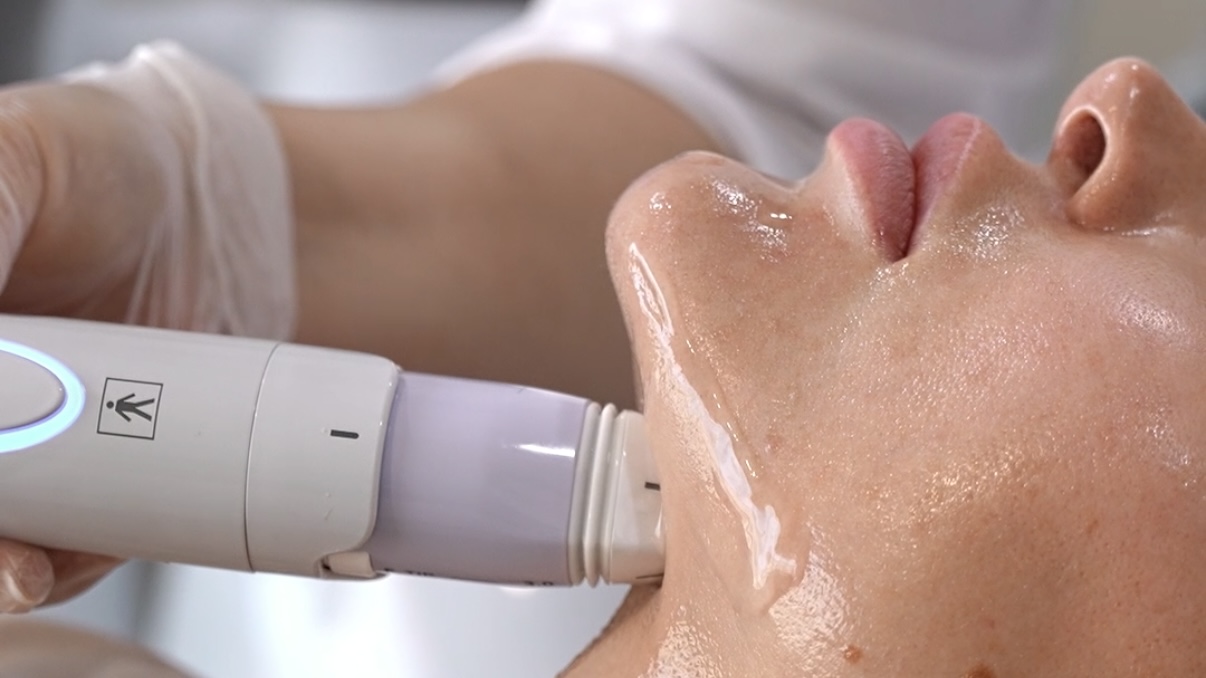
A treatment area is cleaned, a temperature-monitoring or coupling gel is applied, and the device head is moved across the skin in passes while the practitioner tracks skin temperature and patient comfort throughout. Most patients describe a deep warming sensation rather than sharp pain. A single session takes well under an hour depending on the area, and the doctor sets the number of sessions and the interval between them based on the degree of laxity and how the skin responds.
Risks and when to postpone
Temporary redness and a warm sensation in the treated area are expected and usually settle within hours. Less commonly, patients notice small areas of firmness, temporary numbness or, rarely, a burn if energy delivery is not properly monitored, which is why device settings and temperature tracking are the practitioner’s responsibility rather than the patient’s. Treatment is postponed over active breakouts, sunburn, or broken skin at the treatment site, and doctors reassess timing around recent injectables in the same area.
What MED YU MED offers
MED YU MED provides monopolar radiofrequency treatment using the VOLNEWMER and INDIBA Elite systems, with the doctor selecting the device, settings and course length at consultation based on the area and the degree of laxity present.
Frequently asked questions
How many sessions does RF skin tightening usually take?
Protocols vary by device and by how much laxity is being treated, and this is decided at consultation rather than fixed in advance.
Is there any downtime?
Most patients return to normal activity the same day. Mild redness typically settles within a few hours.
Can RF be combined with other treatments?
That depends on the specific treatments and timing, and it’s a decision the treating doctor makes case by case.
At what age does RF stop being enough on its own?
There’s no fixed age; it depends on how much skin excess and laxity is present, not on the calendar. That’s exactly what the consultation assessment is for.
Does the effect show up immediately?
Some tightening is visible from the immediate collagen contraction, but the fuller effect from new collagen production builds gradually over the weeks following treatment.
What to read next
- SMAS vs. RF lifting: which one do you actually need?
- Device-led skin tightening after 40: what the evidence shows
- Endolift vs HIFU: which lifts what
Medical disclaimer: This page is for informational purposes only and does not replace a consultation with a licensed physician. It does not recommend or prescribe any prescription-only medicine.
License statement: MED YU MED operates under DHA License 6589480.
Individual results caveat: Results vary by diagnosis, anatomy, product used and individual response, and no outcome is guaranteed.
References
1.Rohrich RJ, Schultz KP, Chamata ES, Bellamy JL, Alleyne B. Minimally invasive approach to skin tightening of the face and body: systematic review of monopolar and bipolar radiofrequency devices. Plast Reconstr Surg. 2022;150(4):771-780. doi:10.1097/PRS.0000000000009535 — https://doi.org/10.1097/PRS.0000000000009535
2.Wang Z, Li L, Zhang X, Li Z, Yan Y. Long-term efficacy and safety of a novel monopolar radiofrequency device for skin tightening: a prospective randomized controlled study. Lasers Surg Med. 2025;57(3):259-264. doi:10.1002/lsm.70002 — https://doi.org/10.1002/lsm.70002
MEDICALLY REVIEWED BY
DR. Alina Lebedeva
General Practitioner, Aesthetic Medicine Doctor
DHA License No. 35044799-002
Related articles



Medically reviewed by

General Practitioner, Aesthetic Medicine Doctor
DHA License No. 09620692-002