


Published 15 July 2026 · Updated 19 August 2026
During consultations, patients often ask us this question, searching for the perfect device-based rejuvenation method. The choice between these two top-tier technologies sparks a lot of debate, and the internet is flooded with contradictory information. Frequently, one method is praised at the direct expense of the other. In this article, we will break down exactly how each technology works and why a universal answer simply doesn’t exist.
The medical term “lifting” implies repositioning and securing tissues in a higher, more youthful position. Modern cosmetology allows us to achieve this without surgery. However, the approach to solving the problem will be entirely different depending on each person’s unique anatomy.
SMAS-Lifting (Ultrasound): Rebuilding the Foundation
The acronym SMAS stands for Superficial Musculoaponeurotic System: the dense framework of ligaments and muscles that supports our skin. As we age, this framework stretches, and tissues begin to slide downward under the influence of gravity. This is what forms jowls, malar bags, and a double chin.
Focused ultrasound devices, such as the Ultraformer and Ultraformer MPT, generate a powerful sound wave. It passes harmlessly through the top layer of the skin to precisely heat the ligament apparatus to 65-70 °C. This triggers controlled microcoagulation (the contraction of stretched protein fibers), causing the muscular framework to shrink and tighten. In the clinical guidelines of the FDA, this method has long been recognized as a highly reliable, safe alternative to surgery for patients experiencing pronounced gravitational sagging.
RF-Lifting (Radiofrequency): Restoring the Skin
RF stands for radiofrequency energy. Unlike ultrasound, RF specifically targets the quality of the dermis itself (the middle layer of the skin, which holds our main reserves of collagen and elastin). When the face develops wrinkles, loses its tone, and becomes lax, it is usually signaling a deficit of these structural proteins.
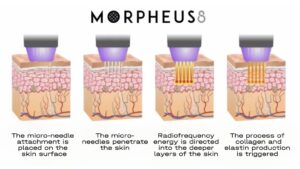
Radiofrequency devices heat the tissue, which causes old collagen to instantly contract and stimulates fibroblasts to actively produce fresh protein. There are two ways of delivering this energy.
The monopolar method, using the Volnewmer, deeply heats a large volume of tissue, creating a firm, sculpted contour. With fractional microneedling RF, such as the Morpheus8, Genius or Vivace platforms, the energy is delivered directly to a targeted depth through ultra-fine needles. The mechanical puncture triggers intense regeneration, while the radiofrequency heat at the needle tips coagulates the structures, further smoothing the skin’s texture.
Comparing the Technologies
The fundamental differences between SMAS and RF lifting lie in the depth of energy penetration and the specific target area. Compared to a surgical facelift, ultrasound works as atraumatically as possible on the ligaments and effectively compacts fat pads in the deeper layers of the skin. Radiofrequency directly thickens and smooths the skin itself.
Key Characteristics:
- Working Depth: Ultrasound penetrates up to 4.5 mm (muscle fascia). Radiofrequency works at a depth of 1 to 4 mm (dermis and hypodermis).
- Primary Objective: Ultrasound is indicated for compacting heavy lower faces and reducing fat pads. Radiofrequency heating excels at eliminating skin laxity and restoring elasticity.
Patients often ask for a straightforward answer regarding whether SMAS or RF-lifting is better for their specific situation. Individual anatomy dictates everything here. If you have a deformation-edematous aging type (prone to heaviness and swelling), dense tissues, and pronounced jowls, ultrasound will effectively eliminate that excess volume. However, if your face is naturally thin, you have very little subcutaneous fat, and your main aesthetic concern is dry, thinning skin, then RF-lifting will provide a much more visible result.
It is also vital to consider the body’s internal resources. Depleted tissues struggle to synthesize protein. Often, before a high-tech device treatment, a practitioner will prescribe biorevitalization injections to ensure your cells have the building blocks necessary to create new collagen.
Which Should You Choose for Maximum Results?
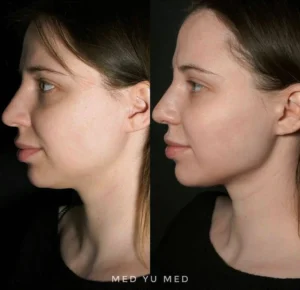
The final decision to proceed with SMAS or RF-lifting is made exclusively by your medical practitioner following an in-person diagnostic assessment of your tissues. Modern cosmetology has long abandoned rigid, one-size-fits-all templates. In current practice, we frequently utilize combined protocols to address multiple patient concerns simultaneously. In this kind of tandem, ultrasound creates a solid foundation by tightening the muscles, while radiofrequency perfectly refines the quality of the upper skin layers.
Medical disclaimer: This page is for informational purposes only and does not replace a medical consultation.
License statement: MED YU MED operates under DHA License 6589480.
Individual results caveat: Results vary by diagnosis, skin type, and individual response.
Risks on both sides of the comparison
Focused ultrasound places heat at a set depth, and the risks come from that heat landing where it was not intended: burns and blistering, prolonged numbness, temporary weakness or asymmetry of the face if a motor nerve is affected, welts or ridging along a treatment line, and loss of facial fat in the treated area, which shows as hollowing rather than lifting. Radiofrequency microneedling reaches the subdermal layer and carries burns, blistering, marks tracing the pin grid, infection, a cold sore flare-up, prolonged swelling, scarring and pigment change. On skin types IV to VI, common in Dubai, post-inflammatory hyperpigmentation heads the list for both methods.
Neither method reproduces the result of a surgical facelift. Where laxity is advanced, a surgical opinion is the honest answer.
When radiofrequency treatment is not done
- Pregnancy and breastfeeding
- Active skin infection, inflammation or open wounds in the treatment area
- Recent isotretinoin use, until the course is completed and cleared by a doctor
- Active acne flare or herpes in the treatment area
- History of keloid or abnormal scarring
- An implanted electronic device anywhere in the body, including a pacemaker or defibrillator, not only in the treatment area
- Metal implants, dermal fillers, lifting threads or facial implants in the treatment area, after doctor assessment
- Uncontrolled chronic conditions that impair skin healing
This list is not exhaustive. Other conditions, medicines and previous treatments may also rule the treatment out or change the plan. Final suitability is determined by a clinician at an in-person assessment.
If something goes wrong afterwards
Call MED YU MED on +971 52 184 5011, daily 10:00-22:00, if you develop a blister, a burn or an open area of skin, pain that increases rather than eases, spreading redness with heat, or a fever. Any change in vision needs assessment the same day. Outside our opening hours go to the nearest emergency department or call 998 for an ambulance, rather than waiting for the clinic to reopen. The clinic does not operate 24 hours.
Related articles

Medically reviewed by

General Practitioner, Aesthetic Medicine Doctor
DHA License No. 09620692-002


