Published 2 August 2026 · Updated 9 September 2026
The short answer
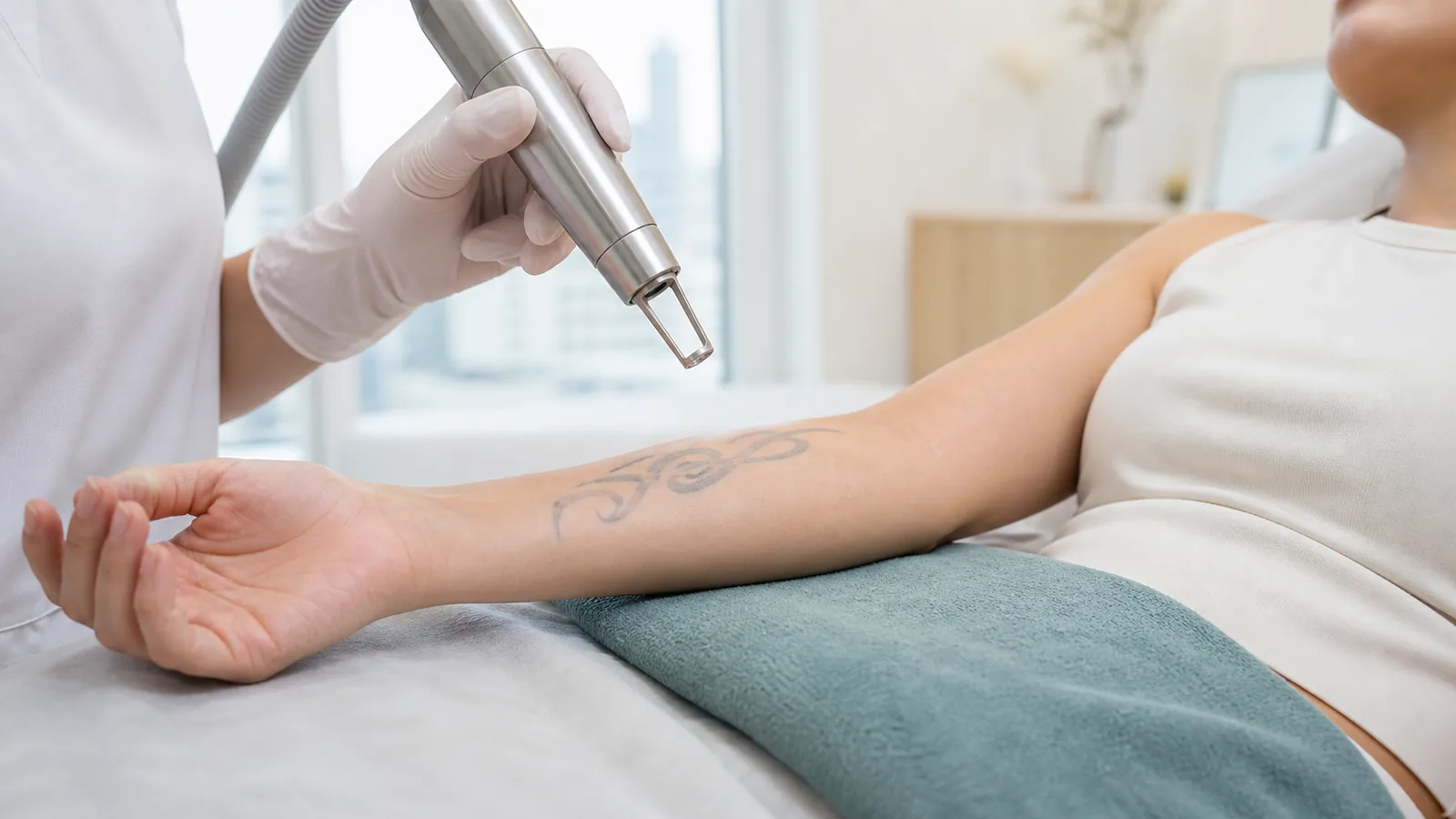
Removal is a sequence of fading steps, not an erasure. The laser breaks pigment into fragments; your immune system carries them away over the following weeks. That second part is why sessions are spaced, why the visible change happens between appointments rather than on the day, and why nobody can promise a finish date at the first consultation.
How many sessions it really takes
Prediction scales exist for this. The Kirby-Desai scale scores skin type, ink colour, amount, scarring, layering and location, then estimates a session count. A retrospective clinical evaluation compared those predictions against what actually happened (doi 10.1111/jocd.16201): the real average was 5.09 sessions against 9.9 predicted, a significant difference at p below 0.001.
Two things follow. Estimates given at a first visit tend to run high, so treat them as an upper bound rather than a plan. And the same study found removal efficiency significantly higher at long-term follow-up than at short-term, which means ink keeps clearing after the last appointment.
What happens in the weeks between
Immediately after a pass the area frosts white, then reddens and swells for a day or two.
Crusting and occasional blistering follow in the first week. The fading itself is slow and happens in the second to eighth week as fragmented pigment is carried off.
This is why photographs taken the day after a session show almost nothing and photographs taken six weeks later show the real result. If you are tracking progress, compare the same lighting and angle at the same point in each cycle rather than day to day.
Does a picosecond laser clear ink faster?
It depends on the wavelength, and the evidence splits.
At 1064 nm on black tattoos, a randomised controlled trial found no statistical difference in clearance between picosecond and nanosecond pulses after two treatments, at P of 1.00 (doi 10.1111/bjd.14962). Pain was the difference: 3.8 against 7.9 on a ten-point scale, at P below 0.001.
At 755 nm the picture reverses. A randomised trial of picosecond against nanosecond alexandrite lasers found higher clearance scores for the picosecond arm, satisfactory clearance in 73.3 per cent of sites against 23.3 per cent, and complete clearance in 10 per cent against none (doi 10.1097/PRS.0000000000012958). Bleeding, blistering and crusting were all less frequent. One finding cuts the other way: hyperpigmentation occurred more often with the picosecond laser.
So the honest version is that pulse duration helps at some wavelengths and for some inks, and that the trade is not purely in favour of newer technology.
Colour changes everything
Black and dark blue absorb across a broad range and clear most predictably. Yellow, red and orange are the difficult end and need shorter wavelengths: a case series using a 532 nm picosecond laser on yellow ink reported one subject clear after a single session and five needing two to four sessions for more than 75 per cent clearance (doi 10.1002/lsm.22354).
Ask which wavelengths a clinic has before starting on a multicoloured piece. A device that cannot reach your ink colours will produce a partial result no matter how many sessions you buy.
What else shifts the outcome
Ink density, depth, how the tattoo was applied, whether it has been treated before and its age all affect response. Location matters through circulation: areas further from the trunk clear more slowly.
One unexpected variable has been measured. A comparison of vegan and omnivore patients undergoing Q-switched laser removal found vegans needed significantly more sessions, showed worse clinical responses and took longer to heal, all at p of 0.006 or lower (doi 10.1111/jocd.14134). The mechanism is not established, and it is a single study, but it illustrates how much of the result depends on clearance by your body rather than on the device.
Risks worth knowing before the first session
Transient hypopigmentation and blistering are the common adverse effects, and scarring or textural change is rare but reported (doi 10.2147/MDER.S77993). Hyperpigmentation is more likely on darker skin, and it is the reason conservative settings and test spots exist.
Laser work on or near the eyelid is a separate matter: external goggles do not protect the eye when the treated area is the lid itself, and that work requires intraocular shields. Ask any clinic directly what it uses before agreeing to periorbital pigment work.
Removal is not started over active infection or inflammation in the area, on freshly tanned skin, during pregnancy, or where the tattoo itself has reacted allergically, and a suspicious pigmented lesion inside a tattoo is examined by a doctor before any laser is aimed at it. This list is not exhaustive, and final suitability is determined by a clinician at an in-person assessment.
Treatment details, areas and pricing for this clinic are on the tattoo removal page, and the device comparison is covered in PicoSure vs Q-switched lasers.
When to call the clinic
Call MED YU MED on +971 52 184 5011, daily 10:00-22:00, if redness spreads rather than settles, if the skin blisters or breaks, if pain increases after the first day, or if a fever follows a session. Outside our opening hours go to the nearest emergency department or call 998 for an ambulance rather than waiting for the clinic to reopen. The clinic does not operate 24 hours.
Questions people ask
How many sessions will I need?
Fewer than most prediction scales suggest. In a retrospective evaluation the actual average was 5.09 sessions against 9.9 predicted by the Kirby-Desai scale. Colour, density, depth, location and previous treatment all move that number.
Why is there a gap of weeks between sessions?
The laser fragments the pigment, but your immune system removes it. That clearance happens over the following weeks, which is also when the visible fading occurs. Treating again too early adds injury without adding result.
Is a picosecond laser always better?
No. At 1064 nm on black ink, a randomised trial found no clearance difference against nanosecond pulses, only less pain. At 755 nm the picosecond arm cleared significantly better, though hyperpigmentation occurred more often.
Which colours are hardest to remove?
Yellow, red and orange. They need shorter wavelengths than black ink, and a clinic without the right wavelength will produce a partial result regardless of how many sessions are done.
References
- Neodymium-doped yttrium aluminium garnet 1064-nm picosecond laser vs nanosecond laser in tattoo removal: a randomized controlled trial. Br J Dermatol. doi 10.1111/bjd.14962
- 755-nm Picosecond vs Nanosecond Alexandrite Lasers for Tattoo Removal. Plast Reconstr Surg. 2026. doi 10.1097/PRS.0000000000012958
- Retrospective clinical evaluation of Q-switched Nd:YAG laser safety and efficacy in tattoo removal. J Cosmet Dermatol. 2024;23(3):818-823. doi 10.1111/jocd.16201
- Alabdulrazzaq H, Brauer JA, et al. Clearance of yellow tattoo ink with a novel 532-nm picosecond laser. Lasers Surg Med. 2015;47(4):285-288. doi 10.1002/lsm.22354
- Laser removal of tattoos in vegan and omnivore patients. J Cosmet Dermatol. 2022;21(2):674-678. doi 10.1111/jocd.14134
- Torbeck R, Bankowski R, Henize S, Saedi N. Lasers in tattoo and pigmentation control: role of the PicoSure laser system. Med Devices (Auckl). doi 10.2147/MDER.S77993
Commercial disclosure: MED YU MED provides this treatment as a paid service. Where the evidence is limited, this page says so rather than filling the gap with confidence.
Medical disclaimer: This page is for informational purposes only and does not replace a medical consultation.
License statement: MED YU MED operates under DHA License 6589480.
Individual results caveat: Results vary by diagnosis, skin type, and individual response.
Related articles


Medically reviewed by