Published 2 August 2026 · Updated 9 September 2026
The short answer
A HydraFacial cleans out congested pores, lifts dead surface cells and leaves skin hydrated and brighter for a few days to a couple of weeks. Histology from the earliest study of the method shows it does slightly more than that over a course. What it does not do is treat inflammatory acne, replace a peel or a laser, or produce a change that lasts without repetition.
Everything below separates what has been measured from what gets promised.
What the machine physically does
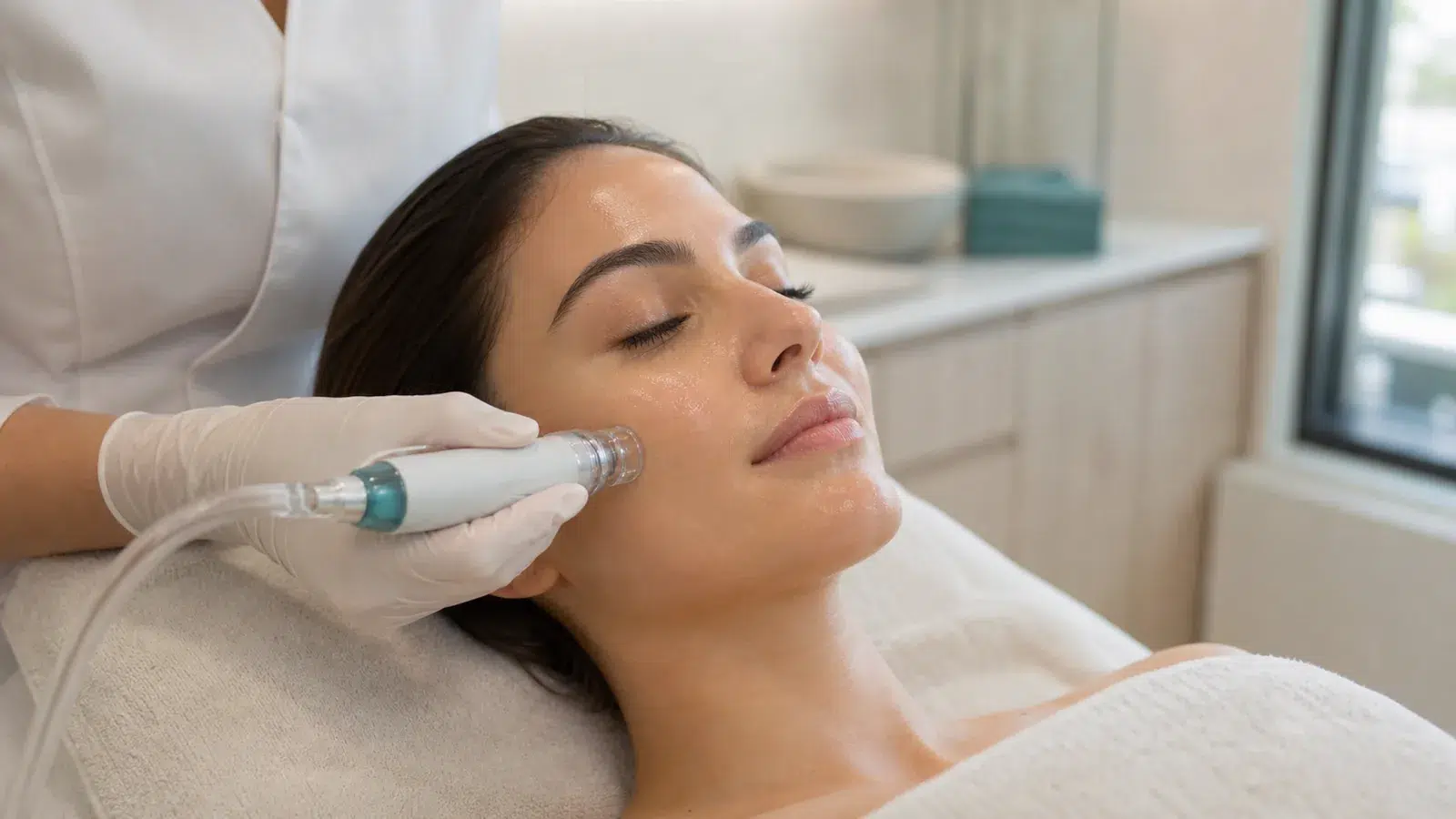
The method is hydradermabrasion: a handpiece holds a spiral tip against the skin, water and active solution flow in while a vacuum pulls debris out. Exfoliation, extraction of comedones and infusion of serum happen in the same pass, which is the difference from a manual facial where each of those is a separate step and extraction is done by hand.
Because the abrasive part is fluid rather than crystals, the treatment does not break the skin barrier the way older crystal microdermabrasion could. That is also why there is no recovery time and no visible peeling afterwards.
What the studies measured
The first published work on hydradermabrasion took biopsies rather than photographs (doi 10.1111/j.1473-2165.2008.00406.x). After a course, treated skin showed increased epidermal and papillary dermal thickness, higher polyphenolic antioxidant levels, replacement of elastotic dermal tissue and greater fibroblast density, all at P less than 0.01. Fine lines, pore size and hyperpigmentation decreased, with no reported complications.
One detail in that study matters more than the headline. It ran two groups: one received the treatment with an antioxidant serum, the other did not. The group without serum showed no change in skin structure, antioxidant levels or clinical appearance. The device alone was not what produced the histological result.
A prospective study in 2024 followed 29 women across Fitzpatrick types II to VI receiving biweekly hydradermabrasion with a growth factor serum (doi 10.1111/jocd.16229). Fine lines, smoothness, radiance and hydration improved significantly after a single treatment, all at p of 0.004 or lower, and every investigator-assessed parameter was significantly better than baseline at week 12. Tolerability scores stayed below 1, and all participants reported satisfaction.
Where expectations run ahead of the evidence
A right-left controlled trial compared microdermabrasion with low-strength glycolic acid peels (doi 10.1046/j.1524-4725.2002.01144.x). Investigator ratings and photographic comparison found no treatment-specific differences and no significant improvement from baseline on either side. Patients leaned towards the peels. That study tested crystal microdermabrasion rather than the fluid-based method, so it does not transfer directly, but it makes the point: mechanical resurfacing at this intensity is a comfort and maintenance treatment, not a corrective one.
If the goal is a structural change to scarring, deep pigmentation or laxity, this is the wrong tool and a consultation should say so.
What the boosters add
Most of the difference between one protocol and another sits in the solution used, not in the handpiece. Salicylic acid is the ingredient with the clearest data behind it for congested skin:
in a randomised split-face trial, salicylic acid peels reduced non-inflammatory lesions by 48.5 per cent from baseline over 98 days, with a lipohydroxyacid comparator at 55.6 per cent and no significant difference between them (doi 10.1111/j.1473-2165.2011.00566.x). Neither reduced inflammatory lesions significantly, which is the same boundary the treatment has as a whole.
Hyaluronic acid, the other common booster, is a humectant: it holds water in the upper layers rather than remodelling anything. Topical formulations improve measured hydration and the appearance of fine lines while they are being used (doi 10.1111/dth.15903).
How long it lasts, and how often to repeat
The immediate effect, that clean and plumped look, is the shortest-lived part and fades over several days as skin rehydrates and sebum returns. The measurable changes in the studies above came from courses rather than single sessions: biweekly in the 2024 study, a course in the 2008 one.
In practice that means a single session before an event is a legitimate use, and a monthly rhythm is a maintenance choice rather than a treatment plan. Neither accumulates into a permanent result.
What it does not treat
Active, inflamed or cystic acne is a medical condition rather than a cleansing problem, and a facial does not address it. Nor do congestion protocols substitute for prescription therapy where that is what the skin needs.
The treatment is also not automatically the mildest option for every skin. Combining the cleanse with a peel changes the picture: expect flaking, and on skin types IV to VI accept a real risk of pigmentation after inflammation, which is why sun avoidance and daily SPF afterwards are part of the protocol rather than advice.
Risks
Mild redness, tightness or dryness for a few hours, and short-lived breakouts as congested pores clear, are the usual picture. Less common: irritation or an allergic reaction to a serum or peel used during the session, and a flare in reactive or rosacea-prone skin. Suitability is determined by a clinician at an in-person assessment; this list is not exhaustive.
Full protocol options, pricing and the assessment that precedes them are on the treatment page.
When to call the clinic
Call MED YU MED on +971 52 184 5011, daily 10:00-22:00, if redness spreads rather than settles, if the skin blisters or breaks, if pain increases after the first day, or if a fever follows a session. Outside our opening hours go to the nearest emergency department or call 998 for an ambulance rather than waiting for the clinic to reopen. The clinic does not operate 24 hours.
Questions people ask
Does a HydraFacial actually do anything, or is it just a nice facial?
Biopsies taken in the earliest study of the method showed increased epidermal and papillary dermal thickness and higher fibroblast density after a course. In the same study, the group treated without an antioxidant serum showed no structural change, so the solution used matters as much as the device.
How often should it be repeated?
The measured results in published studies came from courses, biweekly in the most recent one, rather than single sessions. A single treatment before an event is a reasonable use; a regular rhythm is maintenance rather than a course of treatment.
Will it clear acne?
Not inflammatory or cystic acne, which is a medical condition rather than a cleansing problem. Salicylic acid boosters have trial data for non-inflammatory lesions, comedones and blackheads, and none of those trials showed a significant effect on inflammatory lesions.
Is it safe on darker skin?
The cleansing protocol itself is gentle across skin types, and the 2024 study included Fitzpatrick types II to VI. Adding a peel changes that: on types IV to VI there is a real risk of pigmentation after inflammation, which is managed with conservative settings, sun avoidance and daily SPF.
References
- Freedman BM. Hydradermabrasion: an innovative modality for nonablative facial rejuvenation. J Cosmet Dermatol. 2008;7(4):275-280. doi 10.1111/j.1473-2165.2008.00406.x
- Efficacy and tolerability of a novel cosmetic growth factor serum used as part of biweekly hydradermabrasion treatments. J Cosmet Dermatol. 2024;23(4):1304-1312. doi 10.1111/jocd.16229
- Glycolic acid peels compared to microdermabrasion: a right-left controlled trial of efficacy and patient satisfaction. Dermatol Surg. 2002;28(6):475-479. doi 10.1046/j.1524-4725.2002.01144.x
- Randomized trial comparing a chemical peel containing a lipophilic hydroxy acid derivative of salicylic acid with a salicylic acid peel. J Cosmet Dermatol. 2011;10(3):174-178. doi 10.1111/j.1473-2165.2011.00566.x
- Bravo B, Correia P, Gonçalves Junior JE, et al. Benefits of topical hyaluronic acid for skin quality and signs of skin aging. Dermatol Ther. doi 10.1111/dth.15903
Commercial disclosure: MED YU MED provides this treatment as a paid service. Where the evidence is limited, this page says so rather than filling the gap with confidence.
Medical disclaimer: This page is for informational purposes only and does not replace a medical consultation.
License statement: MED YU MED operates under DHA License 6589480.
Individual results caveat: Results vary by diagnosis, skin type, and individual response.
Related articles



Medically reviewed by

HydraFacial Treatment at MED YU MED: prices
- HydraFacial - basic + T-zone cleansing800 AED
- HydraFacial (face, décolleté) + PRX-T331300 AED
- HydraFacial + PRX-T33 peel1000 AED
Treatment page and booking · full price list
The final protocol and cost are confirmed at an in-person consultation.