Published 2 August 2026 · Updated 19 August 2026
The short answer
Fotona is a platform, not a treatment. It carries two laser sources, and almost every question about results, downtime and risk is really a question about which of them was used, at what depth, on which part of the face. A gentle non-ablative pass and a deep resurfacing pass share a brand name and nothing else.
The numbers below come from studies of those wavelengths rather than from the platform’s marketing, and they are worth reading before choosing a protocol.
Two wavelengths, two different jobs
Er:YAG at 2940 nm is absorbed by water almost immediately, so it removes a precise layer of tissue with little heat spreading sideways. That precision is why it is used for resurfacing: fine lines, texture, scarring. Depth is chosen by the operator, and depth is what decides everything else.
Nd:YAG at 1064 nm passes much deeper and is absorbed by blood and pigment rather than water. It is the wavelength behind vascular work, deeper heating modes and hair removal. It does not ablate the surface, so there is no open wound and no peeling.
Protocol names such as 4D, SMOOTH, FRAC3 and PIANO are sequences that combine these two in different orders and depths. The name tells you the manufacturer’s recipe; it does not tell you the aggressiveness of your particular session.
Depth decides the complication rate
A retrospective review of full-field Er:YAG resurfacing put numbers on this (doi 10.1093/asj/sjz319). For light peels ablating 50 micrometres or less, the complication rate was 10.1 per cent, or 20 of 198 treatments. For deep resurfacing it was 26.5 per cent, or 71 of 268 cases.
Area matters as much as depth. In deep resurfacing the perioral region had the highest rate at 38.6 per cent of 145 cases, followed by the eyelids, cheek, nose and forehead, which ranged from 15.2 to 20.9 per cent. In the light peels the pattern reversed, with the cheek highest and every area under 9.1 per cent.
Read that as a trade: the deeper the pass, the more it can correct and the more often something goes wrong. Anyone offering a deep resurfacing result with a light-peel recovery is describing two different treatments at once.
What Er:YAG achieves when it is the right tool
Long-term follow-up of perioral resurfacing found a mean improvement of 2.2 gradations on the rhytide scale across 45 patients, with an average follow-up of 13 months, and no cases of hypopigmentation at six months (doi 10.1097/PRS.0000000000005163). In a study of Asian skin, re-epithelialisation and erythema resolved faster than previously reported for carbon dioxide resurfacing (doi 10.1111/j.1524-4725.1998.tb00004.x).
Both findings point the same way: erbium buys precision and a shorter recovery than older ablative lasers, at the cost of correcting less per pass.
The pigment problem, which matters here
One study treated refractory melasma with Er:YAG resurfacing (doi 10.1046/j.1524-4725.1999.08103.x). Improvement was marked immediately after the procedure. Then, between three and six weeks, every patient in the study developed post-inflammatory hyperpigmentation. Six months and a course of glycolic acid peels later the melasma had improved against baseline, but the intervening months were the price.
In a city where skin types IV to VI are common, that sequence is the single most useful thing to know about ablative work. A review of energy-based devices by phototype makes the same point from the other side: fractional radiofrequency, which spares the epidermis, is generally safer on darker skin than ablative resurfacing (doi 10.1097/DSS.0000000000003397).
This does not mean darker skin cannot be treated with a laser. It means conservative settings, a test patch and pigment management before and after are part of the plan rather than optional extras, and that a different device may be the better answer.
Does combining wavelengths help?
An evaluator-blinded randomised study compared a 532 nm pass alone against the same pass combined with 1064 nm (doi 10.1002/lsm.22582). Both sides improved pigment scores significantly at one and three months, and there was no difference between them on pigment. Three-dimensional surface analysis did find a difference in favour of the dual-wavelength side, at P of 0.003.
So combining wavelengths changed surface texture measurably but not pigment. That is a narrower claim than most descriptions of multi-mode protocols make.
Risks and when it is not done
The risk profile follows the mode. Gentle Nd:YAG and SMOOTH passes carry mainly redness and warmth. Ablative Er:YAG resurfacing removes surface skin and carries the risks of a controlled wound: burns, blistering, prolonged redness, infection, herpes reactivation, delayed healing and scarring. Pigment change in either direction can take months to fade.
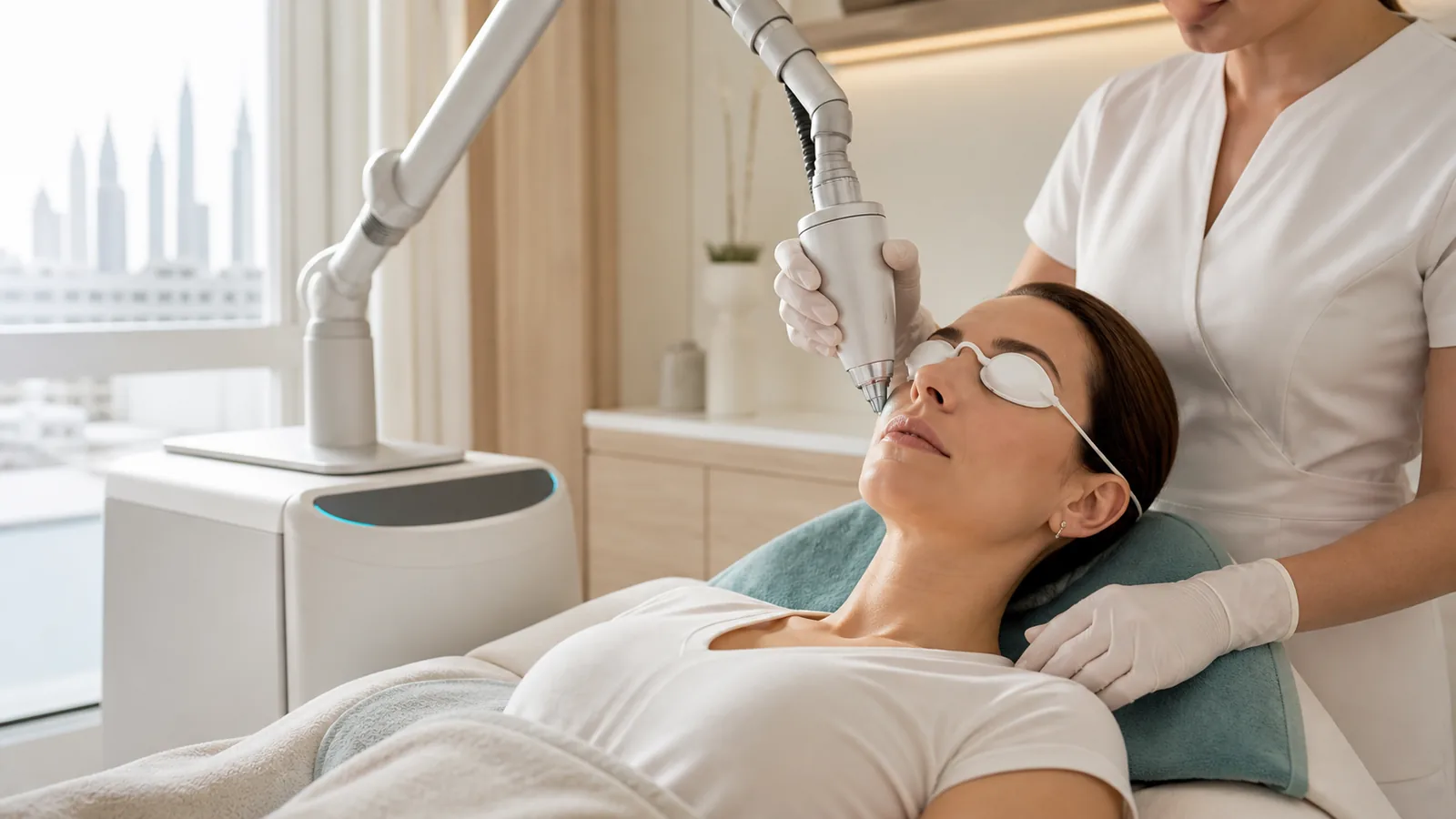
Protective eyewear is worn by everyone in the room for the whole session, and treatment close to the eyes carries a risk of ocular injury, which is why a doctor sets what can be treated and how.
Treatment is not performed during pregnancy and breastfeeding, after recent sun exposure or on an active tan in the area, on photosensitising medication such as isotretinoin or certain antibiotics without a doctor’s assessment, over active infection, herpes or open wounds in the area, with a history of keloid or abnormal scarring, or over skin cancer or suspicious pigmented lesions. This list is not exhaustive, and final suitability is determined by a clinician at an in-person assessment.
Protocols, areas and pricing are on the treatment page, and the device itself is described on the equipment page.
When to call the clinic
Call MED YU MED on +971 52 184 5011, daily 10:00-22:00, if redness spreads rather than settles, if the skin blisters or breaks, if pain increases after the first day, or if a fever follows a session. Outside our opening hours go to the nearest emergency department or call 998 for an ambulance rather than waiting for the clinic to reopen. The clinic does not operate 24 hours.
Questions people ask
What is the difference between Er:YAG and Nd:YAG on this platform?
Er:YAG at 2940 nm is absorbed by water and removes a precise surface layer, which is why it is used for resurfacing. Nd:YAG at 1064 nm penetrates deeper, targets blood and pigment rather than water, and does not ablate the surface.
How risky is laser resurfacing?
It depends almost entirely on depth. In a review of full-field Er:YAG treatments, light peels ablating 50 micrometres or less had a 10.1 per cent complication rate, while deep resurfacing reached 26.5 per cent, and the perioral area in deep resurfacing reached 38.6 per cent.
Is it safe on darker skin?
It requires a different conversation. In one study of Er:YAG for melasma, every patient developed post-inflammatory hyperpigmentation between three and six weeks. Conservative settings, a test patch and pigment management are part of the plan, and for some patients a non-ablative device is the better answer.
Do multi-mode protocols work better than a single wavelength?
In a randomised evaluator-blinded comparison, adding a second wavelength made no difference to pigment improvement but did change measured surface texture. That is a narrower benefit than the marketing around combined protocols usually implies.
References
- Full-Field Erbium:YAG Laser Resurfacing: Complications and Suggested Safety Parameters. Aesthet Surg J. 2020;40(6):NP374-NP385. doi 10.1093/asj/sjz319
- Long-Term Assessment of Perioral Rhytide Correction with Erbium:YAG Laser Resurfacing. Plast Reconstr Surg. 2019;143(1):64-74. doi 10.1097/PRS.0000000000005163
- Erbium:YAG laser resurfacing in Asians. Dermatol Surg. 1998;24(12):1303-1307. doi 10.1111/j.1524-4725.1998.tb00004.x
- Manaloto RM, Alster T. Erbium:YAG laser resurfacing for refractory melasma. Dermatol Surg. 1999;25(2):121-123. doi 10.1046/j.1524-4725.1999.08103.x
- Review of Lasers and Energy-Based Devices for Skin Rejuvenation and Scar Treatment With Histologic Correlations. Dermatol Surg. 2022;48(4):441-448. doi 10.1097/DSS.0000000000003397
- Prospective, randomized, evaluator-blinded study of the long pulse 532-nm KTP laser alone and in combination with the long pulse 1064-nm Nd:YAG laser. Lasers Surg Med. 2016;48(9):844-851. doi 10.1002/lsm.22582
Commercial disclosure: MED YU MED provides this treatment as a paid service. Where the evidence is limited, this page says so rather than filling the gap with confidence.
Medical disclaimer: This page is for informational purposes only and does not replace a medical consultation.
License statement: MED YU MED operates under DHA License 6589480.
Individual results caveat: Results vary by diagnosis, skin type, and individual response.
Related articles
Medically reviewed by
Fotona Laser at MED YU MED: prices
- Face lift 2D2100 AED
- Face lift 3D2750 AED
- Face lift 4D3500 AED
Treatment page and booking · full price list
The final protocol and cost are confirmed at an in-person consultation.