Published 2 June 2026 · Updated 17 September 2026
Reviewed by the MED YU MED medical team, DHA-licensed physicians practising at Med Yu Med, Bluewaters Island, Dubai. Facility DHA License 6589480. Last reviewed 4 August 2026.
Disclosure: Med Yu Med performs both treatments compared on this page. That is a commercial interest, and it is why the section on evidence quality below is less flattering to one of them than a clinic page usually is.
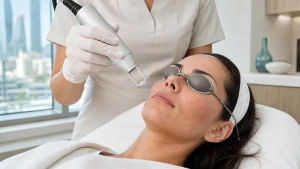
Two treatments get offered for the same complaint in Dubai clinics, and they are not variations of one idea. HIFU sends focused ultrasound through intact skin. Endolift threads an optical fibre underneath it. One is a device pressed against your face for an hour; the other is a procedure done under local anaesthetic that leaves entry points.
The honest comparison is not which works better. It is which one matches the tissue you actually have, and how much published evidence stands behind each answer. On that second question the two are not equal, and most pages comparing them do not say so.
The short answer
| HIFU (Ultraformer MPT) | Endolift (1470 nm diode) | |
|---|---|---|
| Where the energy goes | Focused ultrasound to set depths through unbroken skin, including the SMAS layer | Optical microfibre placed under the skin, heating tissue along its path |
| Does it break the skin | No | Yes, through tiny entry points under local anaesthetic |
| Targets small fat pockets | Not what it aims at, it works by tightening tissue | Yes, the wavelength is absorbed by water and produces selective lipolysis |
| Recovery described by the clinic | Same-day return to normal activity | Mild swelling, bruising and tenderness for a few days |
| Strength of published evidence | Pooled data from 16 studies, PMID 36674277, with durability the weak point | Two systematic reviews disagree, PMID 38886198 and PMID 39827299 |
How HIFU works, and what has been measured
Microfocused ultrasound concentrates acoustic energy at a fixed depth, creating small zones of coagulation that trigger a healing response while the surface stays intact. A 2016 review in Facial Plastic Surgery, PMID 27248024, describes the target as the deep reticular dermis and the superficial musculoaponeurotic system, and notes that the technique increases neocollagenesis while avoiding much of the epidermal heating that causes trouble with other non-ablative devices.
Depth is set by the cartridge rather than by pressure or technique. The specification published on the clinic’s own equipment page lists the face set at 1.5, 3.0 and 4.5 mm, with the 4.5 mm cartridge reaching the SMAS, and a body set at 6.0, 9.0 and 13 mm. Those depths are a manufacturer specification, not a finding from the reviews cited below.
The numbers worth knowing come from a 2023 systematic review in the International Journal of Environmental Research and Public Health, PMID 36674277. It screened 693 studies and included 16, all in female patients. Brow lift measured between 0.47 and 1.7 mm. Submental lift was recorded as a reduction of 26 to 45 square millimetres on lateral photographs. Pooled investigator scores at day 90 in 337 patients showed 92 per cent with some improvement, while patients themselves, 81 of them, described the change as mild, rising from 42 per cent at 90 days to 53 per cent at 360 days.
A brow lift of a millimetre is a real, photographable change. It is also not a facelift, and the 2016 review says so directly: results are not equivalent to those of a rhytidectomy.
How Endolift works, and why the wavelength matters
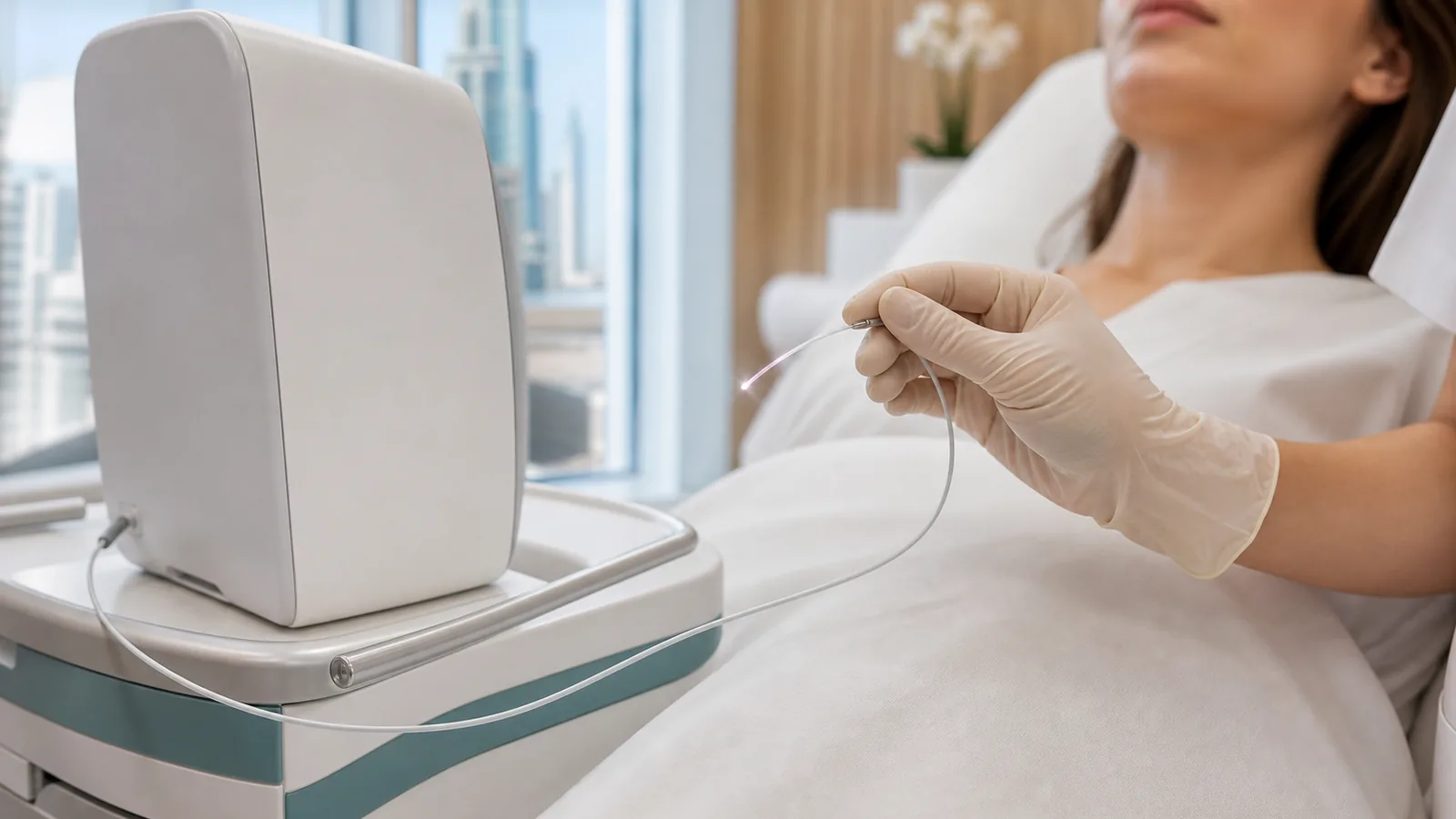
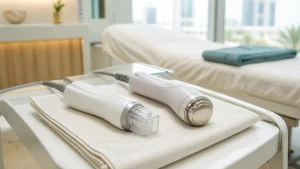
Endolift runs a thin optical fibre beneath the skin and heats tissue along the fibre’s path. At Med Yu Med it runs on the Eufoton LASEmaR 1500, a 1470 nm system, and the clinic’s own service page describes microfibres threaded through tiny entry points under local anaesthetic.
The wavelength explains the difference in what it can do. A 2026 narrative review in the Journal of Cosmetic Dermatology, PMID 42153325, describes the 1470 nm wavelength as having high affinity for water, which allows selective lipolysis alongside deep collagen restructuring through controlled photothermal interaction. That is why Endolift gets proposed for jowls and small submental fat pockets. Focused ultrasound works by tightening tissue rather than by targeting fat, so a fat pocket is not what it aims at. That contrast rests on how the two mechanisms are described rather than on a study comparing them directly.
Where the evidence is uneven, and nobody says it out loud
This is the part that decides more than the mechanism, and it is where the two treatments part company.
For Endolift, two systematic reviews reach opposite conclusions, and both are recent. A 2024 systematic review in Aesthetic Plastic Surgery, PMID 38886198, searched three databases, screened 339 articles and included 23. It reports favourable efficacy and safety for face and neck lifting, skin laxity and wrinkles, describes promise in reducing adipose tissue in the jowl, abdomen, thighs and arms, and records adverse events that were mild and self-limiting across all studies, with high patient satisfaction. It also calls for controlled studies with larger samples.
A 2025 systematic review in Lasers in Medical Science, PMID 39827299, looked harder and concluded the opposite. From 111 articles it selected seven. Those articles, in the authors’ assessment, showed a high risk of bias, a lack of standardisation in treatment parameters, and reports of adverse events that did not align with clinical reality, often occurring with off-label use. Their conclusion is blunt: asserting the efficacy and safety of the technique is challenging, and randomised studies are recommended to curb indiscriminate use.
Both statements can be true at once. Twenty-three studies of mostly uncontrolled design can show consistent improvement while still failing a strict quality filter that leaves only seven papers standing. What follows for a patient is practical rather than academic: with Endolift you are relying more on the operator’s judgement and less on standardised published protocols than the marketing implies.
HIFU is not spared either, but its weak point is different. The pooled data exist and the effect sizes are modest but measured. Durability is the gap. A 2023 narrative review in the Journal of Cosmetic Dermatology, PMID 37128835, covering 11 original articles, found around half of patients rated much improved at days 30 and 90 while most returned to baseline by day 360, and the 2023 systematic review states plainly that longer-term follow-up data are not available.
Invasiveness and recovery, described honestly
Non-surgical is a category, not a promise. HIFU leaves the skin unbroken, and most people go back to normal activity the same day. The published data still record it as moderately painful with transient redness, and adverse effects beyond that in about 2 per cent of cases: numbness or hypersensitivity, bruising, stinging, mandibular burns, striations and contact dermatitis.
Endolift breaks the surface. The clinic’s service page sets the expectation of mild swelling, some bruising and tenderness around the treated area for a few days, settling on their own. Anything introduced under the skin also carries the ordinary risks of that route, which is why it is assessed at its own consultation rather than added to a package.
Which one suits which tissue
Ignore the age ranges you see quoted on comparison pages. Nothing in the published data assigns these treatments by birthday, and the honest sorting is by what the tissue is doing.
- Laxity that is mild to moderate, with skin quality as the main concern and no interest in downtime, points towards focused ultrasound. The systematic review found that results declined as laxity increased, so an ultrasound device is not the answer to heavy sagging.
- Laxity accompanied by a small fat pocket, typically under the chin or along the jawline, is where the fibre-based approach has something ultrasound structurally cannot offer.
- Significant sagging with excess skin is a surgical conversation. Both treatments will underdeliver, and a clinic that books either one for that presentation is selling you the wrong thing.
Two relative contraindications come from the ultrasound data specifically: excessive skin laxity and a body mass index above 30, both because positive results declined as they increased.
How long the result lasts
For HIFU there is a published answer and it is shorter than most clinics imply. Around half of patients were much improved at days 30 and 90, most were back at baseline by day 360, and longer-term follow-up data do not exist. Plan for a result measured in months and expect to repeat.
For Endolift there is no equivalent pooled figure. The 2026 narrative review notes that standardisation of protocols through larger randomised trials remains a priority to confirm long-term durability, which is a polite way of saying the durability question is open. Anyone quoting you a specific number of years for either treatment is quoting something the literature does not contain.
Risks and who should postpone
These are conversations for the treating physician rather than rules to apply yourself, but they are the ones that come up.
- Pregnancy or breastfeeding.
- Active infection, inflammatory flare or an open lesion in the treatment area.
- Recent oral isotretinoin.
- A history of keloid scarring, which matters more when the skin is being entered.
- Anticoagulant medication or a bleeding disorder, which is relevant to any fibre placed under the skin.
- Unrealistic expectations of a surgical result, which is a clinical reason to decline rather than a personality trait.
What to ask before you agree to either
Four questions separate a plan from a sales script.
Which layer are you treating, and why that one for my face? What does the published data show for this specific device rather than for the category? How many of these has this operator performed, and what does their own follow-up look like at three months? And what happens if the result disappoints, including whether a second session is included?
A consultation that answers with popularity rather than with layers, depths and follow-up has not answered.
What Med Yu Med performs
Both treatments compared here are available at the clinic. HIFU runs as SMAS lifting on the Ultraformer MPT, and the fibre-based option runs as Endolift. The clinic also performs radiofrequency microneedling, monopolar radiofrequency, laser treatments and injectable procedures, so a consultation is not restricted to the two options on this page.
Which of them is proposed, if either, is decided after assessment rather than chosen from a comparison table, including this one.
When to seek help after treatment
Call 998 immediately and do not wait for any of these: difficulty breathing, swelling of the lips, tongue or throat, chest pain, fainting or loss of consciousness.
Seek medical attention the same day for a blister, burn or open wound in the treated area, numbness or asymmetry of facial movement that does not resolve within hours, spreading redness with heat and pain, fever after a procedure, or a raised scar that keeps growing weeks later.
Related reading

Frequently Asked Questions
Is Endolift better than HIFU for a sagging jawline?
It depends on whether the jawline is heavy with fat or simply lax. Endolift uses a 1470 nm wavelength with high affinity for water, which produces selective lipolysis alongside collagen restructuring, PMID 42153325, so it can address a small fat pocket that ultrasound cannot. If the issue is laxity alone, focused ultrasound treats it without breaking the skin. Neither replaces surgery when there is excess skin to remove.
Which treatment has better published evidence?
HIFU, though its evidence has a clear gap. Pooled data from 16 studies, PMID 36674277, give measured effect sizes, while durability is unproven because longer-term follow-up data are not available. For Endolift two systematic reviews disagree: PMID 38886198 reports favourable efficacy and safety across 23 studies, while PMID 39827299 selected only seven articles from 111 and found a high risk of bias and a lack of standardised parameters.
Does Endolift require anaesthesia and downtime?
Yes to both, in a limited form. The clinic performs it with optical microfibres introduced through tiny entry points under local anaesthetic, and sets the expectation of mild swelling, bruising and tenderness for a few days afterwards. HIFU needs no anaesthetic and most people return to normal activity the same day, which is the practical trade-off between the two.
How long do the results last?
For HIFU, a narrative review of 11 studies, PMID 37128835, found around half of patients much improved at days 30 and 90 with most back at baseline by day 360. For Endolift no pooled durability figure exists, and the 2026 review, PMID 42153325, states that larger randomised trials are still needed to confirm long-term durability. Treat any promise of a permanent result as a sales claim.
Can the two be combined?
They are sometimes proposed together, and the evidence for sequencing is thinner than the confidence with which it is presented. The 2026 narrative review, PMID 42153325, discusses multimodal protocols combining the 1470 nm laser with fillers, nanofat or resurfacing, and does not cover combinations with ultrasound. A sensible plan spaces treatments so you can tell which one produced the change.
Who should not have either treatment?
Postpone or discuss carefully in pregnancy or breastfeeding, with an active infection or inflammatory flare in the area, after recent oral isotretinoin, with a history of keloid scarring, or while taking anticoagulant medication, which matters most for anything placed under the skin. For focused ultrasound specifically, excessive skin laxity and a body mass index above 30 are relative contraindications, PMID 36674277, because results declined as both increased.
Medical disclaimer: This page is for informational purposes only and does not replace a consultation with a licensed physician.
License statement: MED YU MED operates under DHA License 6589480.
Individual results caveat: Results vary by diagnosis, tissue type, degree of laxity and individual response, and no outcome is guaranteed.
Related articles
Medically reviewed by
General Practitioner, Aesthetic Medicine Doctor
DHA License No. 09620692-002