Published 30 September 2026
The short answer
Radiofrequency works by heat, so it can burn skin when energy, cooling or technique go wrong. Burns are less common than the flushing most people get, but they do happen. Whether it melts facial fat is less clear. Some RF protocols are built to heat body fat, while face-tightening settings aim at the dermis. Evidence on fat change after face tightening is limited, and the treatment page lists fat loss as a possible risk, which looks like hollowing. The doctor’s choice of energy and technique matters for both risks.
How radiofrequency heats the face
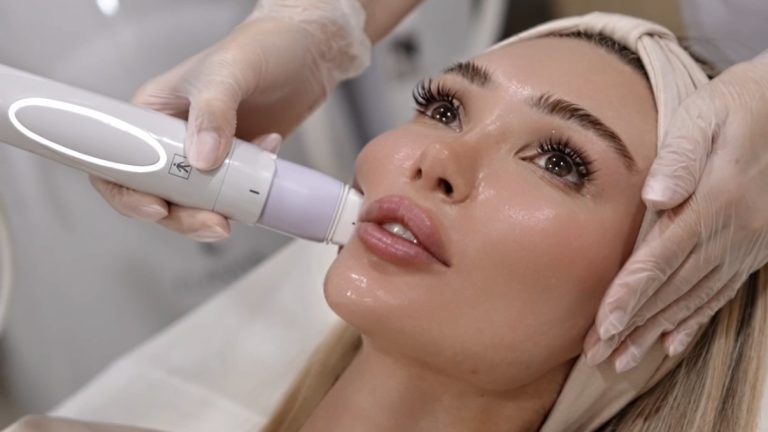
A radiofrequency device sends an electrical current through tissue, and the tissue’s own resistance turns that current into heat. In the VOLNEWMER RF lifting treatment at the clinic, that heat is aimed at the dermis to support collagen renewal and firmer skin. The treatment uses no needles.
The device page on VOLNEWMER lists 6.78 MHz, 115 W and continuous water cooling of the skin surface. Before each shot the tip checks tissue impedance, then the cooling starts and the energy follows. The same page states plainly that radiofrequency is not risk-free and that burns have been reported when energy is misapplied.
So the question is not whether RF is gentle or aggressive. The question is how much heat reaches which layer, for how long, and who controls it.
Does radiofrequency melt fat?
The published evidence gives different answers for different protocols. The table sets out the studies we reviewed and their limits.
| Question | Study | What it reported | Limits |
|---|---|---|---|
| Can RF heat thin body fat? | Taub and Bartholomeusz, Journal of Drugs in Dermatology, 2020: 12 patients, abdomen and flanks, one 60-minute session with a monopolar device built for this purpose | Skin temperature held at 44 to 45 degrees C. Ultrasound showed a mean fat layer reduction of 4.6 mm, a 24% reduction at 12 weeks. Pain scores were 2 to 4 out of 10. | Body, not face. A dedicated fat-heating protocol. Very small group. |
| Does it change fat under the chin? | Park et al., Lasers in Medical Science, 2016: 21 people, two monopolar RF treatments one month apart, real-time temperature monitoring | Submental fat thickness and circumference fell on ultrasound and tape measure, and the effect was maintained 6 months after the last treatment. | Small study. Device not named in the abstract. Goal was fat reduction, not skin tightening. |
| What happens to facial fat with repeated low-energy VOLNEWMER sessions? | Kim, Plastic and Reconstructive Surgery Global Open, 2026: 25 lean women (BMI under 21), 5 sessions at 3-week intervals | At 18 weeks total fat thickness on ultrasound rose (baseline 14.73 mm, 16.33 mm at 18 weeks) and so did superficial fat (baseline 5.99 mm, 7.64 mm at 18 weeks). | One center, not randomized, one biopsy for the tissue analysis, no long-term follow-up. |
| How often does fat loss follow face tightening? | None of the sources we reviewed gives a rate | Not established | Ask your doctor what data exist for the exact device and settings. |
Two points stand out. First, fat change depends on the protocol: how long the heat is applied, how far it travels and how the skin surface is protected. The 2020 and 2016 studies used protocols designed around fat. A face-tightening session is designed around the dermis. Second, the 2026 paper opens by noting that concerns about facial volume loss after RF procedures have been raised, especially in lean people, and then reports the opposite result at low energy. That finding comes from one author and a small, uncontrolled group, so it supports caution in both directions.
The clinic’s treatment page lists loss of fat in the treated area among the less common risks and describes it as hollowing instead of lifting. None of the VOLNEWMER studies we reviewed used fat reduction as the goal of a tightening session.

Can radiofrequency burn the skin?
Yes. Heat is the mechanism, and any heat-based treatment can injure skin if energy builds up at one spot or cooling fails. Depending on the device, safeguards include surface cooling, impedance checks and temperature monitoring, and doctors reduce it by choosing the energy, moving the tip and stopping when a patient reports too much heat.
A 2022 analysis of US reports on non-invasive body contouring devices (the FDA MAUDE database) counted 1,325 reports. Radiofrequency devices produced the most, 41.9%, and most of those described burns. The database collects voluntary reports for many devices and operators, so the figure shows what kinds of injury occur, not how often. The small trials above reported no serious problems: no adverse events in the 12-patient body study and no significant adverse effects such as scars or pigment change in the 21-person submental study.
Normal and worrying signs differ in kind. The treatment page describes flushing and warmth for a short while and occasionally mild swelling or tenderness as expected. It lists burns and blistering, prolonged redness, pigment change and fat loss as less common but important. The urgent signs are in the box below.
Two myths worth dropping
- “Radiofrequency melts face fat.” Face-tightening RF aims at the dermis. Fat protocols exist, but they are built differently, and the evidence on facial fat after tightening is limited.
- “Non-invasive means no risk.” No needle enters the skin, yet heat can still burn, blister or change pigment. A pacemaker or other implanted electronic device rules the treatment out, anywhere in the body.
How the risks are kept low
- The doctor reviews your history, implants, fillers and any skin condition before choosing the energy.
- Metal implants, permanent fillers, threads or facial implants in the treated area change the plan, so declare them.
- The treatment page also rules out treatment in pregnancy and breastfeeding, under 18, with active infection, herpes or open wounds in the area, active cancer or cancer treatment, uncontrolled chronic, endocrine or autoimmune conditions, severe uncontrolled diabetes or poor wound healing, and a tendency to keloids.
- Say at once if a spot feels too hot. The doctor can lower the energy or move the tip.
- If your face is lean, discuss volume before treatment and ask what is known about the device and settings proposed.
- Choose a doctor trained on the specific device. The VOLNEWMER device page lists the clinic’s trained specialists and says each certificate appears on the doctor’s profile.
When to seek urgent help
Contact the clinic the same day if you develop a blister or an open area of skin, a burn, pain that increases instead of easing after the first day, redness and heat that spread beyond the treated area, discharge or fever, or a dark or white patch of skin that was not there before. Eye pain or any change in vision after treatment near the eyes needs assessment the same day. The clinic’s treatment page gives +971 52 184 5011 and hours of 10:00 to 22:00. The clinic does not work around the clock. When it is closed, go to the nearest emergency department or call 998 for an ambulance. Sudden loss or blurring of vision, or a large, deep or rapidly worsening burn, needs emergency care at once, whatever the hour: go to the nearest emergency department or call 998.
Frequently asked questions
Can Thermage melt face fat?
Thermage is a separate branded system from another manufacturer, and none of the studies we reviewed measured facial fat after a Thermage session. Across monopolar RF the evidence on face fat is limited and depends on protocol, so ask the treating doctor for device-specific data.
Does Volnewmer melt fat?
The clinic uses VOLNEWMER for skin tightening; its treatment page notes that skin tightening is not a cleared indication for the device in the FDA database. The studies we reviewed did not report fat reduction as an outcome. One 2026 study of lean women measured thicker fat after repeated low-energy sessions, and the treatment page lists fat loss as a possible risk.
Does radiofrequency burn fat?
Heat reaches deeper layers in some protocols, and fat-targeted RF has reduced fat thickness in small studies on the body and under the chin. A tightening session is not planned as fat treatment. Your doctor can explain which layer your settings aim at.
Can radiofrequency cause hollow cheeks?
Loss of fat in the treated area is a recognized but less common risk listed on the treatment page, and it shows as hollowing. Published evidence on how often it happens is limited. People with lean faces should discuss volume with the doctor before treatment.
How common are burns after radiofrequency skin tightening?
The sources we reviewed give no reliable rate. In FDA device reports on RF body contouring, most entries described burns, while small trials reported no serious problems. Settings, cooling and technique influence the risk, and your doctor controls them.
What is the difference between normal redness and a burn?
Flushing and warmth for a short while are expected. A blister, an open area, pain that grows after the first day, spreading heat or redness, discharge, fever or a dark or white patch are not. Contact the clinic the same day if you notice any of these.
Next step
If you want a doctor to assess your skin, your facial volume and your history before any RF treatment, you can arrange a consultation.
What to read next

Sources
- Taub A, Bartholomeusz J. Ultrasound evaluation of a single treatment with a temperature controlled multi-frequency monopolar radio frequency device for the improvement of localized adiposity on the abdomen and flanks. J Drugs Dermatol. 2020. https://pubmed.ncbi.nlm.nih.gov/31985195/
- Park JH, Kim JI, Park HJ, Kim WS. Evaluation of safety and efficacy of noninvasive radiofrequency technology for submental rejuvenation. Lasers Med Sci. 2016. https://pubmed.ncbi.nlm.nih.gov/27402002/
- Kim JS. Adipogenesis and stem cell activation in facial fat after repeated low-energy continuous monopolar radiofrequency: ultrasound, 3D imaging, and histological study. Plast Reconstr Surg Glob Open. 2026. https://pubmed.ncbi.nlm.nih.gov/42602736/
- Nguyen CN, Nguyen QD, Hebert AA, Gold MH. Adverse events of non-invasive body contouring: analysis of the FDA Manufacturer and User Facility Device Experience database. Dermatol Surg. 2022. https://pubmed.ncbi.nlm.nih.gov/36054047/
Medical disclaimer: This page is for informational purposes only and does not replace a consultation with a licensed physician. It does not recommend or prescribe any prescription-only medicine.
License statement: MED YU MED operates under DHA License 6589480.
Individual results caveat: Results vary by diagnosis, anatomy, product used and individual response, and no outcome is guaranteed.
Related articles


Medically reviewed by

General Practitioner, Aesthetic Medicine Doctor
DHA License No. 09620692-002
VOLNEWMER Monopolar RF Lifting at MED YU MED: prices
- 1 pulse (price per pulse)17 AED
- Eyes (200 pulses)2100 AED
- Face/body 100 pulses1250 AED
Treatment page and booking · full price list
The final protocol and cost are confirmed at an in-person consultation.