Published 30 September 2026
The short answer
Most people feel heat rather than sharp pain during RF skin tightening, but the intensity depends on the device, the energy setting and the person. In one study of 30 patients, where the team adjusted energy to a “hot but tolerable” level, the average score was 3.13 out of 10. In another study, of 46 patients treated with a different device, the averages were 6.62 and 7.12 out of 10. Expect building warmth and some flushing afterward.Burns are less common than flushing, but pain that grows after the first day needs a call to your doctor.
What the treatment feels like
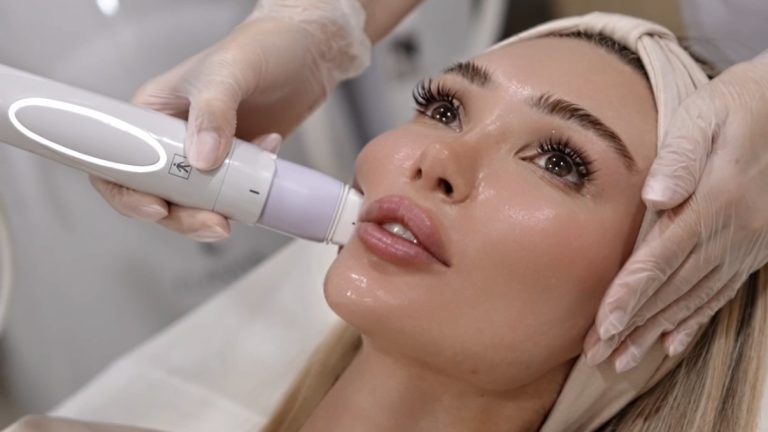
Monopolar radiofrequency works by heat. A handpiece moves across the skin, and each shot delivers energy into the dermis, the layer that holds collagen. What you feel is that heat.
In the VOLNEWMER RF lifting treatment at the clinic, no needle enters the skin. The device checks tissue impedance, starts surface water cooling and then delivers the energy through the tip. The treatment page says most patients describe a comfortable, building warmth, and that the clinician lowers the energy if any spot feels too hot. A session takes about 60 minutes for 300 to 500 pulses and about 90 minutes for 600 to 1,200 pulses.
Your pain threshold, the area treated and the energy your doctor chooses all shape what you feel. Tell the doctor what you notice as the session goes on.
What published studies report about pain
Researchers usually ask patients to rate pain on a 0 to 10 scale. The two studies below used different devices and asked at different moments, so they describe a range, not a verdict on any one machine.
| Study | Device and protocol | How pain was measured | Reported result |
|---|---|---|---|
| Wanitphakdeedecha et al., Dermatology and Therapy, 2022 (30 volunteers, lower face) | 6.78 MHz monopolar RF, one session | 0 to 10 scale during treatment; the team aimed for a level described as “hot but tolerable” (score 3) | Average 3.13 out of 10 |
| Wang et al., Clinical, Cosmetic and Investigational Dermatology, 2026 (46 patients) | Thermage FLX, each half of the face treated in a randomized order | 0 to 10 visual analogue scale within 5 minutes after each half | 7.12 (left side) and 6.62 (right side) |
The second study also found that younger patients, aged 42 or under, rated the treatment as more painful than older patients, and that the left side scored higher than the right. That study looked only at pain perception, not at treatment results.
The VOLNEWMER device has its own published data. A 2024 study by JongSeo Kim followed 45 people after one session. It did not report a pain score, but it describes the method: start at the top energy level and lower it if the patient feels too much heat. The author also moved the tip along the skin instead of holding it still when a patient reacted to the heat.

How skin looks and feels afterward
Redness is the most common sign. In the 30-patient study, 25 people (83.3%) had redness right after treatment, and it cleared within one to two days. One person (3.3%) had facial dryness at one month, and it had resolved by month three. No complications appeared at the three-month and six-month checks.
The clinic’s treatment page describes a faint flush that lasts a short while, with normal activity resuming immediately. Occasional mild swelling or tenderness is also listed. Because no needle enters the skin, there are no puncture marks and no wound care. The page advises daily sun protection and gentle skincare for the rest of the day. Your doctor sets the exact aftercare for your treatment.
Firmness often changes in two steps. Some tightening may show soon after a session, and the larger change builds over the following weeks. How many sessions you need and how long the effect lasts are separate questions, covered in our guide to RF lifting sessions and results.
Less common problems and who should not have RF
Because RF heats tissue, its risks are thermal. The treatment page lists burns and blistering, prolonged redness, pigment change and loss of fat in the treated area, which shows as hollowing instead of lifting. These are less common than flushing and warmth, but they are real.
A 2022 analysis of US reports on non-invasive body contouring devices (the FDA MAUDE database) found that radiofrequency devices accounted for the most reports, 41.9%, and that most of those reports described burns. The database holds voluntary reports from all kinds of devices and operators, so it cannot tell you how often burns happen. It does show why settings, cooling and temperature checks matter.
Some conditions rule RF out or change the plan. They include:
- pregnancy and breastfeeding;
- age under 18;
- an implanted electronic device such as a pacemaker or defibrillator anywhere in the body;
- metal implants, permanent fillers or facial implants in the treated area, unless the doctor approves;
- active infection, inflammation, open wounds or herpes in the treated area;
- active cancer or ongoing cancer treatment;
- uncontrolled chronic, endocrine or autoimmune conditions;
- severe uncontrolled diabetes or impaired wound healing;
- a tendency to form keloid scars or abnormal scarring.
The list is not complete. Medicines and earlier treatments also count, so tell your doctor about everything at the consultation.
How to keep the session comfortable
- Say at once if a spot feels hotter than “warm”. The doctor can lower the energy or move the tip.
- Declare implants, fillers, threads, a pacemaker and any skin condition before the first shot.
- Ask how the settings will be chosen for each area and how they change if you feel too much heat.
- Do not assume a stronger sensation means a better result. Neither study above measured that link.
When to seek urgent help
Contact the clinic the same day if you develop a blister or an open area of skin, a burn, pain that increases instead of easing after the first day, redness and heat that spread beyond the treated area, discharge or fever, or a dark or white patch of skin that was not there before. Eye pain or any change in vision after treatment near the eyes needs assessment the same day. The clinic’s treatment page gives +971 52 184 5011 and hours of 10:00 to 22:00. The clinic does not work around the clock. When it is closed, go to the nearest emergency department or call 998 for an ambulance. Sudden loss or blurring of vision, or a large, deep or rapidly worsening burn, needs emergency care at once, whatever the hour: go to the nearest emergency department or call 998.
Frequently asked questions
Does RF lifting hurt?
Most people describe warmth, not sharp pain, but scores vary. Published averages range from about 3 to about 7 out of 10 depending on device and settings (the lower figure came from a protocol that targeted a score of 3). The doctor can lower the energy when a spot feels too hot, so speak up during treatment.
Does RF skin tightening need numbing cream?
The VOLNEWMER treatment page describes a needle-free session with surface cooling and does not mention numbing. Whether anything extra is used for comfort is the doctor’s decision. Ask at the consultation what will be used for your area.
What is the downtime after RF lifting?
The VOLNEWMER treatment page describes minimal downtime: a faint flush for a short while, then normal activity. In a 30-patient study, redness cleared within one to two days. Use daily sun protection and follow the exact instructions your doctor gives you.
Can I go back to work after RF skin tightening?
The treatment page says normal activity resumes immediately, since no needles or wounds are involved. A little pinkness may remain for a short time. Ask your doctor about your own plans that day, especially if you have an event or a flight.
Can RF skin tightening leave marks or burns?
Needle marks do not occur because nothing pierces the skin. Burns and blistering are less common but possible, since RF works by heat. Report a blister, an open area or pain that increases after the first day to the clinic straight away.
Who should not have RF skin tightening?
People with a pacemaker or other implanted electronic device, people under 18, pregnant or breastfeeding women, those with active cancer or cancer treatment, and those with active infection, herpes or open wounds in the area should not be treated. Metal implants and permanent fillers in the area change the plan. The doctor confirms suitability in person.
Next step
If you would like a doctor to assess your skin and explain what the treatment would feel like for you, you can arrange a consultation.
What to read next

Sources
- Wanitphakdeedecha R, Yogya Y, Yan C, et al. Efficacy and safety of monopolar radiofrequency for treatment of lower facial laxity in Asians. Dermatol Ther (Heidelb). 2022. https://pubmed.ncbi.nlm.nih.gov/36166188/
- Wang Y, Bai H, Shi C, Wang M. Evaluation of the effect of laterality and age on pain perception in monopolar radiofrequency facial therapy. Clin Cosmet Investig Dermatol. 2026. https://pubmed.ncbi.nlm.nih.gov/41924292/
- Kim J. Evaluating the efficacy of continuous water-cooling 115-watt 6.78-MHz monopolar RF therapy for fine wrinkle reduction. Plast Reconstr Surg Glob Open. 2024. https://pubmed.ncbi.nlm.nih.gov/38410623/
- Nguyen CN, Nguyen QD, Hebert AA, Gold MH. Adverse events of non-invasive body contouring: analysis of the FDA Manufacturer and User Facility Device Experience database. Dermatol Surg. 2022. https://pubmed.ncbi.nlm.nih.gov/36054047/
Medical disclaimer: This page is for informational purposes only and does not replace a consultation with a licensed physician. It does not recommend or prescribe any prescription-only medicine.
License statement: MED YU MED operates under DHA License 6589480.
Individual results caveat: Results vary by diagnosis, anatomy, product used and individual response, and no outcome is guaranteed.
Related articles


Medically reviewed by

General Practitioner, Aesthetic Medicine Doctor
DHA License No. 09620692-002
VOLNEWMER Monopolar RF Lifting at MED YU MED: prices
- 1 pulse (price per pulse)17 AED
- Eyes (200 pulses)2100 AED
- Face/body 100 pulses1250 AED
Treatment page and booking · full price list
The final protocol and cost are confirmed at an in-person consultation.