


Nasolabial fold correction at MED YU MED Dubai is an injectable filler treatment for smile lines, laugh lines and deep nose-to-mouth folds. The procedure uses hyaluronic acid dermal fillers to soften the crease running from the sides of the nose to the corners of the mouth and support a fresher, more balanced lower face appearance.
Nasolabial folds can become more visible with age, loss of mid-face volume, reduced skin elasticity, repeated facial movement and changes in cheek support. In some cases, the fold itself is treated directly; in others, the doctor may also assess the mid-face, cheek support and marionette line area to understand what is making the fold look deeper.

Indications
At MED YU MED, nasolabial fold fillers are selected individually. The doctor evaluates fold depth, facial anatomy, cheek volume, skin quality, smile dynamics, asymmetry, previous filler history and the desired level of correction before choosing the product and injection technique.
The clinic offers Juvederm Ultra 3, Juvederm Volift and Juvederm Voluma for nasolabial folds correction. These hyaluronic acid fillers differ in density, flexibility and lifting capacity, so the choice depends on whether the patient needs soft smoothing, deeper fold correction or structural support.


Nasolabial fold correction at MED YU MED Dubai is an injectable filler treatment for smile lines, laugh lines and deep nose-to-mouth folds. The procedure uses hyaluronic acid dermal fillers to soften the crease running from the sides of the nose to the corners of the mouth and support a fresher, more balanced lower face appearance.
At MED YU MED, nasolabial fold fillers are selected individually. The doctor evaluates fold depth, facial anatomy, cheek volume, skin quality, smile dynamics, asymmetry, previous filler history and the desired level of correction before choosing the product and injection technique.
Nasolabial folds can become more visible with age, loss of mid-face volume, reduced skin elasticity, repeated facial movement and changes in cheek support. In some cases, the fold itself is treated directly; in others, the doctor may also assess the mid-face, cheek support and marionette line area to understand what is making the fold look deeper.
The clinic offers Juvederm Ultra 3, Juvederm Volift and Juvederm Voluma for nasolabial folds correction. These hyaluronic acid fillers differ in density, flexibility and lifting capacity, so the choice depends on whether the patient needs soft smoothing, deeper fold correction or structural support.
Four products cover this zone in the price list, and their registered indications are not
identical.
That last point decides more cases than the choice of brand. When the fold is a shadow cast
by a flattened cheek, filling the line makes the lower face heavier and the result looks worse
in three months than it did on day one. Building the cheekbone belongs on the
face contouring page,
and a consultation should tell you which of the two your face needs before any syringe is
opened.
Smile lines are often planned together with the lips: see lip fillers in Dubai.
The doctor evaluates fold depth, facial anatomy, cheek support, smile dynamics and your filler history, reviews your medical history, medications including blood thinners, allergies and any history of cold sores, explains the possible risks, and agrees the product and level of correction with you.
The skin is cleansed and a topical numbing cream is applied. Most of the fillers used also contain lidocaine, which helps reduce discomfort during the injection, though some sensation is normal.
The doctor places the hyaluronic acid filler along the fold — and, where needed, in the supporting mid-face — with a fine needle or cannula. The treatment takes about 20-30 minutes.
Swelling and tenderness usually settle within about a week, and a bruise can take up to two weeks to fade. Avoid heat, pressure and intense exercise for 48 hours, and attend the follow-up review. Contact the clinic straight away if anything concerns you before it.
An initial change is usually visible immediately, though early swelling can mask the true result — the fold is assessed properly at about two weeks, once swelling has settled. How long the correction holds depends on the product used, the depth of the fold and your metabolism: manufacturer data differs between the fillers used in this area, so the doctor confirms the expected duration for the product chosen for you, after which a top-up maintains the correction. If needed, a hyaluronic acid filler can be partially or fully dissolved with hyaluronidase — a separate medical procedure that may require more than one session, does not always remove the filler completely, and carries its own risks, including allergic reaction. Results vary between individuals, and the degree of correction differs from person to person.
Most people have some swelling, tenderness, firmness and bruising at the injection points — these are common, not unusual. Swelling and tenderness typically settle within about a week, while bruising can take up to two weeks to clear fully. Avoid strong facial massage, saunas, steam rooms, sunbeds and intense exercise for 48 hours, and keep makeup off the injection points for the rest of the day. Where possible, postpone dental procedures for about two weeks after treatment. Most people return to everyday activity the same day, within the limits above, and the doctor gives written aftercare instructions and clinic contact details.
When to contact us urgently. Serious complications after filler are rare, but they need fast action. Contact the clinic immediately if you notice pain that is severe or increasing rather than settling; skin that turns white, blue, dusky or develops a mottled, net-like pattern; blistering; or any change in vision. These need treatment within hours. Contact the clinic within days if you develop increasing redness, heat, fever, or a lump appearing days or weeks after treatment.
How to reach us. During clinic hours, call MED YU MED on +971 52 184 5011 (daily 10:00–22:00). Outside those hours, or if any symptom above is severe or getting worse, go to the nearest emergency department or call 998 for an ambulance — do not wait for the clinic to reopen. With any change in vision after a facial injection, go straight to an emergency department rather than waiting for a call back.
| Protocol | Price |
|---|---|
| Juvederm Ultra 3 - 1 ml | 2100 AED |
| Juvederm Ultra 4 - 1 ml | 2100 AED |
| Juvederm Volift - 1 ml | 2300 AED |
| Juvederm Voluma - 1 ml | 2100 AED |
Final protocol and cost are set after consultation and depend on the treatment area, the product selected and the number of sessions. See the full price list.
At MED YU MED nasolabial fold correction starts from 2100 AED per 1 ml syringe, with Juvederm Ultra, Volift and Voluma priced per product. The total depends on the depth of the fold and how much filler it needs, which the doctor confirms at consultation.
How long the result holds depends on the product used, the depth of the fold and your metabolism. Manufacturer data differs between the fillers used in this area, so the doctor confirms the expected duration for the product chosen for you. A top-up maintains the correction. Results vary between individuals.
The aim is to soften the fold, not erase every line of the face. The doctor matches the product density and amount to your anatomy and smile dynamics, and can treat the mid-face instead when lost cheek support is what deepens the fold. The filler can be adjusted or dissolved if needed.
A numbing cream is applied first and most fillers contain lidocaine, so most patients feel pressure rather than sharp pain, though sensitivity varies from person to person. The area can be tender for a few days afterwards.
A deep fold is often a symptom of lost mid-face volume: as cheek support drops, the tissue above the fold slides down and presses into it. In those cases supporting the cheek lifts the fold more naturally than filling the crease itself. The doctor assesses which approach fits your face.
In most cases, yes. Hyaluronic acid fillers can be dissolved with hyaluronidase if you want the result reduced or corrected. This is a separate medical procedure performed by a doctor: it may need more than one session, complete removal cannot be guaranteed for every product, and hyaluronidase carries its own risks, including allergic reaction. Reversibility is one of the reasons HA fillers are widely used in this area, but it does not remove the need for careful assessment and technique.
Common effects are swelling, tenderness, bruising and temporary firmness. Less common issues include lumps, asymmetry, infection and delayed nodules that can appear weeks or months later. Rare but serious complications include filler entering a blood vessel, which can cause skin damage or, very rarely, vision problems — the nose-to-mouth area is anatomically demanding, which is why it should be treated only by an experienced licensed doctor. The doctor discusses these risks with you before treatment.
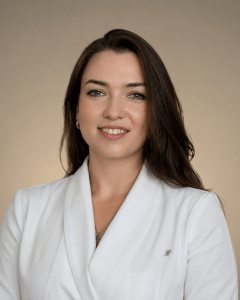
Aesthetic Medicine Doctor
DHA License No. 26439795-001
Last reviewed September 2026
The information on this page does not replace a medical consultation. Results are individual. Indications and contraindications are determined by a specialist at an in-person appointment.
The form sends a request for a call back: the clinic confirms the time and the plan by phone.
This site is protected by reCAPTCHA and the Google Privacy Policy and Terms of Service apply.


