Published 31 August 2026
A wart is a virus growing in the top layer of skin, not a lump of dead tissue you can scrub away. That single fact explains why filing it down does nothing, why the chemist’s bottle takes three months, and why the same wart comes back on the same knuckle after it looked gone.
What follows is general information about cutaneous warts in adults. It is not an assessment of your skin, because nobody can grade a lesion from an article. If a growth bleeds, changes colour, hurts or looks different from everything else on your body, that is a reason to be examined, not a reason to keep reading.
What a wart actually is
Warts are caused by human papillomavirus infecting keratinocytes in the epidermis. DermNet lists the common cutaneous types as HPV 1, 2, 3, 4, 10, 27, 29 and 57 — a different family from the mucosal types discussed in cervical screening. The virus spreads by direct skin-to-skin contact or by autoinoculation, which is the medical word for moving it around your own body by scratching, shaving or biting.
Incubation runs long. DermNet puts it at up to twelve months, so the swimming pool you blame is rarely the one responsible.
The NHS is blunt about the stakes: “Warts are not harmful”. They usually clear without treatment, and the NHS adds the part people hate — that clearance “may take months or even years”. In children the odds are good, with DermNet citing 50% gone within six months and 90% within two years. But adult warts sit longer, and they argue more.
So treatment is a decision about time, not survival.
Why treat at all, then? Because the wart is on your hand and you shake hands for a living. Because it hurts when you walk. Because it is multiplying, or because you are tired of waiting out a virus that keeps its own schedule.
The kinds of warts, and which one you probably have
Four presentations cover most of what walks into a clinic.
Common warts, verruca vulgaris, are the rough cauliflower-textured papules on knuckles, fingers and around nails. DermNet describes the surface as papillomatous and hyperkeratotic, which is why they catch on fabric.
Plantar warts grow on the sole and are pushed inward by body weight. DermNet separates tender deep myrmecia from mosaic warts, the flatter clusters that spread across the ball of the foot. These are the ones that feel like a pebble in the shoe.
Plane warts are small, flat-topped and skin-coloured, and they arrive in numbers on the face, the backs of the hands and the shins. Men who shave and women who shave their legs often carry a line of them along the razor’s path, which is autoinoculation drawn as a diagram.
Filiform warts look like a cluster of fine fronds on a narrow stalk, usually around the mouth, nose or eyelids. Their shape makes them easy to catch and easy to spread.
Nothing on this list is dangerous in itself. What matters clinically is that all four can be imitated by lesions that are not warts at all.
Wart, skin tag or mole: the distinction that decides everything
Patients tend to arrive with a category rather than a diagnosis: “a growth”. Sorting it out is the first job of the appointment, and the answer changes the entire route.
A wart is viral, rough and often clustered, and it is treated once the doctor has confirmed what it is. A skin tag is a soft fibrous outgrowth with a narrow base, not viral and not contagious. A pigmented lesion — a mole, a naevus, a seborrhoeic keratosis — is a different conversation entirely, because pigment is where melanoma hides.
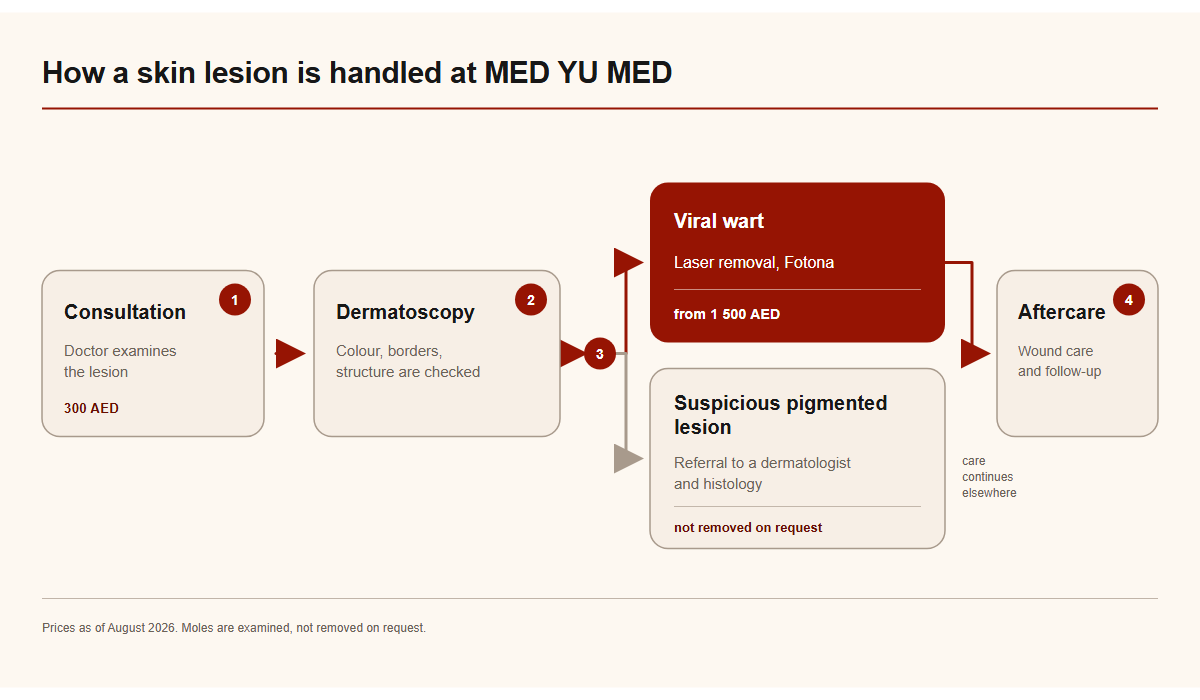
Every lesion is examined before anything is treated: under proper light, and where relevant with dermatoscopy. DermNet notes that a biopsy is required when squamous cell carcinoma cannot be excluded clinically. We have no histopathology service behind us, so anything in that category leaves with a referral rather than a procedure. Our dermatology page states the same boundary.
Why pharmacy treatments stall and home burning is a bad trade
Salicylic acid works. It is slow.
DermNet reports roughly 70% of warts resolving within twelve weeks of consistent topical treatment, and the NHS warns that over-the-counter courses “can take up to 3 months to complete, may irritate your skin and do not always work”. Most people abandon the bottle in week three, when the skin around the wart is sore and the wart is still there.
Stopping early is what turns a treatable wart into a two-year wart.
Cryotherapy with liquid nitrogen sits in the same range: DermNet puts success at about 70% after three to four months of sessions repeated every one to two weeks, and the American Academy of Dermatology describes in-office freezing repeated every two to four weeks. Neither number is a promise for an individual wart.
Then there is the internet method — cauterising pens, undiluted acids, cutting. The AAD is explicit that self-treatment does not belong on the face or the genital area, and that aftercare exists specifically to prevent scars, including keloids, dark spots and light patches. A wart is a cosmetic nuisance. A keloid on a knuckle is permanent.
How warts are treated at MED YU MED
We treat viral warts with the laser. The device is a Fotona SP Dynamis, a platform carrying a 1064 nm Nd:YAG and a 2940 nm Er:YAG in one body. The Er:YAG is absorbed at the surface and works precisely at the top layers; the Nd:YAG reaches deeper into the dermis. The doctor selects the wavelength and the settings for the lesion in front of them.
Laser sits in the second line of wart treatment in the literature rather than the first. The AAD lists it among the options for stubborn warts, alongside injectable and topical prescription treatments and immunotherapy, all of which are a dermatologist’s decision; DermNet lists pulsed dye laser and photodynamic therapy in the same tier. That is an honest description of where it belongs: it is what you reach for when the wart has already outlasted patience, when it sits somewhere awkward, or when the patient wants it dealt with in a controlled setting rather than over a season. What the laser does not do is make you immune. HPV persists in surrounding skin, and every method on the list carries a recurrence rate. No method for warts carries a published permanent-clearance rate after a single session.
What we treat, and what we send elsewhere
We treat cutaneous viral warts, at the doctor’s discretion after examination. Which sites are suitable is decided at the appointment, not in advance.
We do not remove moles or pigmented lesions on request. We do not perform biopsies and we do not run histology, so a lesion that needs tissue examined goes to hospital dermatology or a dermato-oncologist. Genital warts sit outside this page entirely: both the AAD and the NHS advise seeing a doctor for that area rather than treating it cosmetically. Paediatric skin needs a paediatric dermatologist, and our protocols are written for adults.
The soft fibrous growths people call skin tags are a separate question. The clinic’s published price list carries laser removal of warts, not of skin tags, and we would rather say so than quietly treat one as the other. If that is what you have, ask at the consultation and the doctor will tell you what is possible and what it costs before anything is booked.
What it costs
Prices are published rather than quoted on the phone.
- Dermatological consultation, examination and plan — 300 AED
- Warts — 1 500 AED
- Onychomycosis — 1 000 AED
- Vascular lesions — 2 000 AED
The full list sits on the price page. What the price covers in your case — how many lesions, which sites, how many visits — is confirmed at the consultation. A doctor who has not seen the skin cannot price it accurately, and nobody should quote you a total over the phone.
What makes laser unsuitable
Laser is not automatic once a wart is confirmed. Active infection at the site, photosensitising medication, recent tanning, pregnancy and a history of keloid scarring all change the calculation, and they are what the doctor asks about before anything is switched on. Bring the list of what you take, including supplements.
Say if you have scarred badly in the past. That history matters more than the wart itself.
How the appointment runs
Thirty to forty-five minutes, at Bluewaters Island, any day between 10:00 and 22:00. The doctor takes a history — how long the growth has been there, whether it changed, what you have already tried, whether anyone at home has the same thing. Then the examination, with dermatoscopy where it is relevant. You leave with one of two outcomes. Either a diagnosis of viral wart and a treatment plan with the number of sessions and the total cost, or a referral, if what you have belongs to another specialty. Both outcomes are the appointment working correctly.
Three of our doctors have dermatology in their qualifications: Dr. Alina Lebedeva, Dr. Fariza Dzgoeva and Dr. Ilias Ildarovich Dautov.
Healing, and what to expect afterwards
The treated area crusts over, and the crust separates on its own. How long that takes depends on the site and the depth, and the doctor tells you what to expect for yours. Soles take longest, because you walk on them. Keep the site clean and dry, leave the crust alone, and use sun protection on the healing skin. The AAD ties aftercare directly to the risk of scarring and of dark or light patches in the treated skin, and that risk rises on darker phototypes, which describes a large share of patients in the UAE. Do not soak the area in a pool or the sea until the surface has closed.
Book a review if the site stays painful beyond the first few days, if it discharges, or if the wart re-forms at the edge of the treated zone. Recurrence is not a complication in the sense of something having gone wrong; it is the virus in the surrounding skin, and it is treated as its own event.
Warts and life in Dubai
The virus needs damp skin and a shared surface. The NHS notes that risk rises when “your skin is wet or damaged”, which is a fair description of daily life here: pool decks, gym floors, shared yoga mats, hotel spas, the school swimming lesson, the sand that grazes the sole before you walk barefoot into a changing room.
Practical measures are dull and they work. Wear slides in communal wet areas. Do not share towels, razors or nail files.
Cover a plantar wart before swimming, and change out of wet swimwear rather than sitting in it.
And do not shave over a wart. That is how one wart on a shin becomes eight.
None of this is a reason to avoid pools. It is a reason to treat the wart you already have rather than letting it seed the rest of your household.
When it is not a job for an aesthetic clinic
Go to a dermatologist or a hospital department, not to us, if any of these apply. The list combines the AAD’s referral criteria with the NHS red flags.
- The growth is pigmented, or a mole has changed shape, colour or size
- It bleeds, itches, burns or hurts without being knocked
- It is in the genital area
- It keeps returning after treatment, or it is spreading quickly
- You are immunosuppressed, or you have diabetes with foot involvement
- You are unsure what it is at all — that is a diagnosis question, and it is the cheapest one to ask early
Related reading



Frequently Asked Questions
Are warts contagious?
Yes. DermNet describes spread by direct skin-to-skin contact and by autoinoculation, meaning you can move the virus around your own body by scratching or shaving. Incubation can run up to twelve months, so the exposure that caused a wart is rarely the one you remember.
Will one laser session be enough?
Sometimes, and no honest clinic will promise it. Every published method for warts has a recurrence rate, and the AAD describes cryosurgery as repeated every two to four weeks and laser therapy as often needing several sessions. The doctor gives you a session count for your lesion at the consultation, after examining it.
Does laser wart removal hurt?
The treated point is anaesthetised where the site and depth call for it. Soles are the most sensitive area, and the first days afterwards can feel tender when you walk. Tell the doctor about pain during the session rather than after it, because settings can be adjusted.
Will it leave a scar?
Any method that destroys tissue can. The AAD links aftercare directly to preventing scars, keloids, dark spots and light patches, and that risk is higher on darker skin. Keeping the crust intact, keeping the site out of the sun and following the aftercare you are given is most of the difference.
Why did my wart come back?
Because HPV persists in the skin around the treated point, not because the treatment failed. Recurrence is common with every method. It is reassessed and treated as a new event, and a wart that keeps returning is a reason to see a dermatologist rather than to repeat the same approach indefinitely.
Can you remove a mole at the same appointment?
No. We do not remove pigmented lesions on request and we do not perform biopsies.
A mole that needs assessment or removal belongs with a dermato-oncologist or a hospital department where the tissue can be examined histologically. You would leave with a referral, which is the correct outcome.
What is the difference between a wart and a skin tag?
A wart is a viral infection of the epidermis, rough-surfaced and contagious. A skin tag is a soft fibrous outgrowth on a narrow stalk, neither viral nor contagious.
But they need different handling, and the price list currently carries laser removal for warts. Ask at the consultation what applies to what you have.
Can I treat a wart at home first?
On hands and feet it can be, and DermNet reports roughly 70% clearing within twelve weeks of consistent use. Not if you have diabetes, poor circulation or reduced sensation in the area, or a weakened immune system: the AAD lists all of these as reasons to see a dermatologist instead of treating at home. Not on the face and not in the genital area either. Stop and book an appointment if the skin becomes raw, or if the lesion changes rather than shrinks.
Medical disclaimer: this article is general information and does not replace an in-person examination, diagnosis or treatment plan. Skin lesions cannot be assessed remotely.
License statement: MEDYUMED MEDICAL CLINIC LLC, DHA Licence No. 6589480, Bluewaters Island 6, Dubai.
Individual results caveat: outcomes, session counts and recurrence differ between patients and are confirmed by a doctor at the consultation.
Sources
- DermNet, Viral wart — HPV types, transmission, wart types, treatment response rates, biopsy indications. Updated November 2025.
- American Academy of Dermatology, Warts: diagnosis and treatment — referral criteria, in-office methods, aftercare and scarring risk.
- NHS, Warts and verrucas — transmission, natural course, when to see a doctor.
Medically reviewed by
Fotona Laser at MED YU MED: prices
- Face lift 2D2100 AED
- Face lift 3D2750 AED
- Face lift 4D3500 AED
Treatment page and booking · full price list
The final protocol and cost are confirmed at an in-person consultation.