


Published 2 August 2026 · Updated 19 August 2026
The short answer
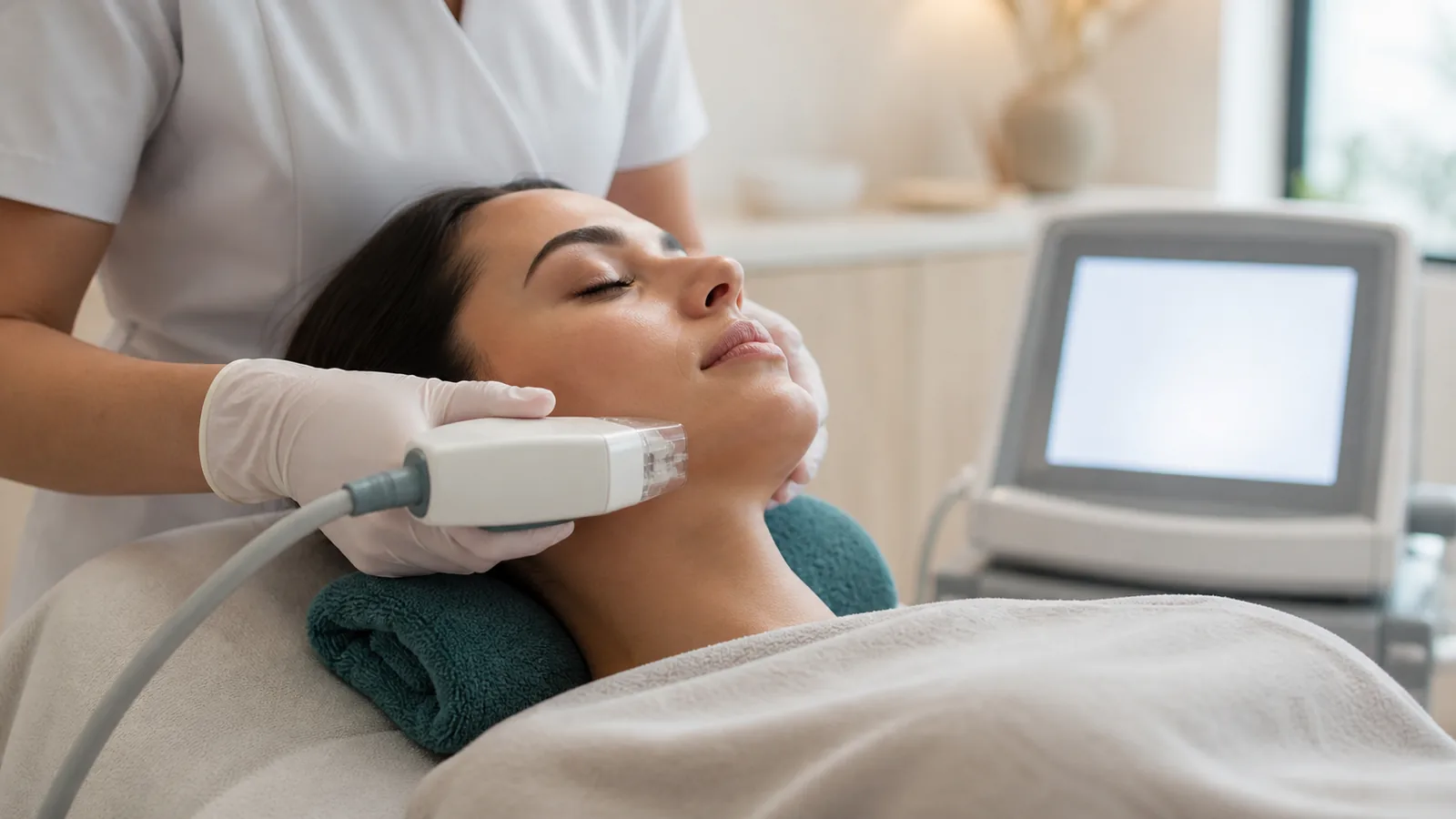
Radiofrequency microneedling delivers heat into the dermis through fine insulated pins while
leaving most of the epidermis intact. That single design choice explains both its main advantage,
a low rate of pigment problems on darker skin, and its main limitation, which is that adding
radiofrequency does not automatically beat plain microneedling at everything.
The evidence is uneven by indication, so it is worth going through them separately rather than
accepting one verdict for the whole method.
How much evidence there is
A critical review applied quality filters and kept 42 studies (doi
10.1097/DSS.0000000000002972). The distribution says a lot about where the method has been tested
seriously: 14 studies for skin rejuvenation, 7 for acne scars, 6 for acne vulgaris, 5 each for
stretch marks and axillary hyperhidrosis, 2 for melasma, and one each for rosacea, cellulite and
androgenetic alopecia.
The review’s conclusion is worth quoting in substance: the intervention can be used repeatedly
and safely, including in people with darker skin phototypes, and the dermal remodelling it
produces is slow and progressive, continuing to improve over months rather than appearing at
once.
Acne scars: where the picture gets complicated
A meta-analysis of 12 studies covering 414 participants compared microneedling with and
without radiofrequency for atrophic acne scars (doi 10.1007/s00266-022-02845-3). Plain
microneedling produced a statistically significant improvement in objective scar scores. The
fractional radiofrequency microneedling group did not reach significance at the same threshold.
Subjective satisfaction showed no significant difference between them.
That is an uncomfortable result for a more expensive technology, and it deserves stating
rather than burying. The authors also recorded something in its favour: no form of microneedling
caused post-inflammatory hyperpigmentation, which they call an advantage in scar treatment.
A 2026 split-face comparison put radiofrequency microneedling against fractional carbon
dioxide laser on atrophic scars (doi 10.1080/09546634.2026.2687842). Both improved scars
substantially, with mean ECCA scores falling from 54.73 to 30.53 and from 53.67 to 31.03, and no
significant difference between treatments. The radiofrequency arm had shorter erythema, pain,
swelling and scab detachment, and fewer pigmentary events.
Read together: for scarring, radiofrequency microneedling is competitive on result and better
on recovery, but it has not demonstrated superiority over simpler needling.
Where combinations add something
The microchannels the device creates can be used to deliver substances that would not
otherwise cross the skin barrier. In a split-face study of 30 patients, poly-L-lactic acid passed
through channels made by microneedling radiofrequency but not through those made by a carbon
dioxide laser, and the combination improved wrinkle percentile scores against age-matched
controls while dermal thickness increased and the fat layer did not change significantly
(doi 10.1097/PRS.0000000000011232).
Combination with an ablative laser has also been tested for inflammatory acne, where the pair
outperformed the laser alone on lesion counts and scar grading, with biopsy evidence of reduced
sebum secretion at molecular level (doi 10.3349/ymj.2023.0234).
Why phototype matters less here
Ablative and many light-based treatments target pigment or remove the surface, which is why
post-inflammatory hyperpigmentation is the dominant risk on skin types IV to VI. Radiofrequency
does not chase melanin: it heats tissue at a depth set by the pins, sparing most of the
epidermis.
That is the mechanism behind the review’s finding that the method can be used safely in darker
phototypes, and behind the lower pigmentary event rate in the comparison against carbon dioxide
laser. It does not make the treatment risk-free on any skin, and conservative settings with a
test area remain the sensible route.
Risks, and when it is not done
Depth raises the stakes. Pins reaching the subdermal layer carry heat further than surface
microneedling, and recovery reflects that: redness, warmth, a visible grid, mild swelling and
pinpoint marks or scabbing for one to three days, occasionally longer. Less common but real:
burns, blistering, marks tracing the pin grid, infection, a cold sore flare, prolonged swelling,
scarring and pigment change.
The US FDA issued a safety communication on 15 October 2025 about certain uses of
radiofrequency microneedling, reporting burns, scarring, fat loss, disfigurement and nerve damage,
some requiring surgical repair, and advising patients to be treated only by a licensed provider
trained on the specific device.
An implanted electronic device anywhere in the body, including a pacemaker or defibrillator,
rules the treatment out, not only in the treatment area. Fillers, threads or implants in the area
change the plan, so declare them beforehand. Treatment is also not performed during pregnancy and
breastfeeding, over active infection or open wounds, on recent isotretinoin without clearance,
with a keloid tendency, or with uncontrolled conditions that impair healing. This list is not
exhaustive, and final suitability is determined by a clinician at an in-person assessment.
Devices, areas and pricing are on the treatment pages for
Morpheus8,
VIVACE and
Genius. For a side-by-side
comparison of the three platforms, the scar-revision evidence and current pricing, see
Microneedling in Dubai. The comparison
against focused ultrasound is covered in
RF microneedling vs HIFU.
When to call the clinic
Call MED YU MED on +971 52 184 5011, daily 10:00-22:00, if redness spreads rather than
settles, if the skin blisters or breaks, if pain increases after the first day, or if a fever
follows a session. Outside our opening hours go to the nearest emergency department or call 998
for an ambulance rather than waiting for the clinic to reopen. The clinic does not operate 24
hours.
Questions people ask
Is radiofrequency microneedling better than plain microneedling?
Not for acne scars, on current evidence. A meta-analysis of 12 studies and 414 participants found plain microneedling reached statistical significance for objective scar improvement while fractional radiofrequency microneedling did not, with no significant difference in patient satisfaction.
Is it safe on darker skin?
It is generally the safer category, because radiofrequency heats tissue at depth rather than targeting pigment and spares most of the epidermis. A critical review of 42 studies concluded it can be used repeatedly and safely in darker phototypes. Conservative settings and a test area still apply.
How soon do results appear?
Slowly. The dermal remodelling described in the literature is progressive and continues to improve over months rather than appearing after a session. Courses are the norm, and judging the result before three months underestimates it.
Can it be combined with other treatments?
Yes, and some combinations have trial support: poly-L-lactic acid delivered through the microchannels improved wrinkle scores and dermal thickness, and pairing with an ablative laser outperformed the laser alone for inflammatory acne. Combining procedures changes the risk profile and is a decision for the treating doctor.
References
- Tan MG, Jo CE, et al. Radiofrequency Microneedling: A Comprehensive and Critical Review. Dermatol Surg. 2021;47(6):755-761. doi 10.1097/DSS.0000000000002972
- Microneedling Monotherapy for Acne Scar: Systematic Review and Meta-Analysis. Aesthetic Plast Surg. 2022;46(4):1913-1922. doi 10.1007/s00266-022-02845-3
- Comparative efficacy, recovery, and pigmentary safety of radiofrequency microneedling versus fractional CO2 laser for atrophic acne scars. J Dermatolog Treat. 2026;37(1):2687842. doi 10.1080/09546634.2026.2687842
- Microneedling Radiofrequency Enhances Poly-L-Lactic Acid Penetration. Plast Reconstr Surg. 2024;154(6):1189-1197. doi 10.1097/PRS.0000000000011232
- Combination of Fractional Microneedling Radiofrequency and Ablative Fractional Laser versus Ablative Fractional Laser Alone. Yonsei Med J. 2023;64(12):721-729. doi 10.3349/ymj.2023.0234
- US Food and Drug Administration. Potential Risks with Certain Uses of Radiofrequency Microneedling. Safety communication, 15 October 2025.
Commercial disclosure: MED YU MED provides this treatment as a paid service. Where the
evidence is limited, this page says so rather than filling the gap with confidence.
Medical disclaimer: This page is for informational purposes only and does not replace a
medical consultation.
License statement: MED YU MED operates under DHA License 6589480.
Individual results caveat: Results vary by diagnosis, skin type, and individual response.
Related articles

Medically reviewed by

General Practitioner, Aesthetic Medicine Doctor, Dermatologist
DHA License No. 09620692-002

