Published 2 June 2026 · Updated 19 August 2026
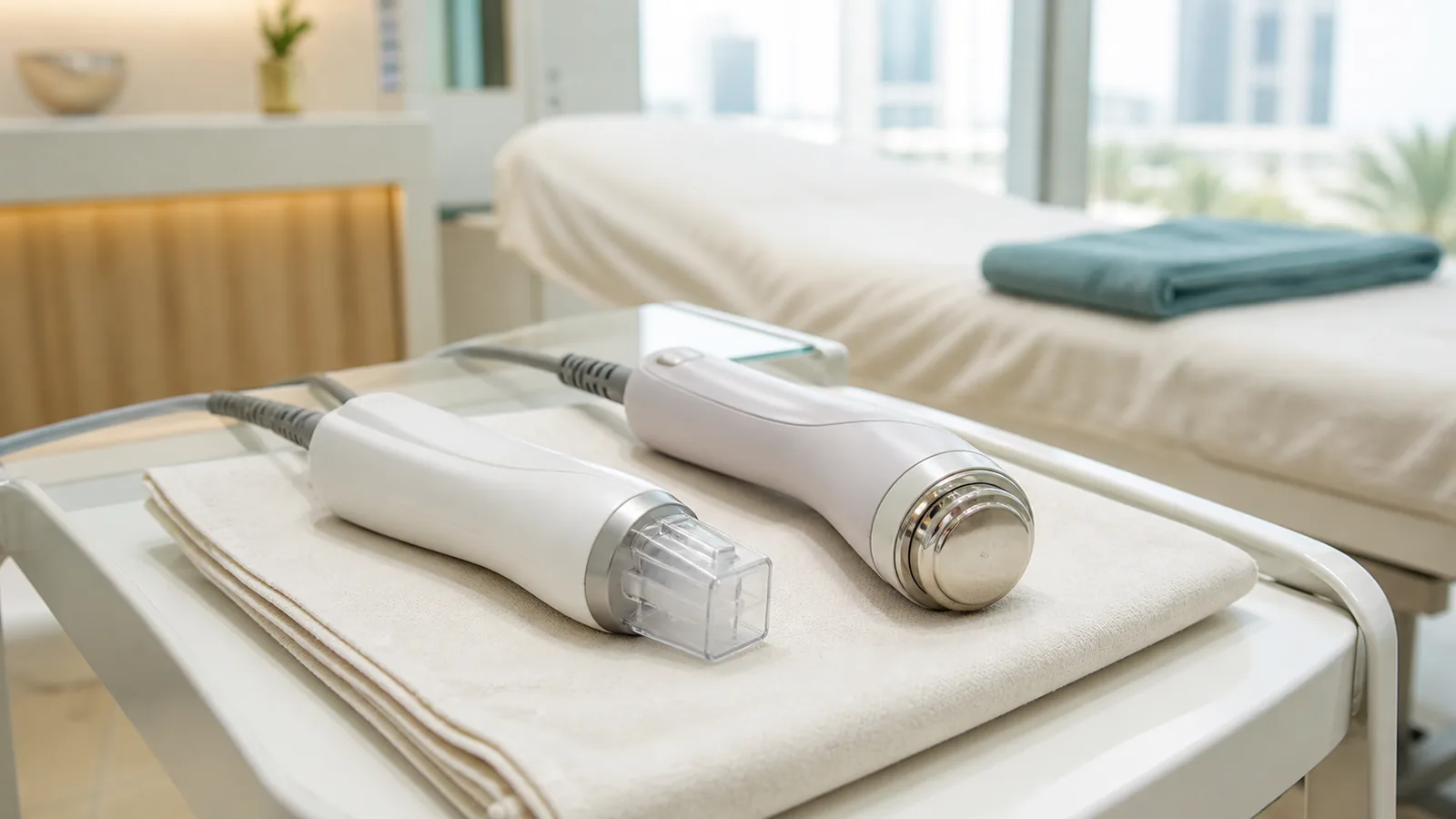
Two technologies dominate non-surgical skin tightening, and they are usually presented as rivals. Radiofrequency microneedling delivers heat through tiny needles placed into the dermis. High-intensity focused ultrasound delivers it through the skin surface to a fixed depth, without breaking the skin at all. Different routes, similar goal.
The interesting part is what happens when someone compares them head to head.
Disclosure: MED YU MED sells both treatments described on this page. The evidence below is what the published literature reports, including where it undercuts the case for either device, and every source is listed at the end.
How each one works
Radiofrequency microneedling drives insulated needles into the dermis and releases radiofrequency energy from their tips, creating controlled thermal zones at a depth the operator sets. Because the energy is delivered below the surface rather than through it, the epidermis is largely bypassed — which is why this method is used on darker skin phototypes where surface heating carries more pigment risk.
High-intensity focused ultrasound focuses acoustic energy to a precise depth, generating small coagulation points in the deeper tissue, including the fibromuscular layer. Nothing punctures the skin. The trade-off is that the energy passes through the surface layers to reach its target.
What a head-to-head comparison can and cannot tell you
No published trial compares Morpheus8 Pro with Ultraformer MPT directly. That is worth stating plainly, because the comparison usually quoted in this context tested something else.
A randomised, evaluator-blinded trial in Dermatologic Surgery compared subsurface monopolar radiofrequency — a probe placed under the skin, not the needle-based device used here — against microfocused ultrasound for neck laxity in 20 patients, followed to 180 days. Both arms improved significantly by day 90 and held to day 180, patient-rated firmness and texture improved on both sides, and the trial found no statistically significant difference between them in investigator or patient assessments, satisfaction or adverse events. Microfocused ultrasound was associated with more procedural pain.
Two limits matter. With 20 patients split between two arms, failing to find a difference is not the same as showing the two are equivalent — the trial simply could not separate them. And the radiofrequency modality tested was not RF microneedling. So the fair reading is that both categories of energy device shift neck laxity, that neither has been shown superior, and that no evidence exists comparing the two specific platforms this clinic runs.
The choice is therefore made on skin phototype, the depth being targeted, what else needs treating, and how you tolerate needles versus discomfort — at examination, not from a chart.
What each does well
A critical review of radiofrequency microneedling in Dermatologic Surgery included 42 higher-quality studies: 14 on skin rejuvenation, 7 on acne scars, 6 on acne vulgaris, 5 each on striae and axillary hyperhidrosis, 2 on melasma and one each on rosacea, cellulite and androgenetic alopecia. Across those 42 studies the reviewers reported no significant safety signal and concluded the method can be repeated and combined with other modalities under medical supervision, including in people with darker skin phototypes, and that the dermal remodelling it triggers is slow and progressive — still improving six months after treatment.
That breadth is the point. Radiofrequency microneedling is not only a tightening device; the same needles that deliver heat also treat acne scarring and stretch marks, which is why it often suits a face that needs texture work as well as firmness.
For focused ultrasound, a 2025 systematic review in Aesthetic Surgery Journal covering 45 clinical trials and cohort studies published between 2010 and 2024 reported skin laxity improvements ranging from 18% to 30%, most notably in the lower face, neck and periorbital regions, and circumference reductions of 2.5 to 4.5 cm in body contouring of the abdomen and thighs. Fewer than 5% of patients reported transient erythema, swelling or mild discomfort. These figures come from focused-ultrasound studies across multiple platforms rather than from trials of Ultraformer MPT specifically, and the reviewers flagged the standing problem in this field: treatment protocols are still not standardised between devices. Treat the range as what the technology has reported, not as a projection for your treatment.
Both technologies, in other words, have decent evidence and an unresolved protocol question. Neither replaces a facelift. Where the goal is surgical-level lifting, the appropriate route is a surgical consultation.
Timelines and what to expect
Collagen remodelling is slow with both. The radiofrequency review describes improvement continuing to build six months after treatment, and courses are usually planned as three sessions rather than one. Results are not permanent — skin continues to age, and maintenance is part of the plan.
Depth matters more than intensity. A study of a microneedle fractional radiofrequency system found that treating nasolabial folds with a deep dermal approach produced significantly better results than a superficial approach at both three and twelve months, while the effect on fine lines under the eyes differed only slightly. Where the energy is placed shapes the outcome as much as how much of it is used.
What MED YU MED performs, and what it costs
The clinic runs Morpheus8 Pro for radiofrequency microneedling and Ultraformer MPT for focused ultrasound. It does not operate Ultherapy — that is a different manufacturer’s ultrasound platform, and comparisons written about Ultherapy do not automatically transfer to another device.
Morpheus8 Pro is priced per session: face 2900 AED, neck 2900 AED, face with eyes 3500 AED, face with neck 3500 AED, décolleté 3400 AED, Ultraformer MPT is priced by the number of ultrasound lines delivered: 200 lines for the periorbital zone 2000 AED, 300 lines from the double chin 2500 AED, 400 lines 3000 AED, 500 lines for the lower third 4000 AED. Three-session courses are priced as a package, and the current package price and its conditions are listed on the service pages. All figures are per session and current as of August 2026; the doctor confirms the protocol and the total at consultation.
Both are medical procedures with contraindications and possible side effects, listed below. A quoted price is not an indication that either is appropriate for you — which device suits your skin, and whether an energy-based device is the right answer at all, is decided after examination. Details sit on the Morpheus8 page and the Ultraformer MPT page.
Risks, and who should not have these treatments
Common and temporary with both: redness, swelling, warmth and tenderness for a day or two. Radiofrequency microneedling leaves visible pinpoint marks in a grid pattern that settle over several days, and bruising is possible. Focused ultrasound is more uncomfortable during the session — the trial above found it produced more procedural pain — and can leave tenderness that lasts longer.
Less common: prolonged redness or swelling, small areas of crusting, local infection of the treated skin that may require antibiotics, post-inflammatory hyperpigmentation (more likely in darker phototypes and slower to fade), temporary numbness or altered sensation, and reactivation of cold sores in people who get them.
Treatment around the eyes carries a specific risk. Focused ultrasound is not delivered over the eyeball or the orbital rim. Energy applied to the eyelid area has been linked in a published case report to traumatic cataract, iridocyclitis and conjunctival haemorrhage, in a patient who developed blurred vision after HIFU on the eyelids. If periorbital work is planned, ask what eye protection is used and where the boundary of treatment lies, and report any visual symptom immediately rather than waiting.
Loss of fat volume in the treated area is a risk with both technologies rather than one: focused ultrasound creates coagulation points in deeper tissue, and radiofrequency microneedling delivers heat at a set dermal depth — the same platform is used at deeper settings to remodel fat deliberately. Depth selection is what separates tightening from unwanted volume loss, which is why the operator sets it individually. Nerve injury is likewise a recognised risk with any device placing heat near branches of the facial nerve, including radiofrequency microneedling, and reported effects range from temporary numbness to weakness of facial movement.
Rare but serious: burns and scarring. For focused ultrasound specifically, a 2025 systematic review in Dermatologic Surgery is worth reading carefully. Across 19 published articles covering 506 patients, significant adverse events were limited — transient swelling, redness and post-procedure pain dominated, with a single reported case of subcutaneous atrophy. But the authors also pulled 106 records from the FDA’s device-complaint database, and there the most frequently reported problems were lipoatrophy (loss of fat in the treated area), neurological effects including nerve damage, focal numbness, altered sensation and drooping, and scarring. One qualification matters, and by our own logic we have to state it: that database search was run on the brand name Ulthera, a different manufacturer’s platform from the one used here. Complaint data from one ultrasound device does not transfer directly to another any more than efficacy data does. The authors note that the published literature contains no evidence that this treatment compromises a later facelift, and that the reports behind such concerns are anecdotal and largely unverified; they do not extend that assessment to the lipoatrophy and neurological reports themselves, which they simply record as the most frequent categories in the complaint database. That database collects voluntary, unverified reports and has no denominator, so it cannot tell you how often any of this happens — only which problems get reported. These are the ones that get reported, which is why they are listed here rather than left out.
Any of these need assessment rather than waiting.
For Morpheus8, MED YU MED does not treat during pregnancy and breastfeeding; with active skin infection, inflammation or open wounds in the treatment area; after recent isotretinoin, until the course is completed and cleared by a doctor; with an active acne flare or herpes in the treatment area; with a history of keloid or abnormal scarring; or with uncontrolled chronic or autoimmune conditions that impair skin healing. Radiofrequency energy can interfere with implanted electronic devices, so a pacemaker, implanted defibrillator or similar device anywhere in the body — not only in the treatment area — rules out radiofrequency treatment; metal implants or permanent fillers within the treatment area are assessed individually before any decision.
For Ultraformer MPT, the clinic does not treat during pregnancy and breastfeeding; with active skin infection, open wounds or inflammation in the treatment area; with implanted electronic devices such as a pacemaker or metal implants in the treatment area, after doctor assessment; with severe or cystic acne in the treatment area; with a history of keloid or abnormal scarring; where skin is very loose and may need a surgical opinion rather than ultrasound; or with uncontrolled chronic or autoimmune conditions that impair healing.
The two lists differ because the devices work differently — radiofrequency microneedling breaks the skin surface, focused ultrasound does not. Neither list is exhaustive: bleeding disorders, anticoagulant therapy and active cancer in the treatment area are also assessed before any decision. Tell the doctor about permanent or semi-permanent fillers, threads and implants in the area regardless of when they were placed, since heat can affect them and their presence changes the depth the operator can use. Final suitability is determined by a clinician at an in-person assessment.
Do not stack procedures
Neither treatment should be combined with peels, lasers, injectables or the other device in the same period unless the doctor plans the sequence and the intervals. Tell the doctor about every treatment you have had in the previous month and every one already booked.
When to seek help
Call 998 — the UAE ambulance number, free, 24 hours, working in every emirate — or go to the nearest emergency department immediately if you develop difficulty breathing, swelling of the face, lips or tongue, a spreading rash, fainting, any sudden change in vision or pain in or around the eye, or a fever above 38.5 °C with spreading redness and severe pain in the treated area. Call 998 also if one side of your face suddenly droops or becomes weak, an arm becomes weak, or your speech becomes slurred — these are stroke signs and are treated as an emergency regardless of any procedure you have had. Within the hours after treatment, ringing in the ears, a metallic taste, numbness around the mouth, dizziness, confusion or muscle twitching can indicate a reaction to the topical anaesthetic and need the same urgency. Do not wait for the clinic to open. While you wait for help, do not apply creams, ointments, ice directly on the skin or home remedies to the affected area.
Seek assessment the same day — at the clinic during opening hours, at a DHA-licensed urgent care in Dubai if it is closed, or, if you are in another emirate, at a DoH- or MoHAP-licensed facility — if the treated skin turns white, grey or leathery, if blisters form, if pain increases rather than settling, or if you develop pus or spreading redness. If whitened or leathery skin covers a large area, or the pain is severe, do not wait for a same-day appointment — go to the nearest emergency department.
Contact the clinic during opening hours (10:00–22:00, +971 52 184 5011) if numbness or altered sensation appears or persists, if redness lasts beyond the period you were told to expect, if the skin darkens as it heals, or if a treated area looks hollow or thinner than before. Outside opening hours, contact any DHA-licensed urgent care in Dubai, or in other emirates a DoH- or MoHAP-licensed facility. The clinic is not a 24-hour service.
Related reading
For injectable approaches to volume and contour rather than tightening, see face contouring. For RF microneedling on a different platform aimed at scarring, see Genius RF and Vivace. These are also paid services at this clinic, and none should be combined with the treatments above without the doctor planning the interval.
Frequently Asked Questions
Which is better, RF microneedling or focused ultrasound?
No published trial compares these two specific devices, so nobody can answer that from evidence. The study usually quoted compared a different radiofrequency modality — a probe placed under the skin — against focused ultrasound in 20 patients, and found no significant difference between them; with that sample size, failing to find a difference does not establish equivalence. The choice depends on skin phototype, target depth, what else the plan needs to treat and how you tolerate needles versus discomfort.
Is RF microneedling safe for darker skin?
A critical review of 42 higher-quality studies concluded that radiofrequency microneedling can be used repeatedly and safely in individuals with darker skin phototypes, because the energy is delivered below the epidermis rather than through it. That does not remove the risk of post-inflammatory hyperpigmentation, which remains more likely in darker phototypes and slower to fade, so settings and aftercare still matter.
How long until I see a result?
Slowly, and that is expected. The dermal remodelling behind these treatments is progressive: the radiofrequency review describes improvement still building six months after treatment. Courses are usually planned as three sessions. Results are not permanent, skin continues to age, and maintenance is part of the plan.
Can either replace a facelift?
No. Published improvements in skin laxity with focused ultrasound run from about 18% to 30%, which is meaningful but is not surgical lifting. Where skin is very loose, the honest answer is a surgical opinion — that is why very loose skin appears in the contraindications for ultrasound at this clinic rather than as an indication.
Does the clinic use Ultherapy?
No. MED YU MED runs Ultraformer MPT for focused ultrasound. Ultherapy is a different manufacturer’s platform, and results published for one ultrasound device do not automatically transfer to another — protocols, depths and delivery differ, and the systematic reviews in this field consistently flag the lack of standardisation between devices.
Which hurts more?
In the head-to-head trial, microfocused ultrasound was associated with more procedural pain than radiofrequency. RF microneedling involves needles and topical anaesthetic, and afterwards leaves visible pinpoint marks for several days, while ultrasound leaves no surface marks but is more uncomfortable during the session. Tell the doctor if discomfort is what would stop you completing a course.
Commercial interest disclosure: MED YU MED provides both treatments discussed on this page as paid services, and states plainly which devices it does not operate.
Medical disclaimer: This page is for informational purposes only and does not replace a medical consultation.
License statement: MED YU MED operates under DHA License 6589480.
Individual results caveat: Results vary by diagnosis, skin type, and individual response.
References
- A Randomized Evaluator-Blinded Trial Comparing Subsurface Monopolar Radiofrequency With Microfocused Ultrasound for Lifting and Tightening of the Neck. Dermatol Surg. 2017;43(12):1441-1447. doi:10.1097/DSS.0000000000001216 (PMID 28902019)
- Tan MG, Jo CE, Chapas A, Khetarpal S, Dover JS. Radiofrequency Microneedling: A Comprehensive and Critical Review. Dermatol Surg. 2021;47(6):755-761. doi:10.1097/DSS.0000000000002972
- Haykal D, Sattler S, Verner I, Madhumita M, Cartier H. A Systematic Review of High-Intensity Focused Ultrasound in Skin Tightening and Body Contouring. Aesthet Surg J. 2025;45(7):690-698. doi:10.1093/asj/sjaf053
- Lu W, Wu P, Zhang Z, Chen J, Chen X, Ewelina B. Curative effects of microneedle fractional radiofrequency system on skin laxity in Asian patients: a prospective, double-blind, randomized, controlled face-split study. J Cosmet Laser Ther. 2017;19(2):83-88. doi:10.1080/14764172.2016.1256485
- Humphrey VS, Rambhia PH, Gmyrek R, Chapas A. Microfocused Ultrasound With Visualization: A Systematic Review of Adverse Events and Risk of Subsequent Facelift Compromise. Dermatol Surg. 2025;51(4):424-429. doi:10.1097/DSS.0000000000004510
- Eye injuries caused by high intensity macro and micro focused ultrasound treatment: a case report. BMC Ophthalmol. 2024. doi:10.1186/s12886-024-03645-w
Related articles
Medically reviewed by

General Practitioner, Aesthetic Medicine Doctor
DHA License No. 09620692-002