Published 2 June 2026 · Updated 9 September 2026
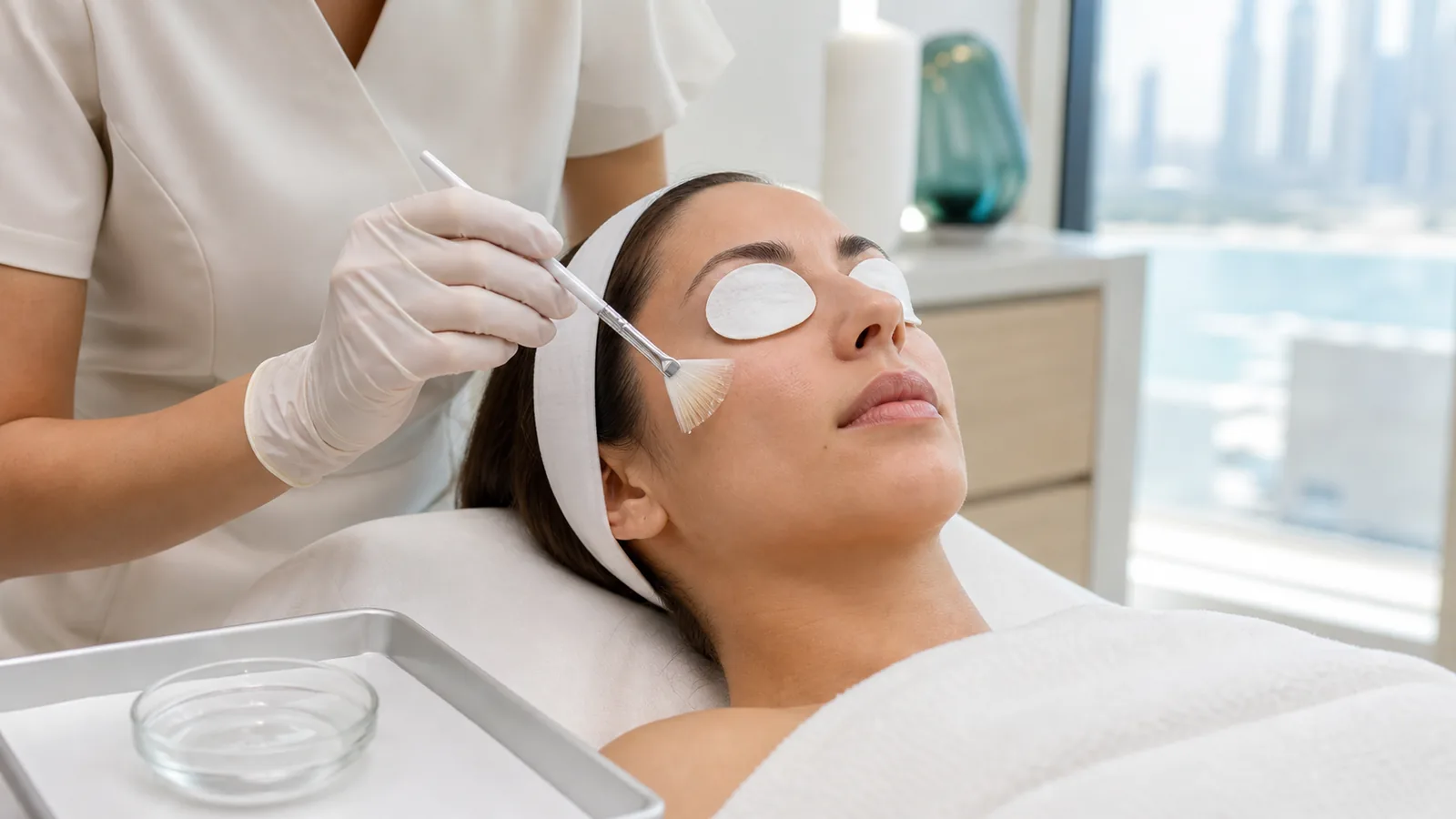
Chemical peels get sold by brand name, but the variable that decides the result, the downtime and the risk is depth — how far into the skin the solution goes. A peel that reaches the epidermis and one that reaches the reticular dermis are different procedures with different consequences, and only one of them can be done over a lunch break.
For skin types common in the Gulf there is a second point that matters more than brand: deeper is not better. It is often worse.
The three depths, and what actually separates them
The standard classification, set out in a review in the Journal of the European Academy of Dermatology and Venereology, divides peels into three groups by how far the agent penetrates.
Superficial peels use alpha-hydroxy acids and, more recently, lipohydroxy acid to exfoliate the epidermis. These are the peels with little or no visible shedding and no real downtime.
Medium-depth peels use trichloroacetic acid below 50%, reaching from the epidermis to the papillary dermis. Visible peeling, a defined recovery period and stricter preparation come with this level.
Deep peels use trichloroacetic acid above 50% or phenol-based formulations and reach the reticular dermis. The results last: for phenol peels specifically, a 1991 review describes the changes holding 15 to 20 years and being permanent in some patients. So does everything else about them.
As the authors of that review put it, the success of any peel depends on the physician understanding the chemistry, the indications and the side effects. The agent on the label is a smaller part of the answer than most price lists suggest.
Why MED YU MED does not offer deep phenol peels
Phenol is absorbed systemically. Because of that, patient selection for a phenol peel involves evaluating liver, renal and cardiac function, and — because of the risk of cardiac arrhythmias — the procedure is performed in a medically supervised environment with continuous cardiac monitoring. That description comes from a 1991 review in Annals of Plastic Surgery, and it still describes a level of monitoring an aesthetic treatment room is not equipped to provide.
There is a second reason, and in Dubai it is the more relevant one. A 2018 review in Clinical, Cosmetic and Investigational Dermatology states it directly: patients with Fitzpatrick types IV to VI are at higher risk of post-inflammatory hyperpigmentation, and when treating these populations deep chemical peels should be avoided, with preoperative preparation emphasised instead. The same review notes that the literature supports superficial to medium-depth peels as adjuvant therapy for acne.
Deep phenol peels remain a legitimate and effective procedure in the hands of practitioners licensed and equipped for them, and they are performed in the region. MED YU MED does not offer them. That is a scope-of-practice decision based on the population this clinic treats, not a judgement on providers who do.
What the data show for the depths that are used
The largest safety picture for acid peels comes from a case series of medium- and deep-depth trichloroacetic acid peels published in JAMA Facial Plastic Surgery in 2017: 923 peels across a cohort of 803 women and 120 men, mean age 41.6, with follow-up from six months to thirteen years. The clinic works at the superficial and medium end of that range. Complications were uncommon: persistent hyperpigmentation in 54 patients (5.9%), mild telangiectasia in 3 (0.3%), acute herpesvirus infection in 2 (0.2%), staphylococcal infection in 2 (0.2%) and hypopigmentation in 1 (0.1%). The authors concluded that properly applied trichloroacetic acid peels are efficient and safe for light and dark skin. Worth noting the evidence level: this is a retrospective case series, not a randomised trial.
Persistent hyperpigmentation at 5.9% is the number to hold onto. It is low, and it is not zero — and it is the complication that a peel is often bought to fix.
Peels for pigmentation: modest, and not a cure
A small 2023 comparison published in Cureus reported a larger average fall in the Melasma Area and Severity Index with a 15% trichloroacetic acid peel (8.5 points) than with a 15% phenol peel (6.0) or a 2% glycolic acid peel (5.2), with fewer side effects in the trichloroacetic acid group. Read it cautiously: the authors call their own findings preliminary, the report gives no sample size or significance testing, and the 15% phenol used here is a light application rather than the deep phenol peel discussed above. This is not evidence that one agent is right for you — that is a clinical decision made after examining your skin.
Melasma is managed rather than cured whatever you use on it. It returns with sun and hormonal triggers, which in this climate means photoprotection is not an add-on to the treatment — it is part of it.
What MED YU MED uses, and what it costs
Disclosure: MED YU MED sells the peels described below and does not sell deep phenol peels. The comparisons above are made by an interested party — the sources are listed at the end so you can check them yourself.
The clinic works with superficial and medium-depth protocols, selected by the doctor after assessing the skin, the concern and the area.
PRX-T33, BioRePeel and APPEX are used for texture, dullness and post-acne marks, at 550 AED each; APPEX with the take-home cream is 750 AED. ME Line protocols are used for pigmentation — dark spots, uneven tone, local discolouration — with the face protocol at 1100 AED, or 2750 AED including home care; the intimate-area protocol is 2200 AED, or 3300 AED with home care. PRX-T33 extended to the décolleté is 880 AED.
Deep phenol peels are not performed here, for the reasons set out above.
A chemical peel is a medical procedure with contraindications and possible side effects, listed below. A quoted price is not an indication that a peel is appropriate for you — the doctor decides which depth and which agent suit your skin, and whether a peel is the right approach at all. Details and the current price list sit on the peels page.
Preparation is where results are won or lost
For darker skin the 2018 review is explicit that preoperative preparation carries much of the safety burden. In practice that means arriving without a fresh tan, stopping retinoids and acids on the schedule the doctor gives you, and committing to daily SPF afterwards rather than treating it as optional. A peel performed on sun-exposed skin in a high-UV city is the classic route to the pigmentation it was meant to treat.
If you have ever had cold sores, say so before the appointment even if nothing is visible: peels can reactivate herpes simplex, and the doctor may start antiviral prophylaxis before the procedure rather than treating a flare afterwards. Also declare pregnancy or breastfeeding, any recent isotretinoin course, any waxing, threading, laser or IPL in the area in the preceding weeks, and any medication that increases sun sensitivity.
Take-home products supplied with a protocol — the APPEX cream, the ME Line home-care kits — are dispensed medical skincare rather than ordinary cosmetics. Use them only as instructed, and tell the doctor if you are pregnant or breastfeeding before they are dispensed.
Do not attempt a peel on yourself
The concentrations named in this article are professional figures applied by a clinician who watches the skin, controls contact time and neutralises the acid at the right moment. Acids bought online carry no reliable strength labelling, and a peel left on too long is how a routine treatment becomes a chemical burn, a scar or a permanent pigment change. “Home care” in a clinic protocol means maintenance products dispensed by a doctor for use between sessions — it does not mean peeling yourself at home.
Risks, and who should not have a peel
A peel works by causing a controlled chemical injury: the plastic surgery literature describes it as a controlled, partial-thickness chemical burn of the epidermis and outer dermis. Controlled is the operative word. During a medium-depth peel the clinician may see a white “frost” appear on the skin — an expected endpoint showing the acid has done its work, and one that settles before you leave. Whitening, greyness or a leathery texture appearing later, at home, is not frosting: it can mean the injury went deeper than intended, and it needs same-day assessment. Superficial protocols such as PRX-T33 and BioRePeel are not designed to frost at all. Ask what your specific protocol should look like, so you know what is expected and what is not.
Expect redness, tightness, dryness and — depending on depth — visible flaking for several days. Superficial protocols are designed to work without heavy shedding; medium-depth work involves a defined recovery period.
Less common effects include persistent hyperpigmentation, hypopigmentation, prolonged redness, milia (small white cysts), visible demarcation lines between treated and untreated skin, infection including reactivation of herpes simplex, and, rarely, scarring. Pigment changes can take months rather than weeks to settle. Picking or peeling the flakes off by hand is the most reliable way to turn an ordinary recovery into a scar or a pigment problem.
MED YU MED does not perform a peel in the following cases:
- Active skin infection, herpes or open wounds in the treatment area
- Recent isotretinoin use, until completed and cleared by a doctor
- Pregnancy and breastfeeding (for stronger peels), after doctor assessment
- Recent sun exposure or active tan
- Very sensitive or compromised skin barrier
- History of keloid or abnormal scarring
This list is not exhaustive. Other conditions — active eczema, psoriasis or rosacea in the treatment area, immunosuppression, recent radiotherapy or facial surgery, or a known allergy to a peel ingredient — may also rule out a peel or change which agent is chosen. Final suitability is determined by a clinician at an in-person assessment.
Do not stack procedures
A peel should not be combined with lasers, IPL, microneedling, waxing or another peel in the same period unless the doctor plans the sequence and the intervals. A randomised trial in Dermatologic Surgery divided 30 patients with facial melasma into three groups — a glycolic acid peel alone, or the same peel followed by a trichloroacetic acid spot peel at two strengths. All three groups improved significantly, there was no significant difference between them, and the group treated with the single agent had the fewest side effects. Combining peels in one sitting added no benefit and added risk. Tell the doctor about every treatment you have had in the previous month and every one you have already booked.
When to seek help
Call 998 (Dubai Ambulance, free and available 24 hours, and reachable across the UAE) or go to the nearest emergency department immediately if you develop difficulty breathing, swelling of the face, lips or tongue, a spreading rash, fainting, or a fever above 38.5 °C, or spreading redness with severe pain in the treated area. Do not wait for the clinic to open.
If any peel solution or take-home product gets into the eye, rinse with running water for at least 15 minutes and seek urgent ophthalmology assessment. Do not wait to see whether it settles. While you wait for help, do not apply creams, ointments, ice directly on the skin or home remedies to the affected area.
Seek assessment the same day — at the clinic during opening hours, or at a DHA-licensed urgent care if it is closed — if the treated skin turns white, grey or leathery after you have left the clinic, if blisters form, if pain increases rather than settling, or if you develop pus, spreading redness or the clustered blisters of a herpes flare.
Contact the clinic during opening hours (10:00–22:00, +971 52 184 5011) if redness lasts beyond the period you were told to expect, if the skin darkens as it heals, or if flaking is heavier than described. These need review rather than emergency care. Outside opening hours, contact any DHA-licensed urgent care in Dubai — or, in other emirates, a DoH- or MoHAP-licensed facility. The clinic is not a 24-hour service.
Related reading
For device-based approaches to pigmentation, see PicoSure Pro and BBL phototherapy. For hydration-focused cleansing without downtime, see HydraFacial, and for injectable skin-quality protocols, see biorevitalization. These are also paid services at this clinic, and none of them should be combined with a peel without the doctor planning the interval.
Frequently Asked Questions
Is a deeper peel always more effective?
No, and for darker skin it is often the wrong direction. A 2018 review states that patients with Fitzpatrick types IV to VI are at higher risk of post-inflammatory hyperpigmentation and that deep peels should be avoided in these populations, with preparation emphasised instead. Depth is matched to the concern and the skin type, not escalated for its own sake.
Why does this clinic not offer phenol peels?
Phenol is absorbed systemically. Patient selection requires evaluation of liver, renal and cardiac function, and because of the risk of cardiac arrhythmias the procedure is performed under continuous cardiac monitoring in a medically supervised setting. That is a surgical environment rather than a treatment room. For the skin types most common here, the evidence also points away from deep peels.
How safe are TCA peels?
A case series of 923 medium- and deep-depth trichloroacetic acid peels with follow-up from six months to thirteen years reported persistent hyperpigmentation in 5.9% of patients, telangiectasia in 0.3%, herpes reactivation in 0.2%, bacterial infection in 0.2% and hypopigmentation in 0.1%. The authors concluded that properly applied TCA peels are safe for light and dark skin. This is a retrospective series rather than a randomised trial, so read it as reassuring rather than definitive.
Can a peel clear melasma?
It can improve it, not cure it. A 2023 comparison found the largest average improvement with a 15% TCA peel (8.5 points on the melasma severity index) against phenol and glycolic acid, with the authors calling their findings preliminary. Melasma returns with sun and hormonal triggers, so daily photoprotection is part of the treatment rather than an optional extra.
How should I prepare?
Arrive without a fresh tan, stop retinoids and acids on the schedule the doctor gives you, and declare any recent isotretinoin course, history of cold sores, pregnancy or breastfeeding. Preparation carries much of the safety burden on darker skin, and a peel performed on sun-exposed skin in this climate risks causing the pigmentation it was meant to treat.
What should I not do afterwards?
Do not pick or pull the flaking skin — that is the most reliable route from an ordinary recovery to a scar or a pigment problem. Avoid sun, and use SPF daily. Follow the written aftercare for the specific protocol you had, since a superficial peel and a medium-depth peel have different restrictions. If pain increases rather than settling, or blisters form, seek assessment the same day.
Commercial interest disclosure: MED YU MED provides chemical peels as a paid service. This page discusses treatments the clinic sells, and states plainly which peel depths it does not perform and why.
Medical disclaimer: This page is for informational purposes only and does not replace a medical consultation.
License statement: MED YU MED operates under DHA License 6589480.
Individual results caveat: Results vary by diagnosis, skin type, and individual response.
References
- Fischer TC et al. Chemical peels in aesthetic dermatology: an update. J Eur Acad Dermatol Venereol. 2010. doi:10.1111/j.1468-3083.2009.03409.x
- Peters W. The chemical peel. Ann Plast Surg. 1991. doi:10.1097/00000637-199106000-00013
- Castillo DE, Keri JE. Chemical peels in the treatment of acne: patient selection and perspectives. Clin Cosmet Investig Dermatol. 2018. doi:10.2147/CCID.S137788
- Fanous N, Zari S. Universal Trichloroacetic Acid Peel Technique for Light and Dark Skin. JAMA Facial Plast Surg. 2017. doi:10.1001/jamafacial.2016.1666
- Prasad N, Singh M, Malhotra S et al. Comparative Efficacy of Chemical Peeling Agents in the Treatment of Melasma. Cureus. 2023. doi:10.7759/cureus.47312
- Garg S et al. Glycolic acid peel alone versus in combination with trichloroacetic acid spot peel for facial melasma: a randomised comparison. Dermatol Surg. 2019. doi:10.1097/DSS.0000000000001964
- Landau M. Chemical peels. Clin Dermatol. 2008. doi:10.1016/j.clindermatol.2007.09.012
Related articles
Medically reviewed by