Published 2 June 2026 · Updated 9 September 2026
Platelet-rich plasma is widely offered for hair loss in Dubai, and it is one of the least standardised procedures in the category. The same treatment name covers preparations that differ in how the blood is spun, whether the platelets are chemically activated, how many sessions are given and how far apart. Those differences change the result, which is why published trials disagree with each other so sharply.
This page sets out what the research supports, where it falls short, and how PRP sits alongside treatments that have regulatory approval behind them. If you are deciding whether to spend money on a course, the honest answer is more useful than an enthusiastic one.
What PRP is and how it is prepared
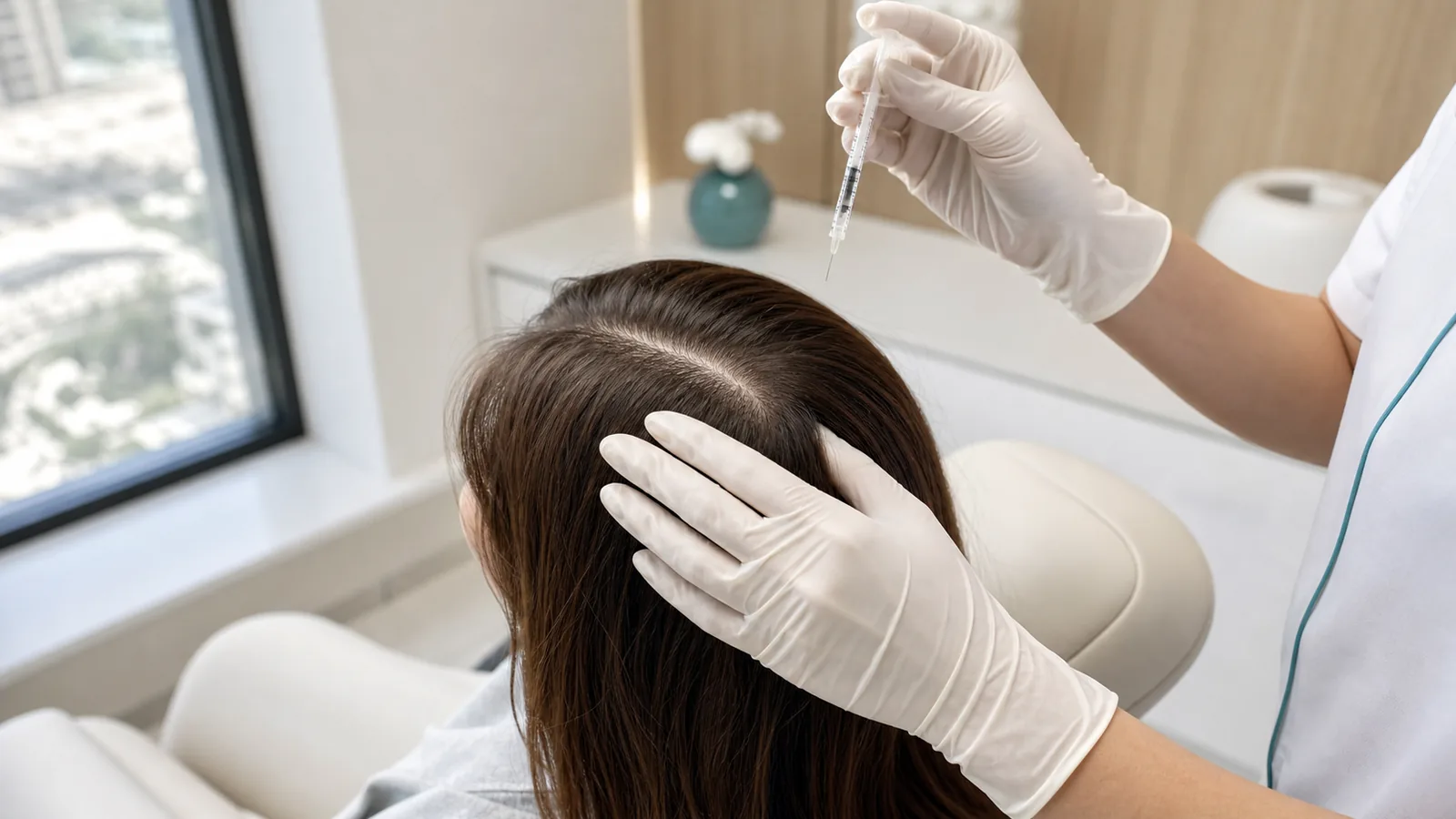
PRP is made from your own blood. A small sample is drawn into a tube containing an anticoagulant, spun in a centrifuge to separate the platelet-rich fraction, and injected into the scalp. Platelets carry growth factors, and the working theory is that concentrating them around the follicle supports blood supply and prolongs the growth phase of the hair cycle.
PRP for hair loss is an off-label use. No regulator has approved PRP as a treatment for androgenetic alopecia, unlike minoxidil and finasteride. That does not make it unreasonable, but it does mean the evidence has to carry the argument on its own.
The theory is plausible. The execution varies enormously. A network meta-analysis of 25 trials by Gupta and Bamimore, published in the Journal of Drugs in Dermatology in 2022, identified ten distinct PRP regimens across the literature and found that efficacy correlated with the number of sessions, the interval between them, whether the PRP was chemically activated, and whether the sample went through one centrifugation or two. A separate meta-analysis from Sechenov University in the International Journal of Trichology (Olisova and colleagues, 2023) reached the same conclusion on one of those variables: double-spin preparation outperformed single-spin.
This matters commercially. When a clinic quotes a price for “PRP”, that price tells you nothing about which of the ten regimens you are buying.
What the evidence actually shows
Several syntheses frame the picture, and they do not fully agree.
Zhang and colleagues pooled nine randomised controlled trials covering 238 patients in the Journal of Cutaneous Medicine and Surgery in 2023. PRP increased hair density at three and six months compared with placebo, and the difference reached statistical significance. Hair count and hair diameter also improved compared with each patient’s own baseline — but against placebo those two measures showed no significant difference.
A 2024 meta-analysis by Li and colleagues in Aesthetic Plastic Surgery pooled ten randomised trials covering 555 treatment units and found the same split: hair density was significantly higher with PRP (mean difference 25.09 hairs/cm², 95% CI 9.03–41.15, p = 0.002), while hair diameter showed no significant difference. One of their subgroup findings deserves attention from anyone reading trial results in this field: the effect was significantly larger in trials with fewer than 30 participants (p = 0.0004). Small studies reporting big effects is a pattern that usually softens as larger trials arrive.
The larger safety-focused synthesis is more cautious still. Cruciani and colleagues, writing in Blood Transfusion, reviewed 27 controlled trials with 1,117 participants, of which 18 trials and 713 participants concerned androgenetic alopecia. Compared with saline injections, PRP increased hair density over medium-term follow-up by a mean of 25.6 hairs per square centimetre, with a confidence interval running from 2.62 to 48.57. That interval is the point: the lower end of the plausible range is a change most people would never notice. The authors graded the evidence as low quality because of inconsistency between studies and risk of bias, and concluded that the benefit of PRP for alopecia rests on limited evidence.
The single trial that should give any clinic pause came from Shapiro and colleagues at NYU Grossman School of Medicine, published in the Journal of the American Academy of Dermatology in 2020. Thirty-five participants had two squares tattooed on the scalp, one randomly assigned to PRP and one to saline, with three monthly sessions and assessment three months after the last. Hair density in the PRP area rose from 151 to about 171 hairs per square centimetre. Impressive — until you read the placebo side, which rose from 151 to about 167. Both changes were statistically significant against baseline. The difference between them was not. The authors noted two possible explanations: PRP may have diffused across the scalp, and the micro-injury of the injections themselves may have stimulated both sides.
A trial in women points the other way. Dubin and colleagues at Mount Sinai, also publishing in the Journal of the American Academy of Dermatology in 2020, randomised 30 women to PRP or saline at weeks 0, 4 and 8. At week 24, blinded photographic assessment rated 57% of the PRP group improved against 7% on saline (P < .01), with mean density changing by +105.9 hairs/cm² against −52.4 in the placebo group. Reported adverse effects included headache, scalp tightness, swelling, redness and bleeding after injection.
How PRP sits alongside established treatment
An open-label randomised trial from JIPMER in Pondicherry, published in the Journal of Dermatological Treatment in 2023, put PRP directly against the standard. Sixty-four men with Grade III and IV androgenetic alopecia received either 5% topical minoxidil for six months or three monthly PRP sessions. At week 24, 56% responded in the minoxidil arm and 38% in the PRP arm. The difference did not reach statistical significance (p = 0.124), but the trial was not designed or powered to demonstrate equivalence, so it cannot show that PRP matches minoxidil — only that this study did not detect a difference. Two other findings deserve attention: adverse events occurred in 53% of the PRP group against 37% on minoxidil, and patient satisfaction favoured minoxidil.
The strongest support for PRP is as an addition rather than a replacement. A 2024 meta-analysis by Xiao and colleagues in Aesthetic Plastic Surgery pooled six randomised trials with 343 participants and found PRP combined with topical minoxidil improved hair growth more than either alone, with a weighted mean difference of 9.14 hairs/cm² (95% CI 6.57–11.70) for density and 4.72 (95% CI 3.21–6.23) for diameter, alongside higher patient satisfaction.
That is the practical conclusion from the literature. PRP has its best evidence as an adjunct to approved treatment, not as a substitute for it, and a hair plan that skips the approved part in favour of injections is skipping the part with the strongest evidence. Minoxidil is not risk-free either: scalp itching and dryness are common, and it is not used in pregnancy or breastfeeding. It should be started after assessment by a doctor, not on the basis of an article.
Who tends to respond
Response is not evenly distributed, and the literature disagrees about one important variable. The meta-regression by Gupta and Bamimore found better outcomes in younger patients and in women. The 2024 meta-analysis by Li and colleagues found the opposite on sex: hair density gains were significantly larger in male-only trials than in mixed-sex samples, and the authors concluded PRP elicits stronger effects in male patients. The evidence on who responds best is not settled.
One factor that gets misread deserves a note. Whole-head studies reported larger effects than split-scalp ones, but this most likely reflects study design rather than treatment: in split-scalp trials PRP appears to diffuse into the control half and mask the difference — the same limitation the NYU authors flagged in their own work.
What recurs across the literature is more useful than any subgroup. Follicles that are miniaturising still respond; follicles that are already gone do not. PRP cannot regrow hair from scarred or empty follicles. In practice that means early-to-moderate pattern hair loss is where the treatment has something to work with, and late-stage smooth scalp is where it does not. A doctor assesses this with trichoscopy and standardised photography rather than by eye, and the same tools track whether a course is achieving anything.
What a session involves
Blood is drawn as for a routine test, spun in the centrifuge, and the plasma fraction is injected across the thinning zones with a fine needle. A session takes roughly 30 to 45 minutes including preparation. This is an invasive procedure: bruising, swelling, tenderness and small bumps at the injection points are common, and infection at an injection site is the complication that matters most. Contraindications apply, and they are listed below.
Most protocols run a loading phase of monthly sessions followed by maintenance, and the doctor sets the number.
Scalp injections hurt more than facial ones for many people. A 2025 comparison in the Journal of Cosmetic and Laser Therapy randomised 20 patients to intradermal injection on one side of the midline and microneedle delivery on the other, three sessions a month apart, assessed six months after the last. Hair density, hair diameter and trichoscopic findings showed no significant difference between the two methods. Pain did: the microneedle side scored significantly lower. If discomfort is what would stop you completing a course, raise it at consultation.
Risks and who should postpone
Redness, swelling, small bumps at the injection points and tenderness are common and usually settle within days. Bruising happens. The trial in women recorded headache, scalp tightness and bleeding after injection among adverse effects. Some people feel faint during the blood draw — tell the staff if you do, it happens occasionally and is easily managed.
No serious adverse events attributable to PRP were reported in the Cruciani review of 1,117 participants or in the Zhang review. These were short trials of low methodological quality, so they cannot rule out rare or delayed harms. The comparison against minoxidil is a reminder that side effects of some kind are frequent rather than rare: 53% of the PRP group reported them.
Because the plasma is your own, there is no risk of a reaction to donor material. Reactions to the anticoagulant in the collection tube, to the topical anaesthetic or to the antiseptic remain possible, and infection at an injection site is the complication that needs the fastest response.
MED YU MED does not perform plasma therapy in the following cases:
- Pregnancy and breastfeeding
- Active infection, inflammation, open wounds or herpes in the treatment area
- Acute viral or bacterial illness
- Exacerbation of chronic diseases
- Active cancer or ongoing cancer treatment
- Uncontrolled chronic, endocrine or autoimmune conditions
- Blood clotting disorders, thrombocytopenia or severe anaemia
- Use of anticoagulants or blood-thinning medication, unless approved by the doctor
- Haemophilia or other bleeding disorders
- Severe uncontrolled diabetes or impaired wound healing
- Keloid tendency or abnormal scarring risk
- Severe active dermatitis, psoriasis or neurodermatitis in the treatment area
- Active scalp infection or inflammatory scalp disease
- Suspicious skin lesions requiring dermatologist assessment first
- Age under 18
Tell the doctor about any blood-thinning or anti-inflammatory medication and supplements before the session — some may need pausing, but only on the doctor’s instruction. Final suitability is determined by a specialist at an in-person appointment.
When hair loss needs a diagnosis before any treatment
This is the part most treatment pages leave out. Not all hair loss is androgenetic, and the evidence above applies to pattern loss only.
Diffuse shedding a few months after illness, surgery, childbirth or crash dieting is usually acute telogen effluvium, which typically resolves within six to nine months once the trigger is gone; shedding that continues beyond six months needs investigation rather than waiting. Patchy round bald spots suggest alopecia areata, an autoimmune condition treated differently. Iron deficiency and thyroid disease both cause hair loss — blood tests identify them, and treating the underlying problem is what restores the hair, not injections.
Scarring alopecias destroy the follicle permanently, and PRP cannot do anything for them. More importantly, they are active inflammatory conditions that keep destroying follicles until they are treated: months spent on injections instead of anti-inflammatory treatment cost hair that does not come back. Scalp itching, burning or tenderness, loss of the visible follicular openings, or a receding hairline with pale smooth skin all warrant assessment by a dermatologist rather than a course of injections.
Paying for a PRP course before anyone has established which of these you have is the most expensive mistake in this category. A consultation with examination and, where indicated, blood tests comes first.
What MED YU MED performs
The clinic offers standard plasmotherapy and RegenLab PRP protocols — Plasmotherapy one tube and two tubes, and RegenLab Blue, Gold and Red — for skin and for scalp. Prices start from 800 AED, and the final cost depends on the protocol, the number of tubes and the number of sessions. The doctor confirms which preparation suits your case and why.
Plasma therapy is an invasive procedure with contraindications and possible side effects, listed above. Final suitability is determined by a DHA-licensed specialist at an in-person appointment; a quoted price is not an indication that the treatment is appropriate for you. Full details and the current price list sit on the plasma therapy page.
When to seek help
Call 998 (Dubai Ambulance) or go to the nearest emergency department immediately if you develop difficulty breathing, swelling of the face, lips or tongue, a spreading rash, fainting, a fever above 38.5 °C with spreading redness or severe pain in the scalp, or rapidly worsening swelling. Do not wait for the clinic to open.
Contact the clinic during opening hours (10:00–22:00, +971 52 184 5011) if you develop increasing redness, warmth, swelling or pain more than 48 hours after a session, discharge or pus at an injection point, a fever without the features above, or numbness lasting more than 24 hours. These are uncommon but need assessment rather than waiting.
Outside opening hours, contact any DHA-licensed urgent care or emergency department. The clinic is not a 24-hour service.
Related reading
For injectable protocols aimed at skin and scalp quality more broadly, see mesotherapy and exosome therapy. For how mesotherapy differs as a delivery route, see does mesotherapy work.
Frequently Asked Questions
Does PRP actually regrow hair?
Pooled trials show increased hair density, but the effect size is modest and the evidence quality is rated low. One split-scalp trial found the placebo side improved almost as much as the treated side, with no significant difference between them, while a trial in women found 57% improved on PRP against 7% on saline. PRP is best understood as an adjunct that may support existing follicles, not as a treatment that regrows lost hair.
How many PRP sessions will I need for hair?
Most protocols run a loading phase of monthly sessions followed by maintenance. Pooled analysis suggests efficacy rises with more sessions and shorter intervals between them, but no standard schedule has been established across the literature. The doctor sets your course after assessment and tracks it with trichoscopy and photography.
Is PRP better than minoxidil?
A randomised trial in men with moderate pattern hair loss found 56% responded to minoxidil and 38% to PRP at 24 weeks. The difference was not statistically significant, but the trial was not powered to prove the two are equivalent. Adverse events were more frequent with PRP and satisfaction favoured minoxidil. The best evidence for PRP is as an addition to minoxidil rather than a replacement: a meta-analysis of six trials found the combination outperformed either alone.
Why do PRP results vary so much between clinics?
Because PRP is not one protocol. Published regimens differ in the number of centrifugations, whether platelets are chemically activated, session count and intervals, and delivery method. A network meta-analysis of 25 trials found all of these correlated with outcome. Ask which preparation a clinic uses rather than assuming the procedures are equivalent.
Does the treatment hurt, and what are the side effects?
Scalp injections are uncomfortable for many people even with topical anaesthetic, and tolerance differs. A randomised comparison found microneedle delivery produced significantly less pain than intradermal injection with no difference in six-month results. Common effects are redness, swelling, tenderness, small bumps and bruising; headache and scalp tightness have also been reported. Infection at an injection site is uncommon but needs prompt assessment.
Should I have tests before starting PRP?
Yes. Hair loss has several causes, and the evidence for PRP applies to pattern hair loss only. Telogen effluvium, alopecia areata, iron deficiency, thyroid disease and scarring alopecias are all treated differently, and some resolve without any procedure. Scarring alopecias in particular keep destroying follicles until treated, so time spent on injections instead costs hair permanently. A consultation with examination and, where indicated, blood tests establishes the diagnosis before you commit to a course.
Commercial interest disclosure: MED YU MED provides plasma therapy as a paid service. This page discusses a treatment the clinic sells. Where the evidence favours treatments the clinic does not sell, we say so.
Medical disclaimer: This page is for informational purposes only and does not replace a medical consultation.
License statement: MED YU MED operates under DHA License 6589480.
Individual results caveat: Results vary by diagnosis, scalp condition, and individual response.
This guide is also available in Arabic: النسخة العربية
Related articles

Medically reviewed by