Published 2 June 2026 · Updated 9 September 2026
Mesotherapy describes a delivery route: a series of micro-injections placing active substances into the superficial dermis instead of relying on a cream to get them there. The same name therefore covers protocols that share almost nothing else, and the quality of any of them rests on two things — what is being injected, and how sterile the process is. The second one is where the serious problems in this field come from.
Disclosure: MED YU MED sells the treatments described on this page. The risks below are the ones documented in the published literature, and they apply to this clinic’s protocols as much as to anyone else’s. Every source is listed at the end so you can check it.
What the technique actually involves
A review of hyaluronic-acid mesotherapy for facial rejuvenation catalogued how varied practice is: eleven different non-cross-linked hyaluronic acid materials and five cross-linked ones across the published studies, with courses running one to six sessions at weekly to bimonthly intervals for the non-cross-linked products. In most of those studies the injections were given by serial micropuncture with needles between 23 and 32 gauge; other techniques used were nappage, depot and micro-linear.
Read that list again and the honest conclusion follows: “mesotherapy” describes a route of administration shared by protocols that differ in almost every other respect. Comparing a clinic’s mesotherapy to a published result means checking that both used a similar preparation on a similar schedule, which is rarely the case.
What the evidence supports, and how firmly
For skin quality, the reviews are cautiously positive. The same body of work concludes that hyaluronic-acid mesotherapy is a favourable method for skin rejuvenation and revitalisation, while stressing that proper selection and precise placement of the material at the intended level of the dermis are what optimise improvement and minimise side effects — specifically skin irregularities and the Tyndall effect, the bluish tint that appears when hyaluronic acid sits too superficially. The same authors note that in older patients with significant photodamage, mesotherapy alone is usually not enough and adjuvant procedures are needed, and that results require maintenance.
For hair, the picture is more mixed and the evidence weaker. A systematic review of injectable therapy for androgenetic alopecia included 7 interventional, 11 observational and 12 descriptive reports — a body of literature that is largely uncontrolled. The most frequently studied agents were multivitamin and peptide formulations, followed by dutasteride, minoxidil, bicalutamide, growth factors and finasteride, with techniques varying in needle type, depth and dosing schedule. Reported outcomes ranged from increased hair density and shaft diameter to stabilisation of shedding. The reviewers described adverse events as generally mild, but the list includes paradoxical alopecia, scarring and acute dermatitis.
The reviewers’ own bottom line belongs in any decision about paying for a course. They conclude that injectable therapy may provide cosmetic benefit in androgenetic alopecia, particularly with dutasteride, but that the current evidence is limited by small sample sizes, variable protocols and short follow-up, and that standardised randomised trials are required before injectable therapy can be recommended as routine therapy.
Paradoxical alopecia deserves the emphasis: hair loss caused by the treatment given for hair loss is a documented outcome, not a theoretical one.
The risk that matters most: what is in the syringe, and how clean the process is
The most serious complications reported after mesotherapy are infections with non-tuberculous mycobacteria. A systematic review screened 1,966 records and included 30 articles covering 423 patients. Most reports came from South America, patients were mostly women aged 16 to 55, and infections arose in the abdomen, buttocks or thighs. Nearly all developed multiple well-localised lesions without systemic symptoms, so there was typically no fever to signal that something was wrong. Most infections resolved with antibiotics, but many patients needed multiple courses or multiple agents, and resolution often took weeks. Disfiguring scarring following mesotherapy-associated mycobacterial infection has its own case reports in the dermatology literature.
These organisms come from contaminated solutions, unsterile technique or compounded products of uncertain provenance — and the equipment counts as much as the product. A 2009 investigation published in the Journal of Clinical Microbiology traced an outbreak of severe subcutaneous Mycobacterium chelonae infections after mesotherapy to inappropriate cleaning of a multiple-injection device with tap water. That is why the substance being injected and the way the equipment is handled are the questions worth asking, far more than which brand name is on the ampoule.
What MED YU MED injects, and what it costs
Disclosure: MED YU MED sells the mesotherapy protocols described below. The cautions above apply to them as much as to anyone else’s, and the sources are listed at the end so you can check them yourself.
The clinic uses NCTF 135 HA and VISCODERM Skinko at 900 AED per session and INNO-TDS Restructurer at 700 AED per session; for the scalp, the Corejen DR.CYJ Hair Filler protocol is 1600 AED per session. All four are per-session prices. Mesotherapy is given as a course, so the total depends on the number of sessions the doctor sets after assessment, the area treated and the preparation selected. Prices are current as of August 2026 and are confirmed at consultation.
These are manufactured, regulated preparations rather than compounded mixtures. That removes one of the two sources behind the infections described above. It does not remove the other: single-use needles, skin antisepsis and how the product is handled at the moment of injection matter just as much, and outbreaks have been traced to clinic equipment rather than to the solution. Ask any clinic, this one included, what it injects and how the equipment is handled.
The clinic does not perform mesotherapy with dutasteride, minoxidil or other prescription medicines delivered by injection; its protocols use the manufactured preparations listed above. Injectable dutasteride and minoxidil do appear in the published literature — the systematic review cited above reported the clearest cosmetic benefit with dutasteride — and other practitioners use them off-label under their own clinical judgement. This is a statement of what this clinic offers, not a judgement of anyone else’s practice. If an injectable prescription medicine has been suggested to you, discuss the evidence, its off-label status and the possible adverse effects with the doctor proposing it.
Mesotherapy is an injectable medical procedure with contraindications and possible side effects, listed below. A quoted price is not an indication that it is appropriate for you. Details and the current price list sit on the mesotherapy page.
What a session involves
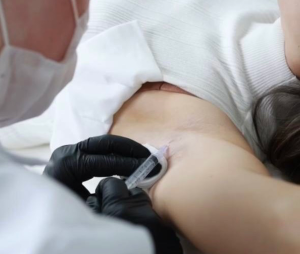
The area is cleansed and, where needed, a topical anaesthetic — usually a lidocaine-based cream — is applied. Tell the doctor before the session if you have ever reacted to a local anaesthetic, including at the dentist, and ask which preparation is being used. The doctor places small volumes across the treatment area with a fine needle. Expect redness, small raised bumps at the injection points and mild swelling for a day or two, and bruising in some cases. Most plans run an induction phase followed by maintenance, and the doctor sets the number of sessions after assessment.
One documented reaction is worth knowing about in advance. A case series of 14 patients treated with scalp mesotherapy for hair loss reported frontal oedema — swelling of the forehead — arising mostly in the first two sessions and lasting one to four days, settling with a cold compress. Lidocaine was used in all those cases, and the authors note that minoxidil and dutasteride may also contribute. In the reported cases it settled within one to four days, but it is alarming if nobody warned you.
Do not do this at home
Dermarollers, microneedling pens and “mesotherapy cocktails” sold online put the same two risks in your hands without the controls: unsterile equipment and a solution of unknown composition and sterility, introduced through the skin barrier. The mycobacterial infections described above came precisely from contaminated solutions and unsterile technique. Preparations intended for injection are medical products meant to be administered by a clinician, and a serum formulated to sit on top of the skin is not formulated to go under it. If you already own a roller, the safe advice is to stop using it and to tell the doctor before any in-clinic treatment — when you last used it, at what needle length and with what product on the skin. This clinic does not advise unsupervised home use of any device that punctures the skin, at any needle length.
Do not stack procedures
Mesotherapy should not be combined with peels, lasers, IPL, waxing or another injectable in the same period unless the doctor plans the sequence and the intervals. Tell the doctor about every treatment you have had in the previous month and every one already booked.
Risks, and who should not have mesotherapy
Common and temporary: redness, small bumps at the injection points, swelling, tenderness and bruising.
Less common: persistent nodules, skin irregularities, the Tyndall effect where hyaluronic acid is placed too superficially, infection at an injection site, post-inflammatory hyperpigmentation — more likely in darker skin phototypes, and able to take months to fade — and reactivation of cold sores in people who get them.
Rare but serious: an allergic reaction to a component of the preparation or to the anaesthetic, which in rare cases can be severe and needs emergency care; injection into a blood vessel, which can cause blanching, dusky or blotchy painful skin and, rarely, tissue breakdown at the site; delayed inflammatory or granulomatous nodules appearing weeks to months after a session; mycobacterial infection requiring prolonged antibiotic treatment; and — reported in the hair-loss literature — paradoxical alopecia, scarring and acute dermatitis.
MED YU MED does not perform mesotherapy in the following cases:
- Pregnancy and breastfeeding
- Active skin infection, inflammation or herpes at the injection site
- Known allergy to the product components
- Tendency to keloid scarring
The following require assessment before any decision, and may mean treatment is declined or a different preparation is chosen:
- Bleeding disorders or anticoagulant therapy
- Autoimmune or uncontrolled chronic conditions
- Active cancer or recent cancer treatment
- Current or recent isotretinoin
- Immunosuppression
- Active eczema or psoriasis in the treatment area
- Recent facial surgery
- A known reaction to a local anaesthetic
This list is not exhaustive. Final suitability is determined by a clinician at an in-person assessment.
When to seek help
Call 998 — the UAE ambulance number, free, 24 hours, working in every emirate — or go to the nearest emergency department immediately if, at any point after an injection, you develop difficulty breathing, swelling of the face, lips or tongue, a spreading rash, fainting, any sudden change in vision or pain in or around the eye, skin that turns white, grey or blotchy and painful near the treated area, a fever above 38.5 °C, or spreading redness with severe pain in the treated area. Sudden visual symptoms after an injection in the face are an emergency in their own right and are not a reason to wait for the clinic to open. While you wait for help, do not apply creams, ointments, ice directly on the skin or home remedies to the affected area.
Seek assessment the same day — at the clinic during opening hours, at a DHA-licensed urgent care in Dubai if it is closed, or, if you are in another emirate, at a DoH- or MoHAP-licensed facility — if you develop pus or discharge at an injection point, blistering, or pain that increases rather than settling.
Contact the clinic during opening hours (10:00–22:00, +971 52 184 5011) if a lump appears and does not settle, if redness or swelling is still worsening after 48 hours, or — importantly — if firm lumps, draining spots or slow-healing sores appear weeks or months after treatment. Late-appearing lesions without fever are the presentation described in the mycobacterial infection reports, and they need assessment rather than waiting. Tell whichever doctor sees you that you had injections, give the date and the name of the preparation, and ask whether mycobacterial culture is appropriate — these organisms are missed by routine swabs. Outside opening hours, contact any DHA-licensed urgent care in Dubai, or in other emirates a DoH- or MoHAP-licensed facility. The clinic is not a 24-hour service.
Related reading
For platelet-rich plasma, which uses your own blood rather than a manufactured preparation, see plasma therapy and the guide to PRP for hair growth. For injectable skin-quality protocols using hyaluronic acid and polynucleotides, see biorevitalization. These are also paid services at this clinic, and none should be combined with mesotherapy without the doctor planning the interval.
Frequently Asked Questions
Does mesotherapy actually work?
For skin quality, reviews of hyaluronic-acid mesotherapy describe it as a favourable method for rejuvenation, with the caveat that results depend on precise placement and require maintenance, and that older skin with significant photodamage usually needs additional procedures. For hair, the evidence is weaker: a systematic review of injectable therapy for androgenetic alopecia found mostly uncontrolled studies with varied techniques and outcomes ranging from increased density to stabilised shedding.
What is the most serious risk?
Infection with non-tuberculous mycobacteria. A systematic review covering 423 patients found these infections typically produced multiple localised lesions without fever, most resolved with antibiotics, but many patients needed multiple courses and resolution often took weeks; disfiguring scarring has been reported. These infections come from contaminated solutions and unsterile technique, which is why the preparation used and the sterility of the process matter more than the brand.
Can mesotherapy cause hair loss?
Paradoxical alopecia is listed among the adverse events in a systematic review of injectable therapy for androgenetic alopecia, alongside scarring and acute dermatitis. The reviewers described adverse events as generally mild, but hair loss caused by a hair-loss treatment is a documented outcome. This is one reason the cause of hair loss should be established before any injectable course begins.
Why did my forehead swell after scalp mesotherapy?
Frontal oedema is a recognised reaction. A case series of 14 patients treated for hair loss found it arose mostly in the first two sessions and lasted one to four days, settling with a cold compress. Lidocaine was used in all those cases, and the authors suggest minoxidil and dutasteride may also contribute. It resolves on its own, but tell the clinic so it is documented before your next session.
Can I use a dermaroller and serums at home instead?
No. Home rollers combine unsterile equipment with solutions of unknown composition, introduced through the skin barrier — the same combination behind the mycobacterial infections reported in the literature. Preparations intended for injection are medical products meant to be administered by a clinician, and a serum formulated to sit on the skin is not formulated to go under it.
How many sessions will I need?
Published courses for non-cross-linked hyaluronic acid ran from one to six sessions at weekly to bimonthly intervals, but protocols in the literature vary widely and no standard schedule is established. Most plans use an induction phase followed by maintenance, and results are not permanent. The doctor sets your course after assessment.
Commercial interest disclosure: MED YU MED provides mesotherapy as a paid service. This page discusses treatments the clinic sells, states which injectable protocols it does not perform, and reports the risks documented in the literature.
Medical disclaimer: This page is for informational purposes only and does not replace a medical consultation.
License statement: MED YU MED operates under DHA License 6589480.
Individual results caveat: Results vary by diagnosis, skin type, and individual response.
References
- Iranmanesh B et al. Employing hyaluronic acid-based mesotherapy for facial rejuvenation. J Cosmet Dermatol. 2022;21(12):6605-6618. doi:10.1111/jocd.15341
- Beer J et al. Injectable Therapy for Androgenetic Alopecia: A Systematic Review. Dermatol Surg. 2026;52(7):659-665. doi:10.1097/DSS.0000000000004999
- Singsing ME et al. Clinical features of mesotherapy-associated non-tuberculous mycobacterial infections: a systematic review. Int J Womens Dermatol. 2022;8(4):e059. doi:10.1097/JW9.0000000000000059
- Melo DF et al. Frontal edema due to mesotherapy for androgenetic alopecia: a case series. Dermatol Ther. 2022;35(2):e15247. doi:10.1111/dth.15247
- Beer K, Waibel J. Disfiguring scarring following mesotherapy-associated Mycobacterium cosmeticum infection. J Drugs Dermatol. 2009;8(4):391-3.
- Carbonne A et al. Outbreak of nontuberculous mycobacterial subcutaneous infections related to multiple mesotherapy injections. J Clin Microbiol. 2009;47(6):1961-4. doi:10.1128/JCM.00196-09
Related articles
Medically reviewed by