


Published 2 September 2026
The one-minute version
A bag under the eye is usually one of three things, occasionally a fourth. Fluid that has pooled overnight and goes down by lunchtime. A fat pad that has slipped forward as the tissue holding it weakens with age, which is there at every hour of the day. Skin that has lost its firmness and folds over the lower lid. And, less often, swelling of the cheek just below the lid, either a festoon or fluid held by an earlier filler injection.
Fluid responds to sleep, salt, allergy control and a cold compress. Loose skin responds to skin-tightening work. A fat pad is corrected by surgery; no cream, device or injection removes fat that has moved forward, and skin-tightening can only make a small pad read less obviously by firming the skin in front of it. At MED YU MED a 300 AED consultation is where a doctor examines the lid and explains which pattern predominates in your case, or advises which specialist to see if the cause belongs to another specialty. The price is from the clinic price list, checked on 16 August 2026.
Three checks at the mirror
You can narrow this down before you see anyone. These checks point towards a cause; they are not a diagnosis.
Time of day. Photograph your eyes when you wake and again at four in the afternoon, same light, same angle. A bag that is visibly smaller by the afternoon suggests fluid. A bag that looks the same in both pictures points to fat or skin.
Look up. Tilt your head back and look at the ceiling in a mirror. A fat pad tends to become more prominent as the eyeball presses on it. Fluid and loose skin change little.
Pinch and release. Gently pinch the skin under the bag and let go. If the skin returns quickly and the bulge stays, something behind the skin is making the bag. If the skin settles back slowly, in fine folds, the skin itself is part of the picture.
| Cause | What you see | What helps | What it cannot do |
|---|---|---|---|
| Fluid | Soft swelling, worst on waking, smaller by afternoon | Head raised at night, less salt, allergy control, cold compress | Nothing to do with fat or skin, so it settles and returns |
| Fat pad | Firm bulge present all day, more visible looking up | Lower blepharoplasty | No cream, device or injection removes it |
| Loose or thin skin | Fine folds, a crepey fold that catches light | Sun protection, retinol for the eye area, skin-tightening protocols | Treatment firms the skin; ageing continues, so maintenance is needed |
| Festoon or filler-related swelling | Swelling on the cheek below the lid, not in the lid itself | Depends on the cause; filler swelling is treated by dissolving the filler | Not corrected by standard eyelid surgery |
Bring the two photographs to the consultation. They save the doctor a guess and save you a course aimed at the wrong thing.
Why the lower lid puffs up
The lower eyelid is a thin sheet of skin and muscle held over three small pockets of fat that cushion the eyeball. A membrane called the orbital septum keeps those pockets in place. With age the septum stretches, the muscle thins and the fat pushes forward against the skin. That forward bulge is the eye bag most people mean when they use the phrase, and it is structural. It can run in families and appear in the twenties.
The same area also swells for reasons that have nothing to do with fat. The tissue under the eye is loose, so it fills with fluid easily: after a salty meal, a short night, alcohol, a cold, hay fever, or simply from lying flat for eight hours. This swelling is soft, it is worse in the morning and it fades as you move around. Mayo Clinic lists fluid retention, lack of sleep, allergies, smoking and heredity among the usual causes, alongside the age-related shift of fat.
The third cause is the skin itself. Under-eye skin is the thinnest on the body and loses collagen early. Once it slackens it folds and catches light, and the fold reads as a bag even when there is little fat behind it. Year-round sun accelerates this, and daily sun protection is the one habit that slows it.
When it is not a fat pad: festoons and swelling after filler
Two kinds of puffiness sit lower than the eyelid, on the upper cheek, and are often mistaken for eye bags. A malar festoon is a soft, sometimes fluid-filled swelling of the skin and muscle over the cheekbone that worsens with age, sun damage and fluid retention. It does not respond to standard lower-lid surgery, and its treatment is a separate conversation with an oculoplastic surgeon or dermatologist.
The second is swelling that appears weeks or months after hyaluronic acid filler was placed under the eye or in the cheek. The gel holds water, and in this zone the tissue drains poorly, so a persistent puffiness can outlast the cosmetic effect by months or years. It is not a fat pad and surgery does not help. It is treated by dissolving the filler with hyaluronidase; filler dissolving is a doctor-led procedure at MED YU MED. If your bags appeared after an injection, say so at the consultation, because it changes the whole plan.
Puffiness that needs a doctor first
Most eye bags are cosmetic. A few are a sign of something else, and they belong with a physician before any aesthetic plan.
- Swelling that appeared suddenly, over days rather than years
- Puffiness on one side only, or that hurts, itches or is red
- Swelling with a change in vision or a bulging eye
- Puffiness alongside leg swelling, shortness of breath, weight change or unusual tiredness, which can point to thyroid, kidney or heart problems
If any of these fit, see a doctor about the cause first. For sudden swelling with pain or a change in vision go to an emergency department; 998 works across the UAE.
What helps at home, and what it cannot do
For fluid, the free measures work and they work quickly. Sleep with the head slightly raised so fluid drains rather than pools. Cut salt in the evening. Treat allergies rather than rubbing the eyes, because rubbing inflames the skin and leaves pigment behind. A cold compress or chilled spoon for a few minutes constricts the vessels and shifts fluid. Caffeine in an eye cream does something similar and can reduce puffiness for a few hours; it earns its place between clinic sessions rather than instead of them.
For loose skin, sun protection every morning is the habit that changes the trajectory. Over-the-counter retinol products formulated for the eye area can thicken the skin slowly over months, though the eyelid tolerates them poorly and many people stop because of irritation. Prescription-strength retinoids are selected by a doctor, and the eye area is where that advice matters most.
For a fat pad, nothing at home moves it. Creams cannot reach it, massage does not drain it, tape and patches flatten it for an evening. Spending on them is harmless, and it is spending on the wrong problem.
Can eye bags be removed permanently? What surgery does and does not do
A fat pad that has moved forward is addressed by lower blepharoplasty, an operation on the lower eyelid performed by an oculoplastic or plastic surgeon. The fat is either trimmed or moved down into the hollow beneath it, which smooths the step between lid and cheek. A transconjunctival incision inside the lid leaves no external scar; a subciliary incision just under the lashes leaves a fine line in the lash line that usually becomes inconspicuous. The result is long-lasting rather than permanent: the fat that was removed does not grow back, but the skin keeps ageing and fluid bags can still come and go.
What to expect. The American Society of Plastic Surgeons says most patients are presentable in public within 10 to 14 days; in practice that means bruising and swelling for one to two weeks, desk work resuming within one to two weeks, strenuous exercise on hold for a few weeks, and the settled result over the following months. Risks the surgeon will discuss include dry or irritated eyes, temporary blurred vision, lid lag, asymmetry, a lower lid that sits lower or pulls away from the eye, the need for a revision and, very rarely, a lasting change in vision. How often they happen depends on the surgeon’s experience with this particular operation.
Choosing a surgeon in Dubai: look for a DHA-licensed oculoplastic or plastic surgeon, check the licence number on the DHA Sheryan portal, ask how many lower blepharoplasties they do a year and to see their own before-and-after cases in patients with your degree of bagging. MED YU MED does not perform blepharoplasty. If the consultation finds a true fat prolapse, the doctor will explain the surgical route and what to look for in a surgeon, and will not offer an injection or a device as a substitute.
Two things to know before choosing that route. Surgery corrects the fat, but it does not change skin colour or pigment, so dark circles caused by melanin stay unless treated separately. And skin that is loose before surgery is still loose after it, which is why some surgeons combine the operation with skin-tightening afterwards.
What a clinic can do without surgery
Where the bag is loose or thin skin, and often where a small fat pad is made more visible by skin that no longer holds it, skin-tightening work can make a visible difference in suitable cases. Three classes of treatment are used for the eye area at MED YU MED: radiofrequency microneedling on the eyelids on the Morpheus Pro platform, a non-ablative laser protocol for the eye zone on Fotona, and injectable polynucleotide and amino-acid preparations that aim to thicken and hydrate thin under-eye skin. All of them run as a course, usually three sessions a fortnight or so apart, with the change appearing gradually over two to three months as collagen builds.
The frame for every one of these is improvement rather than removal. They firm the skin over the bag. They do not take the fat pad away, they need maintenance, and whether you are a candidate is decided at an in-person consultation.
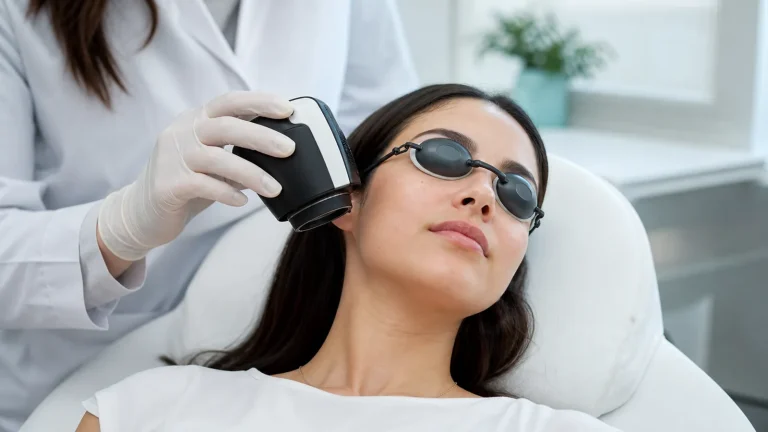
What they involve. Microneedling and injections are invasive procedures: expect swelling, redness and sometimes bruising for two to seven days, and plan them away from events. Laser and radiofrequency work close to the eye is done with protective eye shields in place. Common reasons to postpone include an active eye infection or cold sore, pregnancy and breastfeeding, blood-thinning medication and uncontrolled skin disease in the area; the full list is confirmed by the doctor. In darker phototypes the eyelid answers heat and inflammation with pigment, so settings are gentler, sessions more spaced, sun protection between them strict, and the doctor may decline a device when the risk of post-inflammatory darkening outweighs the gain.
The comparison table of methods, indications and prices, checked against the clinic price list on 16 August 2026, is on the dark circles and eye area page; it covers dark circles as well as puffiness, because the two usually arrive together.
Sources
Related reading
Frequently Asked Questions
Do eye bags come back after treatment?
Fluid bags come and go with sleep, salt and allergies whatever you do. After lower blepharoplasty the removed fat does not return, but the skin keeps ageing, so the lid can loosen again over the years. Skin-tightening protocols firm the skin for a period and are repeated as maintenance.
I am in my twenties and already have bags. Why?
Usually heredity. The fat pockets and the membrane that holds them are inherited, and in some families the fat sits forward early. Allergies and fluid retention add to it. The mirror checks above separate the two; a doctor confirms which it is.
Do massage, patches or facial exercises remove eye bags?
Massage and cold patches move fluid and help a fluid bag for a few hours. None of them reach a fat pad, and exercises do not tighten the skin of the lower lid. They are harmless as a morning routine and useless as a treatment for a structural bag.
I have an event in three days. What works fast?
For fluid: head raised at night, less salt and alcohol, a cold compress in the morning and, if allergies are involved, an antihistamine agreed with a pharmacist or doctor. Nothing removes a fat pad in three days, and this is the wrong week to start injections or microneedling, because bruising can last a week.
My bags appeared after under-eye filler. What now?
Persistent puffiness after hyaluronic acid filler in the tear trough or cheek is well described, because the gel holds water in a zone that drains poorly. It is not a fat pad and surgery does not help. The filler can be dissolved with hyaluronidase by a doctor; tell the clinic what was injected and when.
Can filler fix eye bags?
Filler in the tear trough can soften the hollow beneath a bag and make the step less visible, but it does not remove the bag and it adds volume to an area that is already full. It is a technically demanding zone. MED YU MED does not offer tear-trough filler.
When should I see a doctor before booking any aesthetic treatment?
When the swelling appeared suddenly, is on one side, hurts, itches, comes with a change in vision, or comes with leg swelling, breathlessness or unusual tiredness. Those need a diagnosis first. Sudden swelling with pain or a change in vision is an emergency; 998 works across the UAE.
Medical disclaimer: This page is for informational purposes only and does not replace a consultation with a licensed physician. It does not recommend or prescribe any prescription-only medicine.
License statement: MED YU MED operates under DHA License 6589480.
Individual results caveat: Results vary by diagnosis, anatomy, product used and individual response, and no outcome is guaranteed.
Medically reviewed by

Filler Removal (Dissolving) at MED YU MED: prices
- PB Serum Drain1000 AED
Treatment page and booking · full price list
The final protocol and cost are confirmed at an in-person consultation.

