Published 2 June 2026 · Updated 9 September 2026
How laser tattoo removal works
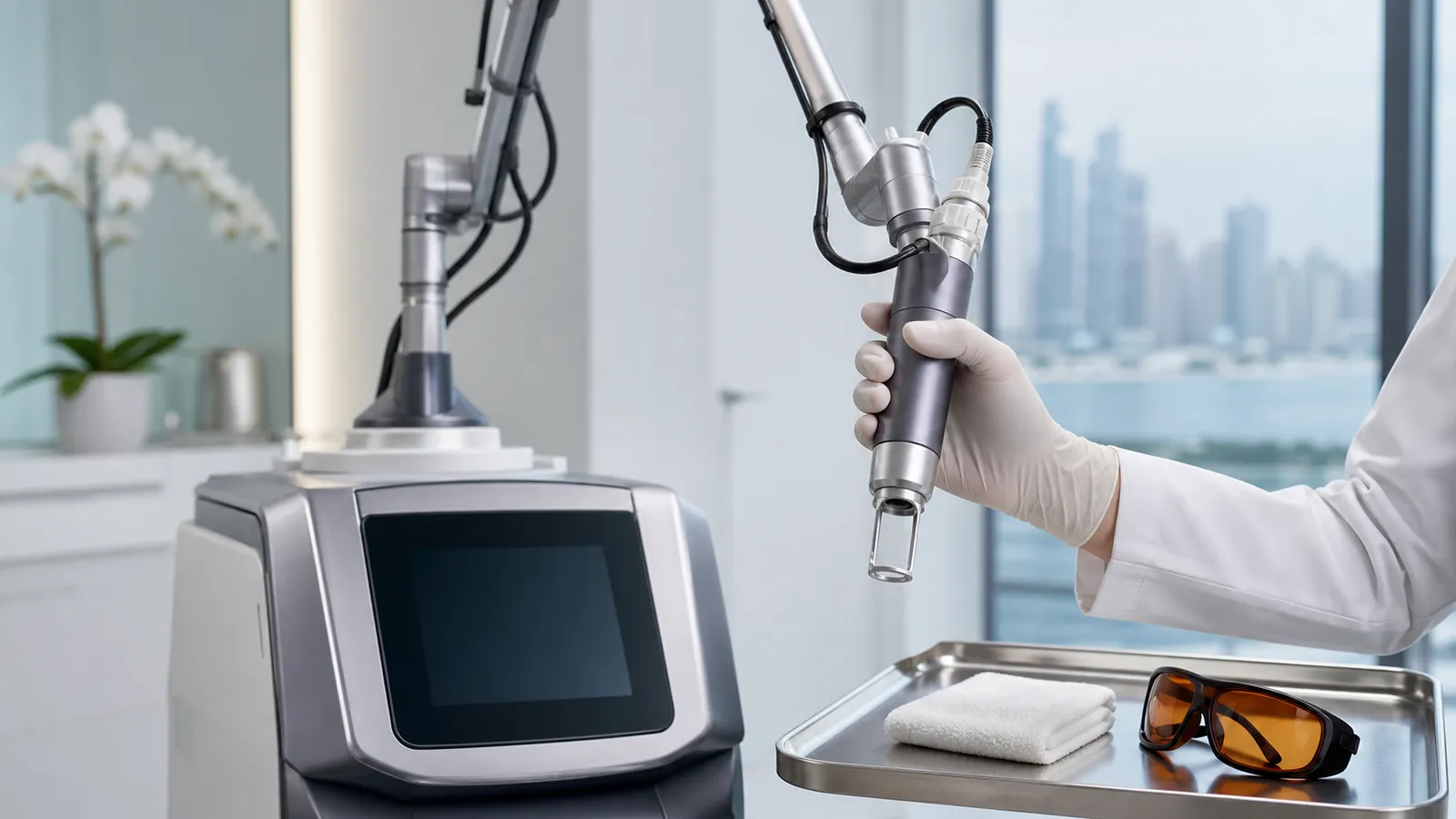
Laser tattoo removal at MED YU MED uses the PicoSure Pro (Cynosure), a picosecond laser working at 755 nm. Picosecond pulses shatter ink particles mechanically, and the immune system carries the fragments away over the following weeks. One session clears only part of the pigment, so a course is always needed.
A split study in 23 patients with 30 tattoos compared picosecond pulses against a nanosecond ruby laser over up to eight sessions four weeks apart (J Eur Acad Dermatol Venereol 2022, PMID 34543473). Picosecond clearance looked better but the difference did not reach statistical significance. What the study did show clearly is that patients felt less pain with picosecond pulses (P<0.001), and that blistering, itching and burning were shorter. The picosecond device there worked at 532 and 1064 nm and the comparator was a 694 nm ruby laser, so the finding describes picosecond pulses as a class rather than the 755 nm device used here. Hypopigmentation appeared only after the nanosecond laser; hyperpigmentation followed both.
Risk statement. This is a medical laser procedure with a complication rate that practitioners report in survey data, set out below. Some tattoos clear completely, others lighten and stop responding.
What decides how many sessions you need
- Ink colour and density. Black and dark blue respond best to 755 nm.
- Professional versus amateur work. Professional tattoos hold more ink in more layers.
- Layering. A cover-up over an older tattoo means two sets of pigment.
- Your skin type. Higher Fitzpatrick types need more conservative settings.
- Tattoo age. Older ink has already been partly cleared by the body.
- Location and circulation. Areas far from the trunk clear more slowly.
Published data give an anchor: with a 755 nm alexandrite laser, clearance above 95% took an average of 8.9 sessions across professional and amateur tattoos (PMID 7986123). Large multi-coloured tattoos are the hard case, and one clinical review states plainly that complete removal there is hardly achievable (PMID 28288463). Our clinic schedules sessions 6 to 8 weeks apart. Your doctor sets the expected number after seeing the tattoo and revises it once the first sessions show how your skin responds.
Colours a 755 nm laser reaches, and colours it does not
Wavelength decides which pigment absorbs the energy. The standard tattoo lasers are 532 nm and 1064 nm Nd:YAG, 694 nm ruby and 755 nm alexandrite (Lasers Med Sci 2022, PMID 35604505). The PicoSure platform exists in a 755/532 nm configuration (Med Devices 2016, PMID 27194919; one author of that review worked for the manufacturer).
Our device works at 755 nm, where black, dark blue and green ink absorb well. Red pigment responds to 532 nm, and yellow responds poorly to any available wavelength. Before planning a course on a tattoo with red or yellow elements, ask at consultation whether a 532 nm handpiece is available, so the plan matches the equipment.
Risks, and how often they occur
A 2026 survey of Dutch dermal therapists recorded what practitioners actually see (Dermatology 2026, PMID 41980006). Among 94 practitioners who actively perform laser tattoo removal, complications were reported in an estimated 8.1% of sessions:
- Oedema, 3.0% of treatments
- Blistering, 1.9%
- Haematoma, 0.7%
- Hypopigmentation and hyperpigmentation, about 0.6%
- Hypertrophic scarring and paradoxical darkening of the ink, 0.2%
- Keloid formation, allergic reaction, ink blow-out and infection, 0.1% each
- Injury to the eye, including the iris, when pigment sits near the eyelid margin. The literature puts no frequency on it, and it is the reason such work needs intraocular shielding rather than goggles
Complications were reported more often in Fitzpatrick skin types III and above, in coloured tattoos, in permanent make-up, in tattoos treated before, and in tattoos less than a year old. The survey comes from Dutch practice, where most clients have lighter skin. Patients in the UAE are typically types III to V, so for this audience the overall 8.1% figure more likely understates the risk than overstates it.
Those are practitioner-reported figures, collected by survey. Patients report higher numbers. In an internet survey of 157 people who had undergone laser tattoo removal, 24% reported slightly visible scars and 8% important scarring, nearly half experienced hypopigmentation, one third were unsatisfied with the result, and complete pigment removal was achieved in 38% (Lasers Med Sci 2014, PMID 23907603). For the 755 nm alexandrite wavelength this clinic uses, transient hypopigmentation has been reported in about 50% of patients and transient texture change in about 12% (PMID 7986123, PMID 11702617). Picosecond pulses cause less collateral damage than the nanosecond lasers behind those figures, and no comparable picosecond dataset exists for Fitzpatrick types III to V. Treat pigment change as a meaningful risk, not a marginal one.
Two further outcomes are documented in the literature and worth knowing. Permanent leukotrichia, the hair inside the treated area turning white and staying white, has been reported after picosecond treatment (J Cosmet Dermatol 2022, PMID 36083690). Immune reactions to released pigment range from local hypersensitivity to anaphylaxis (J Lasers Med Sci 2023, PMID 38318216), which is why the urgent-care section below exists.
Laser cannot always erase a tattoo completely, and the procedure carries risks of scarring, pigment change, ink darkening and flare of a latent skin condition (Curr Probl Dermatol 2015, PMID 25833629). This list is not exhaustive; your doctor will go through the risks that apply to your skin, your ink and your medical history.
Permanent make-up and tattoos near the eye
Cosmetic tattoos on the brow, eyeliner and lip line behave differently from body ink. They often contain iron oxide and titanium dioxide, and pigment-specific lasers can turn these compounds dark (Dermatol Surg 2018, PMID 29894434). A test spot in an inconspicuous part of the tattoo, and a conversation about what happens if darkening occurs, come before any full treatment. The same review recommends ablative CO2 laser for iron oxide and titanium dioxide pigments, precisely because it does not target ink selectively. PicoSure Pro is a pigment-specific laser, so some permanent make-up cases belong in a referral.
Ink close to the eyelid margin raises a separate question. Laser energy near the eye can injure the iris, and goggles do not protect the eye when the treated area is the lid itself; that work requires intraocular eye shields placed on the eye. Eyelid pigment removal appears in our price list at 800 to 1500 AED, so before you pay for it, ask the doctor at consultation to show you what shielding will be used and what the plan is if the pigment darkens. If the answer is not intraocular shields, the correct outcome is a referral, and you are entitled to ask for one.
When we will not treat
- Pregnancy and breastfeeding
- Active infection, inflammation or open skin in the treatment area
- Isotretinoin within the timeframe your doctor specifies
- Photosensitising medication or a photosensitivity disorder
- A recent tan or sunburn on the area
- A history of keloid scarring
- Uncontrolled diabetes or an immunosuppressed state
- A suspicious mole or lesion within the tattoo, which needs dermatological assessment first
- A tattoo that already itches, swells or flares, red ink especially. Laser on an allergic tattoo can amplify the allergy and carries a risk of anaphylaxis, so it is not recommended and needs dermatological assessment first (PMID 28288463)
This list is not exhaustive. Conditions such as eczema, vitiligo, an allergy to a component used during the session, or a bleeding disorder also change the plan. Bring your full medication list to the consultation.
What the treatment does not promise
Some tattoos clear completely. Others lighten to a shadow and stop responding at that point. Some colours resist any available wavelength. When further sessions stop adding clearance, the doctor says so and the course is stopped.
Session protocol
- Consultation, skin type assessment and a documented photograph before the first pass
- Topical anaesthetic before each session
- Session length 15 to 60 minutes depending on tattoo size
- 6 to 8 weeks minimum between sessions
- Progress reviewed against the baseline photograph at each visit
Aftercare
- Cool compress for the first hour
- A dressing for 24 to 48 hours, and a topical antibacterial ointment only if your doctor prescribes one
- Do not pick or drain blisters
- SPF 50 on the area once healed, and no sun exposure on the treated skin throughout the course
- No sauna, hot tub or swimming pool until the skin has closed
When to seek urgent help
Call 998 for Dubai Ambulance immediately if you develop swelling of the lips, tongue or throat, difficulty breathing, widespread hives, dizziness or fainting after a session. These are signs of a systemic allergic reaction and they need emergency care, not a phone call to a clinic.
Go to a hospital emergency or ophthalmology department immediately, at any hour, if your vision changes after treatment near the eye: blurring, pain, light sensitivity or a shadow in your field of view. Do not wait for the clinic to open and do not wait to see whether it settles.
Go to an emergency department the same day, whatever the hour, if you develop fever above 38C, chills, or redness that spreads quickly. Systemic infection needs intravenous treatment in hospital without delay (PMID 28288463).
Contact the clinic the same day for local problems: redness and heat around the treated area, pus, pain that increases instead of settling, or a widespread rash or eczema-like eruption appearing days after a session, including on untreated skin (PMID 34925838, PMID 28061317). Our number is +971 52 184 5011 and we are open 10:00 to 22:00. The clinic is not a 24-hour service; outside those hours go to a hospital emergency department and call us on the way. 998 works across the UAE.
Pricing and booking
The price list gives a per-session price by tattoo size: 300 AED for an area up to 2×2 cm, 600 AED for S, 800 AED for M, 1000 AED for 10×10 cm, 1300 AED for 20×15 cm and 1900 AED for a half sleeve. Permanent make-up removal is priced separately, from 600 AED for an eyebrow tip to 1500 AED for eyelid pigment.
Each figure is the price of one session. A course usually runs several sessions, so multiply before you plan a budget, and ask the doctor for the expected session count for your tattoo.
Laser tattoo removal carries risks including blistering, pigment change, texture change, scarring and, rarely, allergic reaction. Paying for a course does not buy complete clearance: some tattoos lighten to a shadow and stop responding there. The clinic provides this treatment as a paid service, and that commercial interest is exactly why the limits above are stated on this page.
Pico laser treatments on PicoSure Pro and the PicoSure Pro device page cover the pigment and skin-quality side of the same laser.
What patients say about tattoo removal
A great clinic. I am having a tattoo removed here and I am very happy. The whole team is polite and attentive, and the doctor explains in detail how to care for the skin after the procedure. The atmosphere is comfortable, it is always a pleasure to come in.
…I came in for tattoo removal (by the way, it did not hurt at all, the machine really is good) and a hydrating facial. Everything was at a high level: attentive staff, pleasant atmosphere, modern equipment. Very happy, I will definitely come back.
The best clinic. Great service, original devices. Before this I did a tattoo removal course at another clinic with no result, and the doctor there kept saying I needed more visits. When I came to MED YU MED I saw a difference after the first session and bought a course right away. The result is excellent, a couple more sessions and the mistakes of my youth will be in the past.
Reviews describe individual experiences. How a tattoo responds depends on the ink, colours, depth and your skin; the number of sessions and the degree of clearance vary, and the limits described on this page apply to every case.
MED YU MED operates under DHA License 6589480. Health regulators by emirate: DHA in Dubai, DoH in Abu Dhabi, Sharjah Health Authority in Sharjah, MoHAP elsewhere.
FAQ
How many sessions will my tattoo need?
Published data on the 755 nm alexandrite laser show an average of 8.9 sessions for clearance above 95% (PMID 7986123). We schedule sessions 6 to 8 weeks apart. The doctor gives you an expected range after seeing the tattoo. Results vary by skin type, ink and individual response, and complete clearance is not guaranteed.
Will the tattoo disappear completely?
Not always. Lasers cannot always erase a tattoo fully, and some colours resist the available wavelengths (PMID 25833629). Expect a range of outcomes from full clearance to a faint shadow.
Does it hurt?
Yes, though less than with older nanosecond lasers. In a split study comparing the two, patients reported significantly less pain with picosecond pulses (PMID 34543473); that study used a 532/1064 nm picosecond device against a 694 nm ruby laser, so it describes picosecond pulses as a class. Topical anaesthetic is applied before each session.
How risky is it?
Practitioners reported complications in about 8.1% of sessions, most often oedema (3.0%), blistering (1.9%) and haematoma (0.7%), with scarring and paradoxical darkening at 0.2% (PMID 41980006). Patients report more: in a survey of 157 people, 24% reported slightly visible scars, 8% important scarring and nearly half hypopigmentation (PMID 23907603). Risk is higher in skin types III and above, in coloured ink and in permanent make-up.
Can eyebrow or eyeliner tattoos be removed the same way?
They need a different conversation. Cosmetic pigments often contain iron oxide and titanium dioxide, which pigment-specific lasers can darken (PMID 29894434), so a test spot comes first. Work near the eyelid margin also raises the question of eye protection, which you should ask any clinic directly.
Related Pages
Medical disclaimer: This page is for informational purposes only and does not replace a medical consultation.
License statement: MED YU MED operates under DHA License 6589480.
Commercial interest: the clinic provides laser tattoo removal as a paid service. Where the evidence limits what the treatment can achieve, this page says so.
Individual results caveat: Results vary by diagnosis, skin type, ink and individual response.
Sources
- Poelhekken M et al. Practitioner-Reported Complications in Tattoo Removal. Dermatology 2026;242(4):449-456. PMID 41980006
- Bäumler W et al. The efficacy and the adverse reactions of laser-assisted tattoo removal, a prospective split study. J Eur Acad Dermatol Venereol 2022;36(2):305-312. PMID 34543473
- Hernandez L et al. Laser tattoo removal: laser principles and an updated guide for clinicians. Lasers Med Sci 2022;37(6):2581-2587. PMID 35604505
- McIlwee BE, Alster TS. Treatment of Cosmetic Tattoos: A Review and Case Analysis. Dermatol Surg 2018;44(12):1565-1570. PMID 29894434
- Torbeck R et al. Lasers in tattoo and pigmentation control: role of the PicoSure laser system. Med Devices 2016;9:63-67. PMID 27194919
- Han Y et al. Permanent leukotrichia after picosecond laser treatment for tattoo removal. J Cosmet Dermatol 2022;21(12):7228-7229. PMID 36083690
- Tjipta A et al. Immune Response in Laser Tattoo Removal: A Systematic Review. J Lasers Med Sci 2023;14:e66. PMID 38318216
- Eklund Y, Rubin AT. Laser tattoo removal, precautions, and unwanted effects. Curr Probl Dermatol 2015;48:88-96. PMID 25833629
- Klein A et al. Patient survey on laser tattoo removal and side effects. Lasers Med Sci 2014. PMID 23907603
- Fitzpatrick RE, Goldman MP. Tattoo removal using the alexandrite laser. Arch Dermatol 1994. PMID 7986123
- Kuperman-Beade M et al. Laser removal of tattoos. Am J Clin Dermatol 2001. PMID 11702617
- Serup J et al. Guide to Treatment of Tattoo Complications and Tattoo Removal. Curr Probl Dermatol 2017;52:132-138. PMID 28288463
- Wong IT, Cheung LW. Delayed reaction after picosecond laser tattoo removal. PMID 34925838
- Willardson HB et al. Diffuse urticarial reaction associated with titanium dioxide following laser tattoo removal. PMID 28061317
- Dubai Health Authority (DHA)
Medically reviewed by

Pico Laser Treatment with PicoSure Pro at MED YU MED: prices
- Skin rejuvenation / tightening1500 AED
- Face (lite)1800 AED
- Face (medium)2200 AED
Treatment page and booking · full price list
The final protocol and cost are confirmed at an in-person consultation.