Published 2 August 2026 · Updated 9 September 2026
The short answer
One trial has compared the two directly. It found no difference between them, and it tested topical exosomes rather than injections, so it answers less than it appears to. Beyond that trial the two treatments sit at different stages of evidence: platelet-rich plasma has years of randomised trials behind it, with results that vary by indication and include clear failures. Exosome therapy has promising laboratory work, a handful of small human studies and no approved product anywhere.
That gap matters more than any comparison of mechanisms.
Both treatments are offered for hair loss in Dubai, where the clinic publishes what it uses for the scalp and what each option costs.
What each treatment actually is
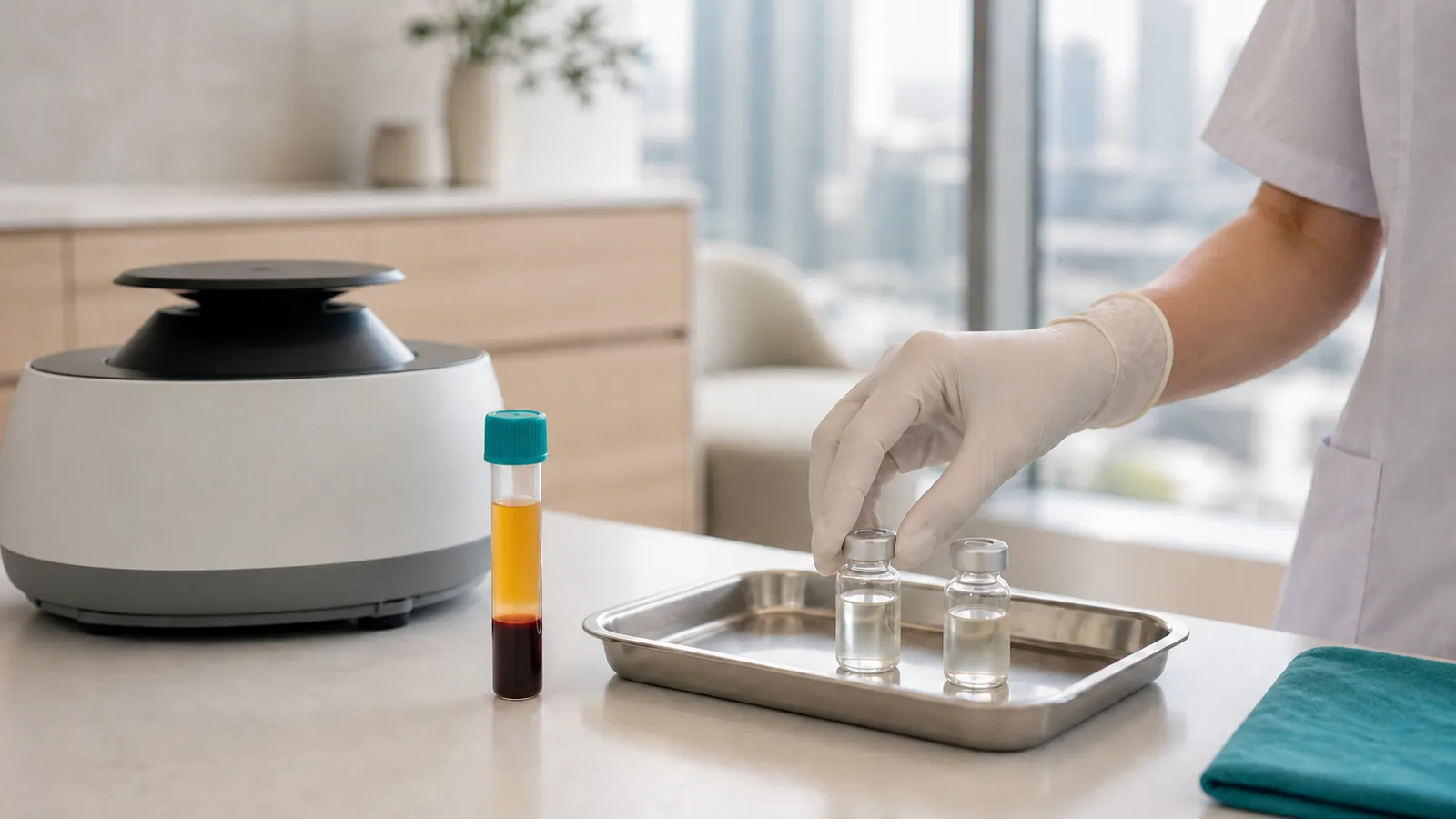
PRP is your own blood. A doctor draws it, spins it in a centrifuge to concentrate the platelets, and injects that plasma back into skin or scalp. Because the material is autologous, there is no donor tissue and no allergy to the plasma itself. What the platelets release once injected is the working part: growth factors that recruit the skin’s own repair response.
Exosomes are extracellular vesicles, tiny membrane-bound packages that cells use to send signals to other cells. They carry proteins and genetic material but contain no living cells. The preparations used in aesthetics are allogeneic, meaning the material comes from a source outside your body, and that is the origin of both the interest and the concern.
The one head-to-head trial, and what it does not cover
Estupiñan and colleagues ran an investigator-blinded, split-face non-inferiority trial in photoaged facial skin, published in 2025 (doi 10.1111/jocd.70208). Participants received three radiofrequency microneedling sessions; PRP went on one half of the face and topical adipose-derived exosomes on the other. Both sides improved equally on wrinkling, dyschromia, erythema, texture and overall appearance, and histology showed increased collagen I and glycosaminoglycans with no significant difference between them.
Three limits deserve stating plainly. The exosomes were applied to the skin surface after microneedling, not injected, so the result does not transfer to an injected exosome protocol.
Both arms sat on top of radiofrequency microneedling, which does its own work, so the trial compares add-ons rather than standalone treatments. And a split-face design on one group of patients with mild to moderate photoaging is a starting point, not a settled answer.
Skin: what the data shows
For PRP the picture is mixed in a useful way. A systematic review of randomised controlled trials in dermatology covered 64 studies and 2,888 patients (doi 10.1186/s13287-024-03800-6).
In melasma a systematic review of seven studies rated the evidence a moderate grade of recommendation on the Oxford Centre for Evidence-Based Medicine scale (doi 10.1097/DSS.0000000000003266).
Against that, a randomised single-blind study of hand rejuvenation is worth reading before anyone promises a general anti-ageing effect: 18 women received PRP injections into one hand and saline into the other every four weeks for twelve weeks, and a blinded investigator found no reliable difference between the hands on any measure (doi 10.1097/PRS.0000000000011164). The authors concluded the three-injection course was not effective for ageing skin of the hands.
For exosomes the largest skin study is a single-arm, non-randomised trial of a topical platelet-derived exosome serum in 2022 (doi 10.1093/asj/sjac149). Skin health scores improved significantly at six weeks. With no control group and no randomisation, that design cannot separate the product from the skincare routine around it, which the authors do not claim it can.
Hair: what the data shows
Androgenetic alopecia is where PRP has been studied most. In the systematic review above it accounted for 45.3 per cent of the included trials, with improvement reported up to 68.4 per cent depending on the study.
For exosomes, a 2025 review in Dermatologic Surgery searched three databases and found 48 studies, of which nine clinical studies were relevant to alopecia (doi 10.1097/DSS.0000000000004480). Across those, 125 patients had received an exosome treatment for hair loss. Side effects within that group were rare. In the wider field of dermatology, though, the same review counted at least ten serious adverse events reported with exosome products.
One hundred and twenty-five patients is a small evidence base for a treatment sold as established. That is a statement about the literature, not about any particular clinic.
The regulatory gap
There is no approved exosome product for aesthetic use. A 2025 clinical review written for practising dermatologists is direct about the reasons: clinical studies are lacking, and the safety concerns include infection, unwanted inflammatory response and the theoretical promotion of malignancy (published in the Journal of Clinical and Aesthetic Dermatology, PMID 40256340).
The hair-loss review above ends on the same point, calling for consistent manufacturing standards and regulatory oversight.
Manufacturing is the practical part of that. Exosome preparations differ between suppliers in how they are isolated, what concentration they contain and what else is in the vial. Two products carrying the same word on the label are not necessarily comparable, and no independent standard currently makes them so. Ask which preparation is being used and what documentation the clinic holds for it.
PRP has no equivalent gap, because the material is your own blood rather than a manufactured product. Its variability sits elsewhere: in the spin protocol, the platelet concentration achieved and the injection technique, none of which is standardised across clinics either.
Side by side
| PRP | Exosome therapy | |
|---|---|---|
| Source of material | Your own blood, drawn on the day | Allogeneic preparation from an outside source |
| Session includes | Blood draw, centrifugation, injection | Injection or topical application after a device pass |
| Human evidence | Randomised trials across several indications, results uneven | Small studies, mostly uncontrolled; 125 patients across nine alopecia studies |
| Approved product | Not applicable, autologous | None approved for aesthetic use |
| Allergy to the material | No, plasma is your own | Possible, the material is not yours |
| Head-to-head result | Equal on photoaged facial skin in one split-face trial, with topical exosomes over radiofrequency microneedling | |
Risks, and when neither treatment is done
Both are injectable medical procedures. Redness, small bumps and swelling at the injection points are common, bruising can occur and is more visible around the eyes, and these typically peak within 24 to 48 hours and settle over three to seven days. Infection at an injection point is uncommon but possible, as is a reaction to the topical anaesthetic or antiseptic. With exosome preparations the material is not your own, so allergic reaction is a risk that PRP does not carry.
PRP is not performed with platelet dysfunction syndromes and other clotting conditions, haemophilia or other bleeding disorders, during pregnancy and breastfeeding, over active infection, inflammation, open wounds or herpes in the treatment area, during acute viral or bacterial illness or a flare of chronic disease, with active cancer or ongoing cancer treatment, with uncontrolled chronic, endocrine or autoimmune conditions, with severe uncontrolled diabetes or impaired wound healing, with a keloid tendency, over severe active dermatitis, psoriasis or neurodermatitis in the area, over active scalp infection or inflammatory scalp disease, over suspicious skin lesions before a dermatologist has seen them, or under the age of 18.
Exosome therapy is not performed during pregnancy and breastfeeding, over active skin infection, inflammation or herpes at the injection site, with a known allergy to the product components, with bleeding disorders or on anticoagulant therapy without a doctor’s assessment, with autoimmune or uncontrolled chronic conditions without the same, or with a tendency to keloid scarring.
Neither list is exhaustive. Other conditions, medicines and previous treatments may rule a treatment out or change the plan, and final suitability is determined by a clinician at an in-person assessment.
How the choice is made
The question a doctor asks first is not which of the two is better but what is driving the complaint. Thinning that follows a hormonal pattern, pigment that returns every summer and skin that has lost firmness after weight loss are three different problems, and one of them may need neither treatment.
Where both are reasonable, the practical differences decide. PRP needs a blood draw and centrifugation, which lengthens the appointment and rules itself out for anyone with the clotting conditions listed above. Exosome protocols skip the draw. Against that, PRP carries no possibility of reaction to donor material, and its evidence base in humans is larger.
MED YU MED provides both treatments as paid services. Where the published evidence is thin, this page says so rather than filling the gap with confidence, and where a complaint would be better served by something the clinic does not sell, that is what a consultation should tell you.
Cost at MED YU MED
PRP plasmotherapy starts at 800 AED, with 1,300 AED for a two-tube protocol; course and package pricing is listed on the treatment page. Exosome therapy is 2,100 AED per session for face and body and the same for scalp protocols, with course pricing from 5,985 AED for three sessions. The final protocol and cost are set after consultation and depend on the area, the number of sessions and the plan agreed with your doctor. Full details are on the PRP treatment page and the exosome therapy page.
If something goes wrong afterwards
Call MED YU MED on +971 52 184 5011, daily 10:00-22:00, if you develop spreading redness with heat or pain, a fever, pus at an injection point, pain that increases rather than eases after the first day, or a lump appearing days or weeks after a session. With any change in vision after a facial injection, or with sudden severe pain, skin turning white or mottled, difficulty breathing or swallowing, go to the nearest emergency department or call 998 for an ambulance straight away. Do not wait for the clinic to reopen: it does not operate 24 hours.
Questions people ask
Is exosome therapy better than PRP?
The one trial that compared them directly found no difference on photoaged facial skin, and it used topical exosomes over radiofrequency microneedling rather than injections. Outside that trial the two cannot be ranked, because they have not been tested against each other for hair loss, scarring or pigmentation.
Can PRP and exosomes be combined in one session?
Combining procedures in a single visit changes the risk profile and is a decision for the treating doctor, not a default upgrade. Ask what each component is expected to add and what evidence supports the combination specifically.
Are exosome products approved?
No exosome product is approved for aesthetic use. Reviews written for dermatologists call for manufacturing standards and regulatory oversight before wider clinical use, and note infection, inflammatory response and theoretical promotion of malignancy among the safety concerns.
How many sessions does either treatment need?
Both are course-based rather than single treatments, and the number depends on the area and what is being treated. Scalp protocols generally run longer than facial ones. A doctor sets the course at consultation; anyone quoting a fixed number before examining you is guessing.
References
- Estupiñan B, Ly K, Goldberg DJ. Adipose Mesenchymal Stem Cell-Derived Exosomes Versus
Platelet-Rich Plasma Treatment for Photoaged Facial Skin: An Investigator-Blinded, Split-Face,
Non-Inferiority Trial. J Cosmet Dermatol. 2025;24(5):e70208. doi 10.1111/jocd.70208 - Queen D, Avram MR. Exosomes for Treating Hair Loss: A Review of Clinical Studies. Dermatol
Surg. 2025;51(4):409-415. doi 10.1097/DSS.0000000000004480 - Mahmoud RH, Peterson E, Badiavas EV, Kaminer M, Eber AE. Exosomes: A Comprehensive Review for the Practicing Dermatologist. J Clin Aesthet Dermatol. 2025;18(4):33-40. PMID 40256340
- Proffer SL, Paradise CR, DeGrazia E, et al. Efficacy and Tolerability of Topical Platelet
Exosomes for Skin Rejuvenation: Six-Week Results. Aesthet Surg J. 2022;42(10):1185-1193. doi 10.1093/asj/sjac149 - Jafarzadeh A, Pour Mohammad A, Keramati H, et al. Regenerative medicine in the treatment of specific dermatologic disorders: a systematic review of randomized controlled clinical trials.
Stem Cell Res Ther. 2024;15(1):176. doi 10.1186/s13287-024-03800-6 - Pincelli T, Zawawi S, Shapiro S, et al. A Pilot, Single-Blind, Randomized Controlled Study
Evaluating the Use of Platelet-Rich Plasma for Hand Skin Rejuvenation. Plast Reconstr Surg.
2024;154(4):727-734. doi 10.1097/PRS.0000000000011164 - Sarkar R, Gupta M. Platelet-Rich Plasma in Melasma – A Systematic Review. Dermatol Surg.
2022;48(1):131-134. doi 10.1097/DSS.0000000000003266
Commercial disclosure: MED YU MED provides both PRP and exosome therapy as paid services.
Where the evidence is limited, or favours something the clinic does not sell, this page says so.
Medical disclaimer: This page is for informational purposes only and does not replace a medical consultation.
License statement: MED YU MED operates under DHA License 6589480.
Individual results caveat: Results vary by diagnosis, skin type, and individual response.
Related articles

Medically reviewed by