Published 30 September 2026
The short answer
Baby Botox is not a separate product. It is a popular name for treatment with the same botulinum toxin in smaller amounts, so the muscles keep more movement. People usually choose it for a first treatment, for early or fine lines, or because they fear looking frozen. The doctor decides the dose and the zones after an assessment. Whether starting early prevents deeper wrinkles is still unproven, and the research on it is mixed.
What the term means and what it does not
“Baby Botox” has no official medical definition. The US prescribing information for Botox Cosmetic does not use the term. It gives recommended total doses for each approved area in adults, and it also states that units of one toxin product cannot be converted into units of another. Any plan with lower doses is a judgement your doctor makes for your muscles and your goals.
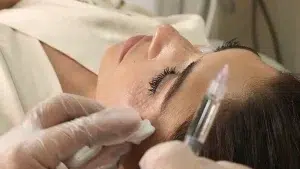
The clinic’s botulinum therapy page defines it in plain words: smaller doses that keep more movement, suited to a first treatment or early lines. The product is the same and so is the procedure, with the same assessment, mapping and fine-needle injections.
A survey-based review in the Journal of Cosmetic Dermatology (Michon, 2023) gives a sense of how practitioners behave. The survey found that younger adults receive, on average, fewer units at the glabella, forehead and crow’s feet, that younger patients who have never had toxin often fear a frozen or unnatural look, and that wrinkle prevention was the most common reason younger patients sought treatment. The author also notes a paucity of high-quality research on botulinum toxin in millennials and other young adults.
How it differs from a standard treatment
| Aspect | Standard treatment | Baby Botox, as the term is commonly used |
|---|---|---|
| Product | Botulinum toxin type A | The same |
| Amount | Doctor’s dose for the muscle and the goal | Smaller amount, chosen by the doctor |
| Movement | More reduction in the treated muscles | More movement is kept by design |
| Typical starting point | Lines visible at rest or strong muscle activity | First treatment, early lines, fear of a frozen look |
| Review | Around two weeks | Around two weeks, with units added if the muscle needs more |
The treatment page says the clinic’s starting doses are deliberately conservative. The aim is a rested look with movement preserved, and the doctor prefers to add units at a review two weeks later rather than overtreat at the first visit. In that sense a cautious first session follows the same idea as baby Botox, whatever name it carries.
A smaller dose does not remove the need for skilled placement. A 2025 study in the journal Toxins notes that the spread of the toxin depends on dose, and the US label gives steps to reduce eyelid ptosis, including keeping injections away from the muscle that lifts the upper eyelid and not injecting closer than 1 cm above the central eyebrow. The same contraindications apply at any dose: known hypersensitivity to a toxin product and infection at the injection site, with caution for neuromuscular disorders.
Does starting early prevent wrinkles?
This is the main reason people ask about baby Botox, and the honest answer is that the evidence points in different directions.
A 2025 systematic review in the journal Muscles (Marinelli and colleagues) selected nine articles on preventive botulinum toxin. Its authors report that early application may reduce muscle hyperactivity, delay the formation of dynamic wrinkles and limit static lines over time, and that histological studies hint at remodelling of dermal collagen. They also state that the data are heterogeneous and that long-term safety and efficacy are not yet fully established.
A 2026 modelling study in Aesthetic Plastic Surgery (Rahman and colleagues) used digital twin facial models over 15 years, starting treatment at 20 to 30, 31 to 40 or 41 to 50 years, with two or three sessions a year. Wrinkle depth fell in every group during the first five years. Early starters on three sessions a year showed the largest short-term change, with glabellar line depth falling from 0.833 to about 0.719 mm. By year 15, wrinkle depths had rebounded and converged at about 1.0 mm in all groups, and the authors found no sustained cumulative benefit in dermal thickness, collagen density or facial sag. The authors stress that this is a simulation and that long-term human studies are needed.
Read together, these papers support a cautious statement: botulinum toxin softens lines while it is active, and whether it changes the long-term course of ageing remains open. The clinic’s treatment page says the same in its own words: whether starting early prevents deeper lines is not firmly established, so the doctor advises from the lines you have at rest and in motion.

Is there an age to start?
There is no single correct age. The FDA label describes adult patients, and the Medication Guide states that Botox Cosmetic is not recommended for people under 18. Beyond that, the decision depends on your lines, your muscles and your reasons.
A sensible consultation covers these questions:
- Which lines do you see at rest, and which only when you move?
- Are you after softer lines today, or are you hoping to prevent future ones? The second aim has weaker evidence, as shown above.
- Is this your first toxin treatment? Previous treatment history affects the plan.
- Do you take medicines or have conditions that change the plan, such as muscle relaxants, blood thinners, a neuromuscular disorder, pregnancy or breastfeeding?
Final suitability is decided by the doctor at an in-person assessment, and your doctor sets the exact plan for your treatment.
What to expect after a lighter treatment
The timeline is the same as for a standard treatment. For frown lines, the US prescribing information says the effect typically begins one to two days after injection and increases during the first week, and the clinic’s page describes the full result as settling over about two weeks. With fewer units the change is milder by design, so the review visit matters: it is when the doctor decides whether a muscle needs more.
Muscle activity returns gradually over the following months, as with any botulinum toxin treatment. The label states that dosing more often than every three months has not been clinically evaluated, so do not plan extra top-ups between visits without your doctor’s agreement. Your doctor sets the exact schedule for your treatment.
The everyday aftercare is the same as well. Our guide to Botox aftercare explains the precautions and what the research says about them.
When to seek urgent help
The prescribing information warns that the effects of botulinum toxin can, rarely, spread beyond the injection area. Blurred or double vision, drooping eyelids, trouble swallowing or speaking, trouble breathing and muscle weakness are the warning signs, and they can begin hours to weeks after injection. If you have any difficulty breathing or swallowing, call 998 or go to the nearest emergency department and say that you have had botulinum toxin injections and when.
Contact the clinic immediately if the skin near an injection turns white, mottled or dark, if pain is severe and getting worse, if your vision changes, or if you notice signs of infection such as spreading redness, heat or discharge. For colour change, vision change or any breathing problem, call 998 or go to the nearest emergency department without waiting for a reply. The clinic does not work around the clock.
Frequently asked questions
What is baby Botox?
It is a popular name for botulinum toxin treatment with smaller doses, so that the treated muscles keep more movement. It is the same product and the same procedure as standard treatment. The doctor chooses the amount and the injection points after assessing your face.
What age should you start baby Botox?
No single age is correct. The FDA label covers adults, and the Medication Guide says it is not recommended under 18. Beyond that, the doctor looks at the lines you have at rest and in motion and at your reasons for treatment.
How is baby Botox different from regular Botox?
The product and the technique are the same. The difference is the amount: a smaller dose keeps more movement and gives a milder change. A survey of practitioners found that younger adults receive fewer units on average at the glabella, forehead and crow’s feet.
Why do people get baby Botox?
Common reasons are early lines, a first treatment, and worry about looking frozen. A 2023 survey review found that preventing wrinkles was the most common reason younger patients sought botulinum toxin. Whether it prevents wrinkles long term is not established, so discuss your goal with the doctor.
Does baby Botox prevent wrinkles?
The evidence is mixed. A 2025 systematic review reports that early treatment may delay dynamic wrinkles but calls the data heterogeneous. A 2026 modelling study found no sustained long-term structural benefit after 15 years. Botulinum toxin softens lines while it is active.
Will baby Botox make my face look frozen?
The aim of a lighter treatment is to soften lines and keep expression. Results vary from person to person, and temporary brow heaviness, a drooping eyelid or slight asymmetry can occur at any dose. The doctor reviews the result after about two weeks and can adjust.
What to read next


If you would like a doctor to assess your lines and explain what dose would suit you, you can arrange a consultation.
Sources
- Michon A. Botulinum toxin for cosmetic treatments in young adults: an evidence-based review and survey on current practice among aesthetic practitioners. Journal of Cosmetic Dermatology, 2023. https://onlinelibrary.wiley.com/doi/10.1111/jocd.15513
- Marinelli G, Inchingolo AD, Trilli I, et al. Proactive Aesthetic Strategies: Evaluating the Preventive Role of Botulinum Toxin in Facial Aging. Muscles, 2025. https://pmc.ncbi.nlm.nih.gov/articles/PMC12372128/
- Rahman E, Webb WR, Michon A, et al. A 15-Year Computational Twin Modeling Study of Botulinum Toxin A Frequency and Age-Related Facial Aging. Aesthetic Plastic Surgery, 2026. https://pubmed.ncbi.nlm.nih.gov/41345304/
- Santorelli A, Salti G, Cavallini M, Fundarò SP, Basso M, Ponzo M, Avvedimento S, Uderzo S. Are Post-Care Recommendations Following Upper-Face Botulinum Toxin Treatment Scientifically Necessary? A Retrospective Study Based on 5000 Patients. Toxins (Basel), 2025. https://pmc.ncbi.nlm.nih.gov/articles/PMC12390119/
- AbbVie/Allergan. BOTOX Cosmetic (onabotulinumtoxinA) for injection: US prescribing information and Medication Guide, revised 10/2024. https://www.accessdata.fda.gov/drugsatfda_docs/label/2024/103000s5316s5319s5323s5326s5331lbl.pdf
Medical disclaimer: This page is for informational purposes only and does not replace a consultation with a licensed physician. It does not recommend or prescribe any prescription-only medicine.
License statement: MED YU MED operates under DHA License 6589480.
Individual results caveat: Results vary by diagnosis, anatomy, product used and individual response, and no outcome is guaranteed.
Related articles


Medically reviewed by

Botox (Botulinum Therapy) at MED YU MED: prices
- Botox - 1 unit, wrinkle correction (price per unit)40 AED
- Dysport - 1 unit, wrinkle correction (price per unit)28 AED
- Nabota toxin - 1 unit (price per unit)35 AED
Treatment page and booking · full price list
The final protocol and cost are confirmed at an in-person consultation.