Published 30 September 2026
The short answer
Skin boosters are generally well tolerated when a trained doctor injects a regulated product, but they carry real risks. Reviews describe mostly mild, short-lived effects: bruising, swelling, tenderness and small bumps. Less common problems include infection, delayed lumps and allergic reactions. Rarely, a product enters a blood vessel, which can damage the skin and, very rarely, affect vision. The studies are small and short, so rare events are not fully mapped. Pregnancy, breastfeeding, active skin infection and certain allergies are reasons to wait or to avoid treatment.
What counts as a normal reaction
A 2023 systematic review of injectable hyaluronic acid for facial skin quality covered 15 studies, most of them observational. It found all formulations very well tolerated with no major safety issues, and it named bruising, swelling and tenderness as the most common events, typically lasting less than two weeks. A manufacturer’s patient leaflet for a hyaluronic acid booster says the same kind of thing in plain language: bruising, redness, itching, swelling, pain or tenderness are expected, and usually go away within a few days without treatment.
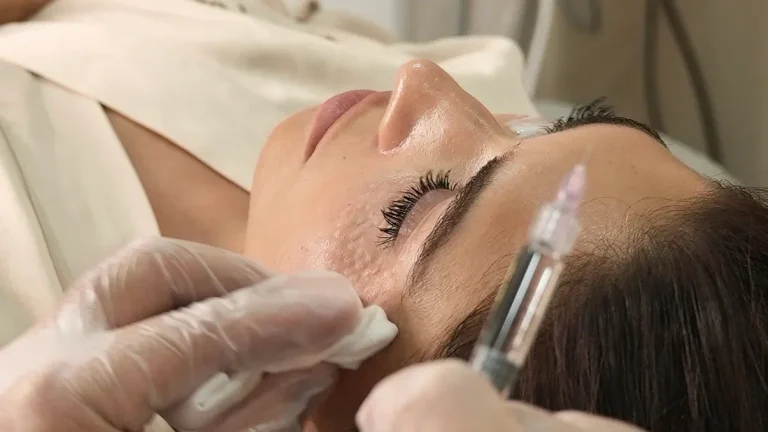
The skin booster treatment at the clinic follows that pattern. Its page describes small raised bumps at the injection points that usually flatten within 24 to 72 hours and can stay visible for up to a week, with mild redness and the odd pinprick bruise. Bruising around the eyes lasts longer. Your doctor tells you what to expect with the product you receive.
Bumps: when they are expected and when they need a check
A booster is placed in small deposits, so tiny blebs at each injection point are part of the procedure. The manufacturer’s leaflet lists lumps and bumps among the spontaneously reported effects, and the hyaluronic acid review names lumpiness and nodules as possible complications whose incidence varies with the product used. Bumps that show up on the day are expected. Bumps that linger or appear late deserve attention, because timing separates the harmless from the worrying.
The leaflet lists hardening (induration) among reported effects and notes that swelling can start immediately or up to several weeks after treatment. It also asks patients to call a doctor about injection-site reactions that persist beyond 14 days. The clinic’s page gives the same instruction in its own words: report a lump that appears days or weeks after the session.
Less common problems
Some complications are rarer and more serious. Infection is the clearest example. A 2026 case report described a healthy 57-year-old woman who developed bilateral cheek abscesses after a polynucleotide injection from another manufacturer. Within 24 hours she had redness and swelling of both cheeks, and her temperature at first presentation was 37.9°C. Over the next five to six days the pain grew and fluid collections formed. She needed drainage and antibiotics, and residual scarring remained at six months. The authors advise that progressive pain, rising inflammatory markers or fluctuance should prompt imaging and aspiration. One case proves nothing about how often it happens, but it shows why worsening pain after a booster is not something to wait out.
The manufacturer’s leaflet also lists allergic reactions, small areas of inflammation in the tissue (granuloma), skin discolouration and scarring among spontaneously reported effects. The leaflet calls unintentional injection into a blood vessel a very small risk, yet its complications can be serious and may be permanent: skin death with scabs or permanent scarring and, in rare cases, temporary or permanent vision changes including blindness, or stroke. Around the eyes the risk is higher, which is why the clinic treats the under-eye area only after assessment and not in everyone.
What the evidence covers and what it leaves open
For polynucleotide boosters, a 2026 systematic review in Cureus analysed seven randomized trials with 183 participants across skin rejuvenation, scar prevention and wound healing. It reported no serious treatment-related adverse events and mostly mild, transient local reactions, and it also said the evidence is limited by small samples and short follow-up. The 2023 hyaluronic acid review reached a similar position about its own base: promising, mostly observational, few randomized trials.
Read those results for what they are. They describe study populations, not your individual risk. They do not promise that you will have no reaction, and they cannot rule out rare or long-term problems. A safe treatment here means a suitable patient, a regulated product, a qualified injector and a plan for what happens if something goes wrong.

Who should avoid or postpone skin boosters
The clinic’s treatment page lists reasons to postpone or avoid treatment until a doctor has reviewed the case:
- pregnancy and breastfeeding;
- active skin infection, inflammation or herpes at the injection site;
- a known allergy to hyaluronic acid or to an ingredient in the product;
- a bleeding disorder or anticoagulant treatment, after doctor assessment;
- an autoimmune or uncontrolled chronic condition, after doctor assessment;
- a tendency to form keloid scars;
- a fish allergy, which may rule out polynucleotide products.
The manufacturer’s leaflet adds precautions worth raising with your doctor: immunosuppressive therapy, a history of herpes, recent laser treatment or peels, and pigmentation disorders or dark skin, where discolouration after treatment may be more likely. It notes that safety in pregnancy and breastfeeding has not been studied for that product. The same leaflet says its product should not be used by people with severe allergies or a history of anaphylaxis, or with an allergy to lidocaine or to the bacterial proteins used to make the HA, and only in adults over 18. No list is complete, and suitability is confirmed at an in-person assessment.
How to lower your risk
Start with a consultation in which the doctor reviews your history, medicines, allergies and earlier treatments. Confirm that a licensed doctor, not a technician, will inject, because the manufacturer’s leaflet says the product should be given only by appropriately trained professionals and the clinic points out that a doctor can manage a complication. Follow the aftercare instructions for the first days; our article on skin booster aftercare and downtime explains what the first two weeks usually look like. Before you agree to treatment, ask four questions: which product will be used and whether it is a regulated medical product, which side effects to expect with it, what to do if a lump or swelling appears later, and whom to contact outside opening hours. The clinic does not operate around the clock, so you should know the emergency route in advance. A doctor who explains these points before the injection gives you the information that the leaflets and reviews assume you already have. For how hyaluronic acid boosters work on the skin in the first place, see our article on whether they hydrate.
When to seek urgent help
If the skin turns white, blotchy or dusky, a net-like pattern appears, or pain is out of proportion to the procedure and keeps growing, these can be signs of a blocked blood vessel: call the clinic immediately, and if you cannot reach a doctor straight away or it is outside opening hours, call 998 or go to the nearest emergency department. For any change in vision, difficulty breathing or swallowing, or signs of a stroke such as sudden weakness or a drooping face, call 998 or go to the nearest emergency department at once.
Contact the clinic the same day about spreading redness, heat, fever or a lump that is getting worse. The clinic does not operate around the clock.
Frequently asked questions
Do skin boosters have side effects?
Yes. The common ones are redness, swelling, tenderness, bruising and small bumps at the injection points, which usually settle within days and in most cases within two weeks. Less common ones include infection and allergic reactions. Your doctor explains the risks for your product before treatment.
How long do skin booster bumps last?
At the clinic, bumps usually flatten within 24 to 72 hours and can stay visible for up to a week. A manufacturer’s leaflet asks patients to report reactions lasting beyond 14 days. Tell your doctor about any lump that appears or grows days or weeks later.
Are skin boosters safe during pregnancy or breastfeeding?
The clinic does not treat during pregnancy or breastfeeding. A manufacturer’s leaflet states that safety in pregnancy and breastfeeding has not been studied for its product. If you are pregnant, breastfeeding or trying to conceive, tell the doctor before any injectable.
Are skin boosters safe under the eyes?
The under-eye area has a higher risk of prolonged swelling and vascular complications, so the clinic treats it only after assessment, and it is not suitable for everyone. Bruising there lasts longer than elsewhere. Any change in vision needs an emergency department or 998.
What are the long-term side effects of skin boosters?
Long-term data are limited. The reviews cited here describe small studies and short follow-up. Delayed swelling, lumps and inflammation have been reported weeks after treatment, which is why late symptoms should always be reported to the treating doctor rather than waited out.
Are polynucleotide skin boosters safe?
A 2026 review of seven randomized trials found no serious treatment-related adverse events, with mild and transient local reactions. A fish allergy may rule these products out, and a case report describes infection after an injection. Evidence is limited, and the doctor decides whether they suit you.
What to read next
 Skin booster aftercare and downtime: the first two weeks
 Do hyaluronic acid skin boosters actually hydrate the skin?
- Skin boosters and biorevitalization at MED YU MED: products and how a visit works
- request a consultation
If you want a doctor to review your history and tell you whether a booster suits you, you can request a consultation.
Sources
- Ghatge AS, Ghatge SB. The Effectiveness of Injectable Hyaluronic Acid in the Improvement of the Facial Skin Quality: A Systematic Review. Clin Cosmet Investig Dermatol. 2023;16:891-899. https://www.dovepress.com/the-effectiveness-of-injectable-hyaluronic-acid-in-the-improvement-of–peer-reviewed-fulltext-article-CCID
- Q-Med AB (Galderma). Patient information: Restylane Skinboosters Vital Lidocaine. Article no. 90-33188-01, revised October 2022. https://www.galderma.com/au/sites/default/files/Restylane_SB_Vital_Lidocaine_e-Patient_information.pdf
- Alhussain AM, et al. Polynucleotides and Polydeoxyribonucleotides for Skin Rejuvenation, Postoperative Scar Prevention, and Wound Healing: A Systematic Review of Randomized Clinical Trials. Cureus. 2026;18(7):e112403. https://pmc.ncbi.nlm.nih.gov/articles/PMC13453133/
- Shanshal M, Bali R, Moon E, Fox R, Khan S. Bilateral Gram-Negative Facial Abscesses After Polynucleotide Injections. J Cosmet Dermatol. 2026;25(7). https://pmc.ncbi.nlm.nih.gov/articles/PMC13348863/
Medical disclaimer: This page is for informational purposes only and does not replace a consultation with a licensed physician. It does not recommend or prescribe any prescription-only medicine.
License statement: MED YU MED operates under DHA License 6589480.
Individual results caveat: Results vary by diagnosis, anatomy, product used and individual response, and no outcome is guaranteed.
Related articles


Medically reviewed by

Biorevitalization at MED YU MED: prices
- Profhilo - 2 ml2100 AED
- Viscoderm Hydrobooster3000 AED
- Xela Rederm silver 1.1% - 2 ml2100 AED
Treatment page and booking · full price list
The final protocol and cost are confirmed at an in-person consultation.