Published 23 September 2026 · Updated 1 October 2026
The claim, and what it’s built on
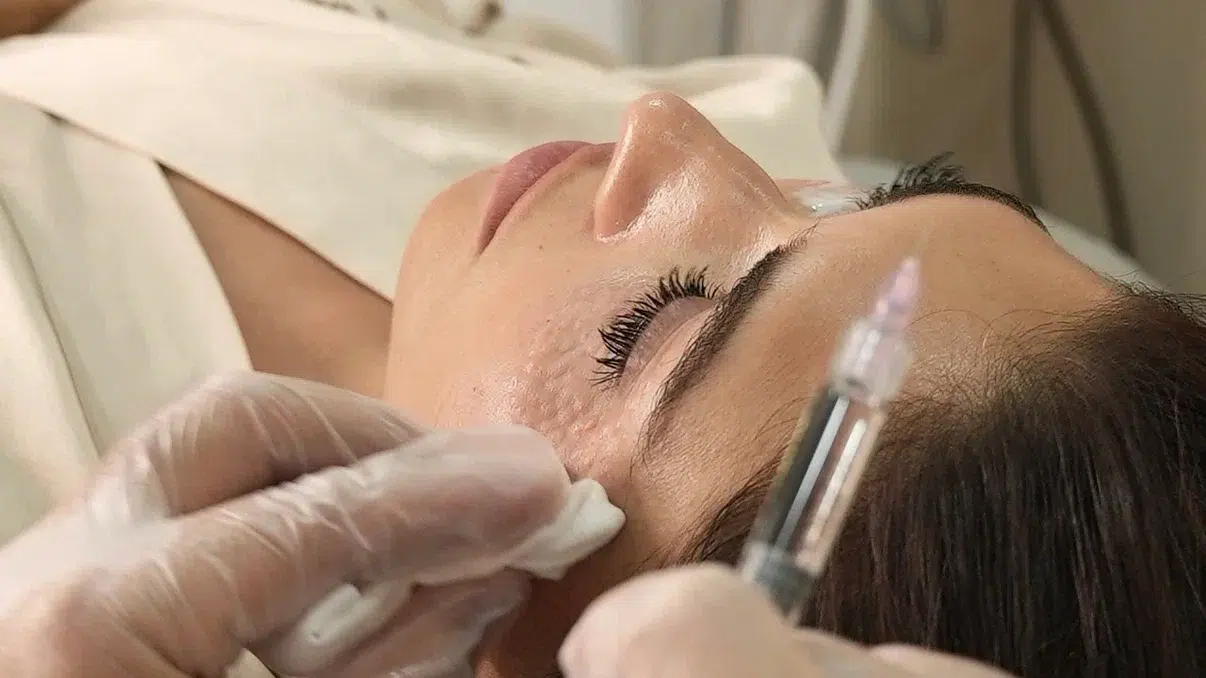
Yes, but with a caveat most marketing leaves out: the hydration effect comes from a course of sessions, not a single visit. That’s not unique solely to this treatment, but it’s simply how the product works. A non-cross-linked hyaluronic acid gel is placed in tiny deposits through the mid-to-upper dermis, where it draws in water and sits as a reservoir the skin can draw on between visits. It isn’t a filler, it doesn’t add volume, and it isn’t a moisturiser either. It’s a separate category with its own evidence base, and that evidence base is worth reading before deciding whether it fits a particular complaint.
Why is skin dehydrated
Dull, tight, finely lined skin that still holds its shape usually isn’t a structural problem. It’s a water-content problem. Heat, air conditioning, sun exposure and simply getting older reduce the skin’s own ability to hold water in the dermis, and topical products can only do so much once that capacity drops, because a cream sits on the surface while the water deficit is deeper. This is the gap skin boosters are designed to address: lost hydration and elasticity at the level a moisturiser can’t reach.
What the research shows
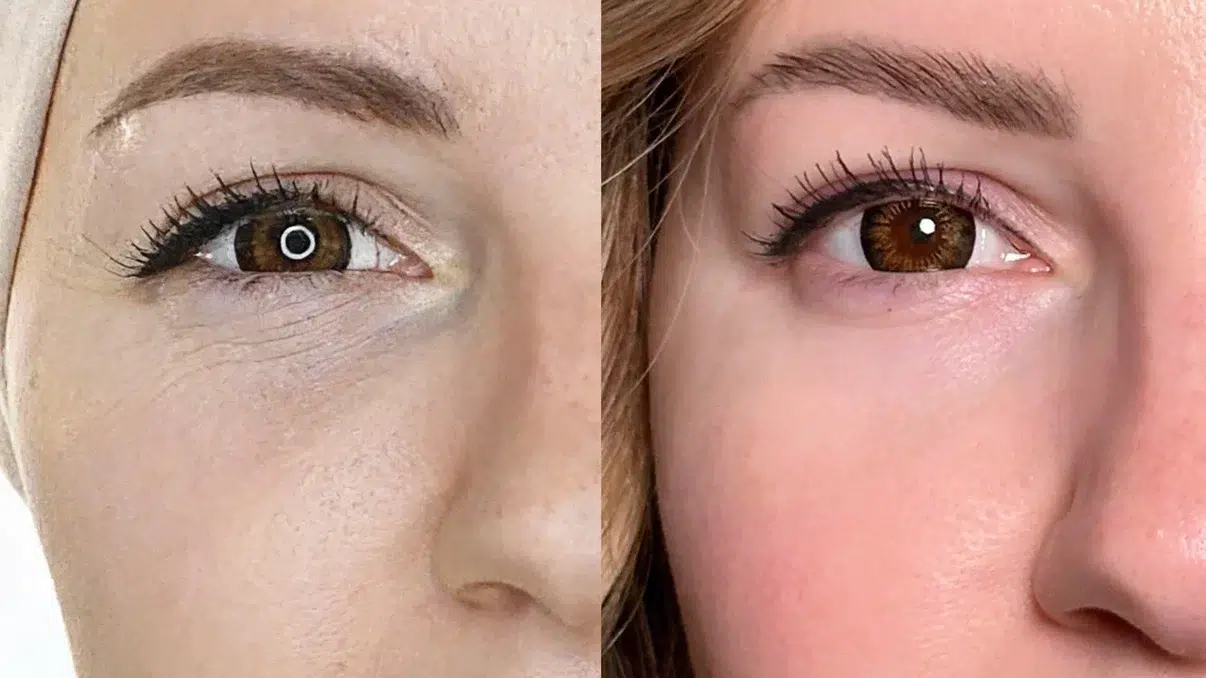
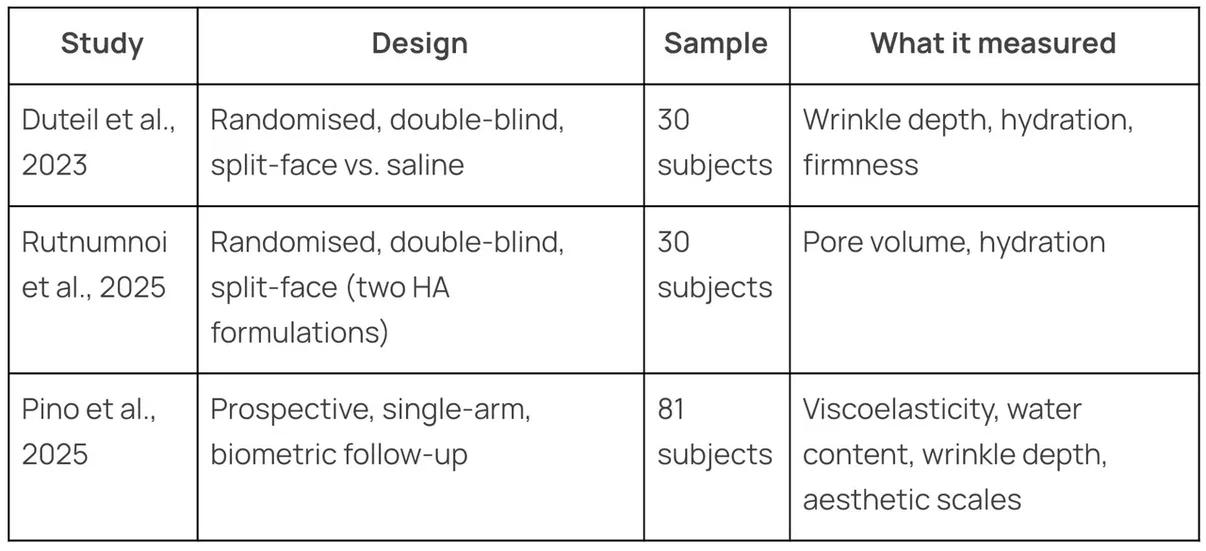
A randomised, double-blind, placebo-controlled, split-face study compared a non-cross-linked hyaluronic acid preparation against saline on thirty subjects, injecting one side of the face with the active gel and the other with saline as a control. (1) Ten days after the final of three sessions, crow’s feet wrinkle depth fell measurably on the treated side while it increased on the saline side, and skin hydration and firmness both rose significantly compared with control. Specialists rated the treated side improved or much improved in the large majority of subjects, while the saline side saw no such rating.
A separate split-face randomised trial looked specifically at pore size, comparing two hyaluronic acid formulations injected superficially into the dermis of thirty participants with enlarged facial pores. (2) Both formulations reduced mean pore volume through week 32 of follow-up, with one formulation modestly ahead of the other, and hydration improved on both sides. Neither side was a true untreated control in this study, so the result speaks to formulation differences rather than to treatment versus nothing.
A third, prospective single-centre study followed 81 people receiving a hyaluronic acid-based skin booster across the face, neck and décolleté, with instrumented measurements (viscoelasticity, water content, wrinkle depth) tracked out to six months. (3) Improvement was measured at each follow-up point using validated aesthetic scales, alongside the biometric readings.
What’s consistent across all three is the outcome category: skin quality measures such as hydration, elasticity, fine lines and pore size. None of them measured volume, contour or lift, because that isn’t what a non-cross-linked gel is built to do. If a study on this class of product reports contouring results, it’s measuring the wrong thing for the product.
How this differs from a filler, and from a skincare routine
A filler is cross-linked to resist breakdown and hold a shape, which is exactly what makes it suitable for replacing lost volume in a cheek or a fold. A skin booster is deliberately the opposite: thin, non-cross-linked, and injected in small deposits so it spreads rather than sits. It changes how the skin behaves and not how the face is shaped. Skincare sits earlier in that same chain. A well-built routine (cleanser, hydrating layer, daily SPF) maintains the skin’s surface and supports what’s already working underneath. When dehydration, dullness or fine lines persist despite a consistent routine over several weeks, that’s usually the point where a topical product has reached its ceiling and a deeper mechanism is being asked to do the same job.
Who this suits, and who it doesn’t
Skin that looks dull, tight or finely lined but hasn’t lost structural volume is the typical candidate profile in the studies above. It’s not the right tool for a hollow under the eyes, a flattened cheek or a deep static fold, those are shape problems, and shape is a filler’s job, not a booster’s. Pregnancy and breastfeeding, active skin infection or inflammation at the injection area, a known allergy to hyaluronic acid, bleeding disorders or anticoagulant therapy without a doctor’s clearance, and a tendency toward keloid scarring are all reasons a session is postponed or avoided until a clinician has reviewed the case. This isn’t an exhaustive list, and suitability is confirmed at an in-person assessment, not from a description on a page.
What happens during a session
The doctor examines the skin, discusses what’s actually being addressed (hydration and quality or another issue) and confirms there’s no reason to postpone. The product is placed as a series of small deposits across the treatment area rather than one or two larger points, which is why the technique looks different from a filler appointment even though both use a hyaluronic acid base. Mild redness, small bumps at injection points and some tenderness over the following day or two are expected and settle on their own. The details of spacing, depth and how many sessions a particular case needs are set at the consultation, because they depend on what the skin actually shows.
Risks and when a session gets postponed
Bruising, swelling and tenderness at injection points are the common, expected reactions to any injectable, hyaluronic acid based or not. Because the gel is thin and placed superficially rather than deep against larger vessels, the vascular risk profile associated with dermal fillers doesn’t apply in the same way here, though any injection carries some risk of infection or an unexpected reaction, and it’s still an in-person medical procedure rather than a walk-in cosmetic service. A session is postponed over active infection or inflammation in the treatment area, during pregnancy or breastfeeding, and when bleeding disorders or anticoagulant use haven’t yet been reviewed by the treating doctor.
When does diagnosis matter
Ordinary seasonal dryness or an occasional dull week responds to a routine adjustment.
- Skin that stays dehydrated and dull for months despite consistent skincare
- Breakouts that recur on a monthly pattern
- Redness and flushing that don’t settle are signals that something other than water content
might be driving the picture, and that calls for an examination before any injectable is considered rather than after.
What MED YU MED offers
A consultation where a doctor establishes whether the concern is hydration, volume, or something that needs a different work-up entirely. We set out the options and sequencing from there. Where biorevitalisation fits a case, it’s discussed and planned as part of that consultation rather than chosen off a list.

Frequently asked questions
How is a skin booster different from just using a hyaluronic acid serum?
A serum sits on the surface and can only hydrate the layers it can reach. An injected gel is placed directly in the dermis, which is why it can influence hydration and elasticity at a depth a topical product doesn’t reach.
Does one session make a visible difference?
The studies above measured courses of sessions spaced weeks apart, not single visits, and the improvements were recorded after the full course.
How long do the effects last?
The evidence base for this category comes from measurements taken during and shortly after a course of treatment.
Can this replace my skincare routine?
No. A booster addresses depth a routine can’t reach. The routine still does the daily work of protecting and maintaining the surface, including SPF, which nothing injectable replaces.
Is it painful?
Injections involve some discomfort, and numbing options are usually available and discussed at the consultation. Individual sensitivity varies.
Can I have this and a filler in the same appointment?
That’s a decision for the treating doctor based on what the face actually needs, and where both are relevant. Structure and skin quality are typically addressed with an interval between treatments rather than combined into a single session.
Medical disclaimer: This page is for informational purposes only and does not replace a consultation with a licensed physician. It does not recommend or prescribe any prescription-only medicine.
License statement: MED YU MED operates under DHA License 6589480.
Individual results caveat: Results vary by diagnosis, anatomy, product used and individual response, and no outcome is guaranteed.
What to read next
- ????
MEDICALLY REVIEWED BY
DR. Alina Lebedeva General Practitioner, Aesthetic Medicine Doctor, Dermatologist DHA License No. 35044799-002
References
- Duteil L, Queille-Roussel C, Issa H, Sukmansaya N, Murray J, Fanian F. The Effects of a Non-crossed-linked Hyaluronic Acid Gel on the Aging Signs of the Face versus Normal Saline: A Randomized, Double-blind, Placebo-controlled, Split-faced Study. J Clin Aesthet Dermatol. 2023;16(2):29-36. PMID: 36909864. https://pmc.ncbi.nlm.nih.gov/articles/PMC10005802/
- Rutnumnoi T, Palakornkitti P, Anuntrangsee T, Yongpisarn T, Sakpuwadol N, Vachiramon V. Superficial Intradermal Injections of Cohesive Polydensified Matrix Hyaluronic Acid Fillers for the Improvement of Facial Pores and Skin Quality: A Split-Face Randomized Study. J Cosmet Dermatol. 2025;24(5):e70209. doi:10.1111/jocd.70209
- Pino A, Torrecilla J, Alonso JM, Tovito L, Pérez R. Clinical and Biometric Assessment of a Hyaluronic Acid-Based Skin Booster for Face, Neck and Décolleté Rejuvenation: A Prospective Study. J Cosmet Dermatol. 2025;24(11):e70547. doi:10.1111/jocd.70547