Published 12 January 2026 · Updated 19 August 2026
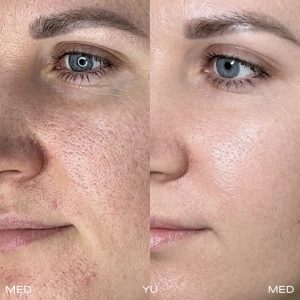
This article was reviewed by the MED YU MED medical team (DHA-licensed physicians).
Age rarely arrives overnight. More often, we blame early signs on stress or a busy week. A slightly less defined jawline after a long stretch of work, skin that looks duller than usual, wrinkles that take longer to smooth out in the morning. Unfortunately, at some point, it becomes clear that these changes are not random. They’re cumulative. And the question shifts from whether age-related changes exist to how to work with them.
When Do Age-Related Changes Begin
From a physiological perspective, skin ageing starts earlier than many people expect. As early as the mid-20s, the activity of fibroblasts — the cells responsible for producing collagen and elastin — gradually begins to decline. However, these changes usually become noticeable later, most commonly after the age of 30-35.
The speed at which ageing appears varies from person to person and depends on several factors: genetics, stress levels, sun exposure, sleep quality, lifestyle, and climate. In a city like Dubai, chronic UV exposure, dehydration from air conditioning, and an active, fast-paced lifestyle can accelerate vascular and dermal changes if the skin is not properly supported.
How Age Reveals Itself
Ageing is not limited to the surface of the skin. Several layers are involved in the process:
- Skin gradually loses density and regenerative capacity
- Subcutaneous fat shifts, which can create heaviness or sagging
- Ligaments weaken over time
- Muscles and bone structure change, altering support for soft tissues

Because of this, early signs of ageing look different for everyone. For some, it is wrinkles. For others, puffiness, changes in facial contours, uneven skin tone, or textural irregularities become more noticeable.
Is It Possible to Slow These Changes?
Ageing cannot be stopped entirely, but it can be slowed and softened. Timing plays a crucial role. The earlier preventive care begins, the less aggressive intervention is needed later.
In a modern cosmetic clinic in Dubai, the approach to age-related changes is not about “erasing” wrinkles. The focus is on preserving skin structure, density, and overall tissue quality. This means working with microcirculation, collagen support, and the skin’s natural ability to renew itself.
What Methods Are Used in Aesthetic Clinics?
The choice of aesthetic treatments depends not only on age, but on how ageing manifests in each individual case. In modern cosmetic clinics in Dubai, treatment plans are built around stages of change rather than a one-size-fits-all approach.

When the First Signs of Ageing Appear (Usually 27–35)
At this stage, changes are often subtle. Skin may lose some elasticity, fine expression lines begin to appear around the eyes or forehead, facial contours become slightly less defined, and recovery after sun exposure or stress takes longer. The focus here is prevention and support. Clinics typically recommend:
- Advanced skincare with active ingredients, such as antioxidants and retinol, to protect against oxidative stress and support collagen production
- Botulinum therapy, usually once every 4-5months, to soften wrinkles before they become fixed
- Biorevitalisation with antioxidant-based formulas, 1-2 times per year, often after periods of intense sun exposure or before starting apparatus-based treatments
- Apparatus-based procedures that stimulate collagen production and maintain skin density without altering natural facial features
This stage is about maintaining balance and slowing visible changes gently and progressively.
When Age-Related Changes Become More Pronounced
As ageing advances, changes become more visible and structural. These may include deeper wrinkles around the eyes, lips, and nasolabial area, thinning of the skin, pigmentation changes, loss of facial definition, and the appearance of jowls. At this point, basic skincare alone is no longer sufficient. A more comprehensive approach is required, combining active home care with in-clinic procedures.
Commonly used methods include:
- Botulinum therapy, typically once every 3-4 months, to manage active muscle movement
- Skin smoothing and superficial wrinkle correction, performed approximately once every 6 months
- Injectable treatments that improve skin density, either by stimulating natural collagen production or partially replacing lost volume
- Microneedling RF treatments, used to tighten skin and improve texture
- Ultrasound SMAS-lifting, aimed at restoring facial contours and improving jawline definition
- Phototherapy, to address pigmentation and uneven skin tone
These treatments are selected based on skin density, degree of tissue laxity, pigmentation patterns, and vascular condition.
A Layered and Individualised Approach
Modern aesthetic medicine in Dubai prioritises natural results. Procedures are combined thoughtfully, targeting both superficial and deep skin layers. The goal is not to dramatically change appearance, but to improve skin quality, restore structure, and maintain facial harmony over time.
Common Myths About Ageing
One common myth is that seeing a cosmetologist only makes sense when it is “already too late.” In reality, preventive care delivers the most stable and predictable results.
Another misconception is that all procedures drastically alter appearance. Contemporary aesthetic medicine has moved away from this, focusing instead on natural-looking outcomes.
It’s also often believed that age shows only through wrinkles. In practice, skin density, tone, vascular health, and texture frequently play a far greater role.
Age begins to reflect on the face long before it becomes obvious. Understanding the mechanisms behind these changes allows them to be addressed consciously and effectively. With proper diagnostics and individually tailored treatments in a cosmetic clinic in Dubai, ageing is not something to fight, but something to accompany, maintaining a balanced appearance at every stage.
Related reading

Frequently Asked Questions
At what age does ageing become measurable?
Biological changes begin in mid-20s; visible signs typically appear later.
Intrinsic vs extrinsic ageing?
Intrinsic is genetic/chronological; extrinsic is environmental, mainly UV-driven.
Can ageing be slowed?
Cannot stop fully, but evidence-based prevention can significantly slow visible progression.
How Dubai climate affects ageing?
High UV and heat accelerate photoaging without strict protection.
When start professional anti-ageing care?
Timing is individualized and based on physician assessment.
Medical disclaimer: This page is for informational purposes only and does not replace a medical consultation.
License statement: MED YU MED operates under DHA License 6589480.
Individual results caveat: Results vary by diagnosis, skin type, and individual response.
Related articles


Medically reviewed by