Published 27 October 2025 · Updated 9 September 2026
This article was reviewed by the MED YU MED medical team (DHA-licensed physicians). Last reviewed: 3 August 2026.
Disclosure: this article is published by MED YU MED, a medical clinic on Bluewaters Island, Dubai, operating under DHA License 6589480. The clinic provides professional facial cleansing and chemical peels commercially and links to those services at the end of the article. Read the argument below with that in mind.
Goat milk soap, buffalo milk body cream, cleansing milk in a pharmacy aisle on Sheikh Zayed Road. The promise on all of them is the same: gentle, natural, made for skin that reacts to everything else. The promise is not baseless, and it is also not the whole story. The best-documented harm of food-based skincare shows up in exactly the group these products are sold to, people with eczema and a damaged barrier, and the label says nothing about it.
Here is what holds up, what does not, and how to decide for your own skin.
Two different things get called milk
A cleansing milk, or face milk, describes a texture. It is a light emulsion of oil and water, thinner than a cream, used to lift makeup and dirt without foam. Many of them contain no dairy at all. A goat milk cream describes an ingredient, actual caprine milk somewhere in the formula.
People searching for one often land on the other, and that matters when you are deciding whether dairy allergy applies to you. Turn the package over. If the ingredient list has no milk, whey, lactose, casein or lactoperoxidase in it, the word “milk” on the front is describing how the product pours, not what is in it.
The lactic acid claim, and what really decides whether it works
The usual argument for goat milk runs through lactic acid, an alpha hydroxy acid that loosens dead cells and holds water. The chemistry behind it is real. StatPearls describes lactic acid as one of the molecules of the skin’s own natural moisturizing factor, formed when filaggrin breaks down. The same source groups AHAs among the humectants and says they “promote desquamation by reducing corneocyte cohesion and also improve barrier function by increasing levels of ceramides.” It also gives a number. “Lactic acid has been used topically at concentrations up to 12% in treating ichthyosis and dry skin for many years.”
Read that number again, because it is where the published evidence stops and the label takes over. The measured effect belongs to a defined concentration. A bar of soap that lists goat milk somewhere after the palm oil does not tell you how much lactic acid reaches your skin, at what pH, or for how long before you rinse it off. Neither does a lotion. The molecule works by dose, and the label gives you no dose.
The industry’s own safety threshold makes the point sharper. The US Food and Drug Administration reports that the Cosmetic Ingredient Review Expert Panel concluded that products with the AHAs glycolic and lactic acid are safe for consumers if “the AHA concentration is 10 percent or less,” “the final product has a pH of 3.5 or greater,” and the product either protects against increased sun sensitivity or tells you to use sun protection daily. Three conditions, all of them numbers. A “natural, gentle” claim on the front of a box tells you nothing about any of them; the ingredient list and a stated pH do.
There is a second effect worth knowing about, and it cuts the other way. StatPearls writes that humectants “can hydrate the skin if the humidity is more than 70%; more commonly, however, they draw water from the deeper epidermis and dermis,” and that “some humectants can increase TEWL and exacerbate skin dryness without concomitant use of an occlusive moisturizer.” A humectant on its own, in a dry air-conditioned room, can leave you drier than before. It needs something on top of it that seals.
What the sun here does to an acid
This is where Dubai stops being a detail. The FDA page above carries a labelling recommendation, written out in full for cosmetics containing an AHA:
Sunburn Alert: This product contains an alpha hydroxy acid (AHA) that may increase your skin’s sensitivity to the sun and particularly the possibility of sunburn. Use a sunscreen, wear protective clothing, and limit sun exposure while using this product and for a week afterwards.
A week afterwards. Not for the evening you used it. If a milk-based product in your routine is doing anything through lactic acid, that recommendation applies to you every time you cross a car park at midday, and daily sunscreen stops being optional. If the product is not doing anything through lactic acid, the gentle exfoliation claim carries no dose behind it. Both readings cannot be true at once, and a label that stated the concentration and the pH would let you tell which one applies.
The risk the packaging leaves out
Food proteins can sensitise a person through damaged skin. That is the part of the story milk-based skincare does not tell, and it is documented in the exact population these products target.
A 2021 report in Asia Pacific Allergy describes a household developing goat’s milk allergy after using goat’s milk soap. The authors describe “the development of goat’s milk allergy in members of a household with pre-existing atopic dermatitis, following use of a goat’s milk soap marketed for sensitive skin.” Their explanation of the route is short: “soaps appear to be an effective vehicle for sensitization to food antigens and the risks are potentiated in those with compromised barrier function.” Their recommendation is shorter still. “Although such products may be marketed for atopic dermatitis, we would advocate for the avoidance of food-based skin care products in this patient group.”
This is a case report, not a trial, and one household is not a population. Treat it as a documented mechanism rather than a measured risk. The mechanism, though, is not isolated. A 1998 study in Allergy tested protein hydrolysates used in hair care, milk among them, across three groups totalling 2,199 people: 11 hairdressers with hand dermatitis, 2,160 adults being skin-prick tested for suspected respiratory allergy, and 28 adults with atopic dermatitis. Twelve came up positive, all of them women with atopic dermatitis, and three reported contact urticaria from a conditioner. Read the detail honestly. Every one of the twelve reacted to a hydrolysed collagen rather than to the milk hydrolysate, so the study indicts the class and not dairy specifically, and twelve out of 2,199 says the reaction happens without saying it is common. Its conclusion is that these hydrolysates “can cause contact urticaria, especially in patients with atopic dermatitis.” The third piece of evidence is a 2013 case report, published as a letter in Annals of Allergy, Asthma & Immunology and titled, plainly, protein contact dermatitis and food allergy to mare milk. Three reports of one mechanism are three reports, not a measured population risk.
What such a reaction looks like matters, because it does not look like ordinary irritation. DermNet describes contact urticaria as appearing “within minutes to about one hour after exposure,” with local burning, tingling or itching and red swellings or weals, and notes that the immunological type “occurs most commonly in atopic individuals.” Milk is on its list of foodstuffs that cause it. Redness that builds over days after a new cream is one thing. Weals within the hour are another, and they mean stop.
None of this makes goat milk soap dangerous for a person with intact skin who tolerates dairy. It does mean that “for sensitive skin” and “for eczema” are the two claims on this category with the weakest footing.
Babies, goat milk soap and eczema
Goat milk products for infants sell on prevention: soften the skin early, avoid eczema later. The largest test of that idea does not support it, and the caution applies to any emollient, dairy or not.
The 2021 Cochrane review of skin care interventions in infants identified 33 randomised trials with 25,827 participants, of which 11 studies and 5,217 participants entered its meta-analyses. Its conclusion: “skin care interventions such as emollients during the first year of life in healthy infants are probably not effective for preventing eczema, and probably increase risk of skin infection.” The numbers behind it are a risk ratio of 1.03 (95% CI 0.81 to 1.31) for eczema by one to two years, from seven trials and 3,075 participants on moderate-certainty evidence, and 1.34 (95% CI 1.02 to 1.77) for skin infection over the intervention period, from six trials and 2,728 participants, also moderate-certainty.
Food allergy is the part most often quoted badly, so here it is at full size. For IgE-mediated food allergy the review gives a risk ratio of 2.53, with a 95% confidence interval running from 0.99 to 6.47, from a single trial of 996 participants, and rates that evidence very low-certainty. A point estimate of 2.53 looks alarming; an interval that touches 1, drawn from one trial, is why the authors will not call it a finding. Separately, the review reports a slight increase in parent-reported immediate reactions to a common food allergen at two years (RR 1.27, 95% CI 1.00 to 1.61, low-certainty, one trial), notes this was “only seen for cow’s milk,” and adds that it “may be unreliable due to significant over-reporting of cow’s milk allergy in infants.” Their own summary is that effects on food allergy are uncertain, and so should be anyone’s who quotes them.
Uncertain is not nothing. Combined with the goat’s milk soap report above, it is a reasonable basis for keeping food-based washes off a baby with eczema and asking a paediatrician or dermatologist what to use instead. Moisturising a child who already has eczema is standard care and a separate question from prevention; do not read the review as an argument against treating diagnosed eczema. Nothing here is a reason to stop something a paediatrician or dermatologist has prescribed. If your child is on a particular wash or emollient, keep using it and raise the question at the next appointment.
One boundary the rest of this article does not cross for children. The concentrations and pH thresholds discussed above were established on adult skin, so exfoliating acid products, meaning anything listing lactic acid, glycolic acid or an AHA, do not belong in an infant’s or a young child’s routine. Urea-containing emollients are worth asking a doctor about before use at this age as well. And separately from skincare, plain goat’s milk is not a substitute for breast milk or infant formula in the first year; that is a question for your paediatrician.
Buffalo milk, and how thin the evidence is
Buffalo milk skincare is sold on higher fat content and richer texture. On 3 August 2026 a PubMed search for buffalo milk AND skin care returned four records, and not one of them studied skin care in people: two on lumpy skin disease in livestock, one on global cancer statistics, one a conference abstract book. There is no human clinical evidence to weigh here, in either direction.
That does not make a buffalo milk cream bad. A rich cream can be a perfectly good occlusive, and it may feel excellent on dry shins in February. It means the ingredient is not the reason it works, and any claim that buffalo milk specifically outperforms other fats is not currently supported by published trials.
What actually repairs a barrier
If the goal is a calmer, less reactive barrier, the evidence points at categories of ingredient rather than at a species of animal.
StatPearls groups moisturisers into three jobs. Occlusives such as petrolatum and mineral oil block evaporation, and it names petrolatum “the most effective, reducing water loss through the epidermis by nearly 99%.” Humectants such as glycerin and urea attract and bind water. Emollients such as ceramides and shea butter fill the gaps between cells. Modern formulas combine them, which is why a single hero ingredient rarely explains a product’s performance.
That ranking measures one thing, water loss, and nothing else. A heavy occlusive can still be the wrong choice for oily or breakout-prone skin, and the wrong texture for a Dubai August; urea stings on cracked skin, as the review below notes; and any of these can be badly tolerated on a face that is currently inflamed. Fragrance-free versions exist across all three groups and are the safer default on reactive skin. Match the class to the skin and to the site, and stop anything that keeps stinging rather than pushing through it.
A 2003 review in American Journal of Clinical Dermatology on topical emollients and moisturizers adds two warnings that apply directly to milk-based formulas. First, formulation can work against you: “emulsifiers may weaken the barrier,” and “some formulations may deteriorate the skin condition, whereas others improve the clinical appearance and skin barrier function.” Second, on tolerance: “low pH and sensory reactions, from lactic acid and urea for example, may reduce patient acceptance.” Stinging is a known property of the acid, not proof that a product is working.
One further finding is often stretched in marketing, so it is worth stating at its real size. A 1999 study in the Journal of Investigative Dermatology found that a cream containing sonicated Streptococcus thermophilus, a lactic acid bacterium, raised stratum corneum ceramide levels after seven days on the forearms of 17 healthy volunteers. Seventeen people, one week, forearm skin, a bacterial preparation rather than milk. It is a signal, not a licence to claim that anything fermented rebuilds your barrier.
How to read the label
Four questions settle most decisions in the shop.
Where does milk sit on the ingredient list? Retail cosmetics list ingredients in descending order of predominance, with one exception that matters here. Under US labelling rules, “ingredients present at a concentration not exceeding 1% may be listed in any order after the listing of the ingredients present at more than 1%” [§ 701.3(f)(2)]. So the order tells you a lot at the top of the list and nothing at the bottom of it, and the actual percentages are not declared at all. Milk listed after the fragrance is present at a fraction of a percent, whatever the front of the pack says.
Does the product name a concentration or a pH? If it does not, do not buy it for exfoliation. Buy it for texture, and get exfoliation from a product that states its numbers.
Is there something occlusive in it? A humectant alone in an air-conditioned flat can leave you drier, per StatPearls. Look for petrolatum, dimethicone, an oil or a butter alongside it.
Do you have eczema, broken skin, or a dairy allergy in the household? If yes, the case report and the Cochrane data both point the same way, and a non-food formula is the lower-risk choice. Ask your doctor rather than the shop assistant.
Whatever you buy, patch-test it, with two exceptions. If you already know you react to dairy, do not test a milk-based product on yourself at all; ask your doctor about allergy testing first. And never patch-test on broken, weeping or actively eczematous skin, because that is the route by which sensitisation happens in the first place.
Otherwise: apply a small amount to intact skin on the inner forearm once a day for five days and watch the site. Burning and weals within the hour are contact urticaria, so wash it off and stop. If that comes with swelling of the lips or face, difficulty breathing, faintness or vomiting, call 998 for an ambulance. Redness or itching that builds over several days points to irritation or contact dermatitis; stop and note which product it was. A patch test that passes does not rule out a reaction later, and it says nothing about eating the same food. This is general information about a class of products, not advice about your skin.
When to see a doctor
Emergency care rather than an appointment. Call 998 for an ambulance. Swelling of the lips, tongue, eyelids or throat; difficulty breathing, wheezing, noisy breathing or a hoarse voice; difficulty swallowing; sudden repeated vomiting or stomach cramps; faintness, collapse or sudden pallor; a baby or small child going floppy, unusually drowsy or unresponsive; or hives spreading across the body after a product or a food. These are signs of anaphylaxis. If adrenaline has been prescribed, use it straight away, lay the person flat with their legs raised, and still call 998. Do not drive yourself and do not wait to see whether it settles, because symptoms can return hours later; anyone who has needed adrenaline needs hospital observation even if they look well again.
Same day. Weals, burning and swelling within an hour of using a milk-based product, especially if you or your child has atopic dermatitis. Also same day if broken or weeping skin becomes hot, tender or crusted, which can mean infection, or if the reaction involves the skin around the eyes. Stop the product, keep the packaging and photograph the reaction; both make the consultation faster.
A routine consultation. Dryness or redness that has not settled after several weeks of a simple routine, a rash you cannot link to any product, eczema that keeps returning, or a child whose skin is not responding to what your paediatrician suggested. Bring the packaging of everything you have used. Ingredient lists shorten the search for a culprit considerably. If a reaction to a food-based product keeps coming back, ask whether allergy testing is appropriate; that is a reason for referral rather than for more experiments at home.
At MED YU MED on Bluewaters Island, professional facial cleansing and chemical peels are performed after the specialist assesses your skin and reviews what you have been applying at home. Both carry risks. Peels can cause irritation, prolonged redness, pigment change and, less often, scarring, and are not appropriate for every skin type, for skin that is currently inflamed or infected, or in pregnancy without specialist advice. Professional cleansing can leave transient redness and swelling, bruising, and post-inflammatory pigmentation on darker phototypes, and is not performed on actively inflamed or infected skin. The consultation exists to decide whether either suits you. MED YU MED provides these procedures commercially.
Related reading
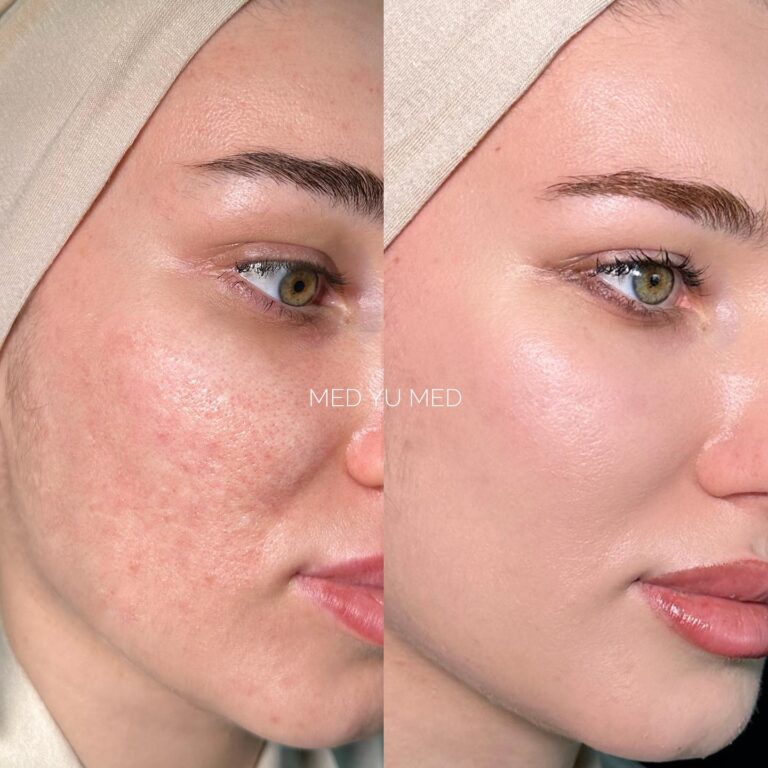
MED YU MED provides the treatments linked below commercially. Chemical peels and professional cleansing both have the risks and contraindications set out above, and neither is performed on skin that is currently inflamed or infected. Suitability is decided at a consultation, not from a web page.
Frequently Asked Questions
Is goat milk good for sensitive skin?
It depends on what is causing the sensitivity. For skin that is simply dry, a milk-based cream can work as well as any other emollient. For eczema or a damaged barrier, a 2021 case report in Asia Pacific Allergy described goat’s milk allergy developing in a household that used goat’s milk soap marketed for sensitive skin, and its authors advocate avoiding food-based skin care products in that group. One case report is a plausible mechanism, not a measured risk, so treat it as a reason to ask your doctor rather than a verdict on the product.
Does goat milk contain enough lactic acid to exfoliate?
The label almost never says. StatPearls notes lactic acid has been used topically at concentrations up to 12% for ichthyosis and dry skin, and the FDA reports an industry safety threshold of 10% or less at a pH of 3.5 or greater. A product that states neither concentration nor pH gives you no way to judge the dose reaching your skin.
Can I use a milk-based product with lactic acid in Dubai sun?
Only with daily sun protection. The FDA recommends that cosmetics containing an alpha hydroxy acid carry a Sunburn Alert stating the product may increase sensitivity to the sun and the possibility of sunburn, and advising sunscreen, protective clothing and limited sun exposure while using it and for a week afterwards.
Is goat milk soap safe for a baby with eczema?
Ask a paediatrician or dermatologist first. The 2021 Cochrane review of skin care in infants found that emollients in the first year probably do not prevent eczema (RR 1.03, 95% CI 0.81 to 1.31, moderate-certainty) and probably increase the risk of skin infection (RR 1.34, 95% CI 1.02 to 1.77, moderate-certainty). On food allergy the evidence is very low-certainty and the authors call the effect unclear. Combined with a case report of goat’s milk soap sensitising a household with eczema, that is a reason to prefer a non-food formula on a baby with eczema, and not a reason to stop anything a doctor has prescribed.
What is the difference between face milk and milk-based skincare?
Face milk, or cleansing milk, is a texture. It is a light oil-in-water emulsion for removing makeup, and many contain no dairy. Milk-based skincare means actual milk is in the formula, listed as milk, whey, lactose or casein. Check the ingredient list rather than the front of the pack.
Is buffalo milk better for skin than goat milk?
There is no published human evidence to compare them. A PubMed search on 3 August 2026 for the terms buffalo milk AND skin care returned four records, none of which studied skin care in people. Absence of published studies is not proof that an ingredient does nothing; it means there is nothing to weigh. A rich buffalo milk cream may work well as an occlusive, but the species of milk is not what makes it work.
Medical disclaimer: This page is for informational purposes only and does not replace a medical consultation.
License statement: MED YU MED operates under DHA License 6589480.
Individual results caveat: Results vary by diagnosis, skin type, and individual response.
Related articles
Medically reviewed by