Published 14 January 2026 · Updated 19 August 2026
Medically reviewed by: the MED YU MED medical team (DHA-licensed physicians).
Last reviewed: May 2026
The idea of harmonious facial features has fascinated humanity for thousands of years. Across cultures and centuries, people have tried to understand why certain faces feel balanced, pleasing, and memorable, while others feel less so. Today, modern aesthetic medicine does not aim to create a single ideal face. Instead, it focuses on balance, proportion, and individuality — principles that are especially valued in contemporary cosmetology in Dubai.
How Beauty and Harmony Were Understood Through History
In ancient times, beauty was closely tied to order and proportion. Ancient Greek and Roman sculptors believed that harmony in nature could be translated into the human form. Their statues were not portraits of real people, but idealised representations built on symmetry and mathematical relationships.
During the Renaissance, this fascination with proportion reached a new level. Artists and scientists sought to connect art, anatomy, and mathematics. Beauty was no longer only something to observe, but something to study, measure, and understand.
In the twentieth century, perceptions of beauty became more diverse. Cultural influences, fashion, cinema, and photography expanded aesthetic ideals. Yet even as standards changed, one concept remained constant: faces perceived as harmonious were those where elements worked together in balance.
Mathematics of Beauty: Proportions and the Golden Ratio
One of the most famous mathematical concepts linked to beauty is the golden ratio, approximately 1:1.618. This proportion appears repeatedly in nature: in shells, flowers, and leaf structures, and was believed by ancient scholars to represent ideal harmony.

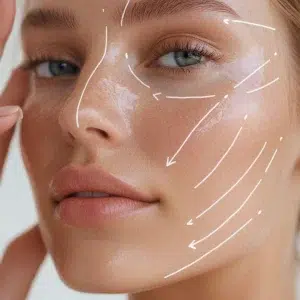
Leonardo da Vinci explored these ideas deeply. In his studies of the human body and face, he described proportional rules that still influence aesthetic medicine today. He introduced the concept of dividing the face vertically into three equal parts: the upper third (from hairline to brow), the middle third (from brow to the base of the nose), and the lower third (from the base of the nose to the chin). When these thirds are balanced, the face is often perceived as harmonious, even if individual features are not “perfect.”
These principles are still used in facial analysis in modern aesthetic clinics in Dubai, not as strict rules, but as reference points.
Nature as a Guide: Symmetry and Individuality
Nature rarely creates absolute symmetry. A flower may appear balanced, yet its petals are never identical. A shell follows the golden ratio, while the veins of a leaf are irregular and unpredictable. Human faces follow the same logic.

Most faces are generally symmetrical, but subtle asymmetries give character and individuality. Complete symmetry can feel artificial, while controlled asymmetry feels alive. Modern aesthetics respects this balance — maintaining natural differences while correcting disharmony that disrupts overall perception.
The Anatomical Structure Behind Facial Harmony
Facial harmony is not created by skin alone. It is the result of interaction between several anatomical layers:
- Skin, which reflects light and determines texture and tone
- Fat compartments, which provide volume and contour
- Ligaments, which hold tissues in position
- Muscles, responsible for facial expression and movement
- Bone structure, which forms the foundation of the face
Ageing affects all these layers differently. Bones may resorb, fat pads shift, ligaments weaken, muscles overact, and skin loses density. This is why modern aesthetic treatments in Dubai focus on structural balance rather than surface correction alone.
Modern Aesthetic Approach in Dubai
The approach to cosmetology in Dubai is refined, analytical, and individualised. Specialists begin with a detailed facial assessment that includes proportions, symmetry, facial expressions, and anatomical structure. The goal is not transformation, but enhancement — preserving identity while restoring balance.
Modern aesthetic medicine relies on a step-by-step strategy, combining different techniques to maintain natural results.
Injection-based methods play a central role in facial harmonisation. Hyaluronic acid fillers are used to restore volume in key areas such as cheekbones, chin, jawline, and under-eye zones. Botulinum therapy relaxes overactive muscles that distort facial balance, while biorevitalisation improves skin quality, hydration, and elasticity.

Apparatus-based treatments complement injections.
Ultrasound SMAS lifting works on deep support structures, improving facial contours and firmness.
RF-lifting stimulates collagen production, enhancing skin density and texture.
Laser technologies address pigmentation, uneven tone, and surface irregularities.
These methods are not used in isolation. Their combination allows specialists to address both deep and superficial layers, maintaining harmony across the entire face.
Harmony Over Perfection
Modern aesthetic philosophy has moved away from rigid beauty standards. Facial harmony is no longer about achieving ideal measurements or copying celebrity features. It is about balance — between proportions, between symmetry and asymmetry, between structure and expression.
In a leading cosmetic clinic in Dubai, facial harmonisation means working with anatomy, respecting individuality, and enhancing what already exists. When done correctly, the result does not look fake. It looks natural, rested, and balanced.
Frequently Asked Questions
What is facial harmony?
Proportional balance preserving identity.
Can results look natural?
Yes with conservative anatomy-led planning.
Does culture influence ideals?
Yes, goals should be culturally personalized.
Why anatomy matters for safety?
It reduces vascular and structural complication risk.
How aging changes anatomy?
Bone-fat-ligament-skin changes require layered approach.
Medical disclaimer: This page is for informational purposes only and does not replace a medical consultation.
License statement: MED YU MED operates under DHA License 6589480.
Individual results caveat: Results vary by diagnosis, skin type, and individual response.